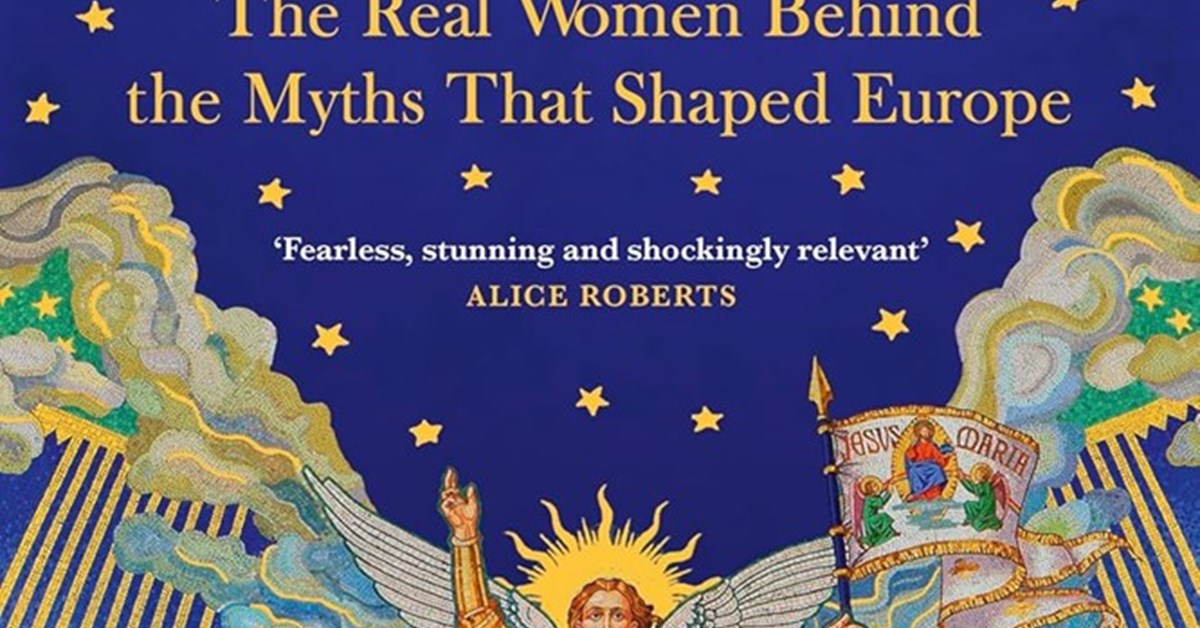
THE title of this book by the historian Janina Ramirez concisely sets out its underlying thesis. The author realised that medieval figures, both real and mythical, had been used in the construction of historical-political narratives of European national identity. She wanted to examine what parts women played in these narratives. To do so, she has taken seven European countries in which the idea of nationhood developed over medieval and modern times, and for each has looked at the part played by two women in this development: one comparatively modern and one medieval. Some of these women will be known to most British readers; some are more obscure. Each chapter is headed with two alliterative nouns.
Beginning with France, “Revolution and Reinvention”. Both women are well-known: Charlotte Corday, Marat’s murderer, and Joan of Arc. Joan was involved in the process of creating the French nation from several independent fiefdoms, while Charlotte was concerned with the way in which that nation should be governed. Next, the Iberian Peninsula, “Dynasty and Discovery”. The medieval Isabella of Castile is well known; her marriage to the King of Aragon united the two main kingdoms in the peninsula. The other is more obscure: Augustina Saragossa, who fought against Napoleon’s invasion.
Then to Greece, “Autonomous and Atypical”. The medieval Anna Komnene, a princess and the first woman historian, is well known to historians of Byzantium, while the modern woman, Laskarina Bouboulina, features in the history of 19th-century Greek independence. For the Low Countries, “Exceptional and Extreme”, the medieval mystic Marie of Oignies is central. The modern woman is the abbess who saved priceless relics of that mystic from French Revolutionaries by hiding them in her convent.
“Bonds and Bloodlines”: Germany, the last of these countries to become a unified nation, is represented by the medieval Holy Roman Empress Adelaide, who became a saint, and the 19th-century concubine of Ludwig of Bavaria, Lola Montez. She was no saint, and the king’s obsession with her led to his abdication and revolution. For Italy, “Piety and Papal Power”, we have the famous medieval mystic St Catherine of Siena, and a poor servant, Anna Morisi. Both played a part in the centuries-long conflict between papal and political power in the Italian peninsular. Finally we go to Britain, “Traditional and Transnational”, represented by Queen Victoria and Lady Godiva. Victoria gave Albert a statue of the legendary naked Godiva on a horse. The real Godiva, however, was a powerful noblewoman who survived the conquest of Anglo-Saxon Britain by the Normans.
This book provides an interesting, if necessarily incomplete, study of how the acts and myths of women influenced the development of European nation states. The extensive notes and bibliography show that it is well researched, but there are a few obvious mistakes. For example, discussing the stigmata of Catherine of Siena, the author refers to the experience of St Francis at Mount Verna, and says: “There he built the Church of Santa Maria degli Angeli.” That church, however, is in the plain below Assisi, about 90km from Mount Verna. Overall, Ramirez has provided a useful contribution to European women’s history.
Dr Hilary Pearson is a professed Anglican Franciscan Tertiary. She studied Christian spirituality at Heythrop College. Her research interests are medieval and early-modern women religious writers, and Franciscan spirituality.
Legenda: The real women behind the myths that shaped Europe
Janina Ramirez
Ebury £25
(978-0-7535-6041-9)
Church Times Bookshop £22.50