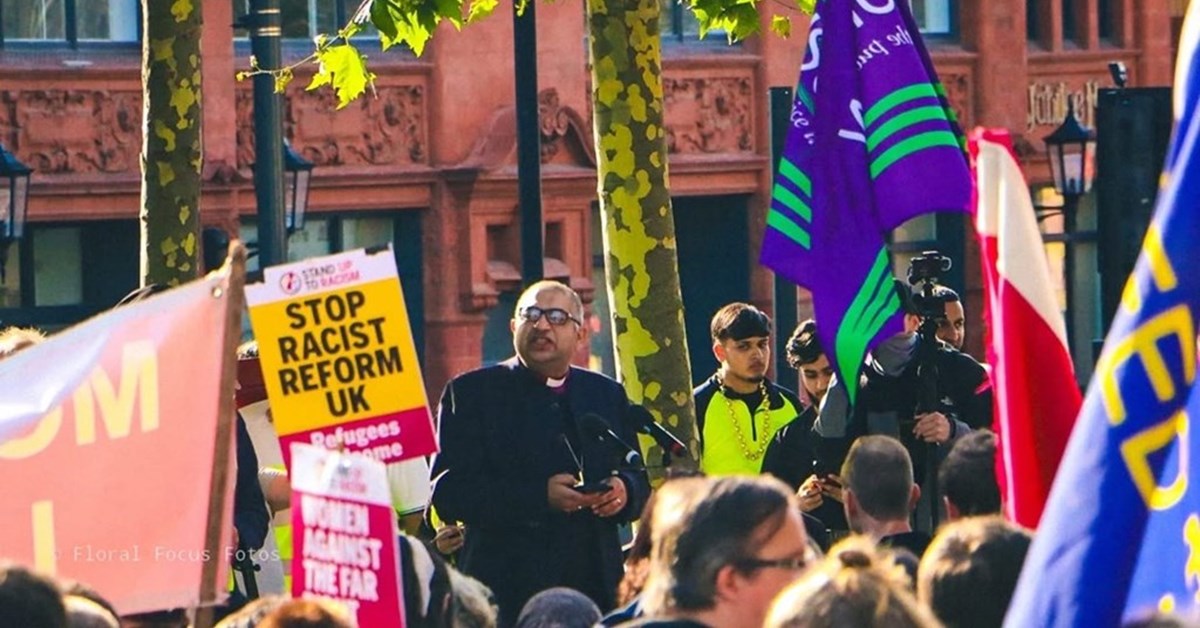
“SOMETHING great is happening,” the anti-Islam activist Tommy Robinson, a convert to Christianity while in prison, said in his closing words at a carol concert in December. “I‘ve seen it at each one of our Unite the Kingdom events, as I saw the cross start playing prevalence.”
More than 110,000 people gathered for his “Unite the Kingdom” march in Westminster last September. The “free speech festival”, as it was billed, followed months of anti-immigration protests across the country. Protests outside asylum-seeker hotels had escalated after the arrest of an Ethiopian asylum-seeker later convicted of attempted sexual assault (News, 25 July 2025).
The owner of X, Elon Musk, told the Whitehall gathering that “massive uncontrolled migration” was contributing to the “destruction of Britain”. “Violence is coming. . . You either fight back or you die,” he said; and huge cheers greeted Mr Robinson, who heralded “the spark of a cultural revolution” taking place: a defiance of the “traitors in Westminster” and a “globalist revolution” that had opened the borders and “attacked Christianity”. Labels such as “racist” and “Islamophobe” no longer worked, he concluded. “The dam has well and truly burst.”
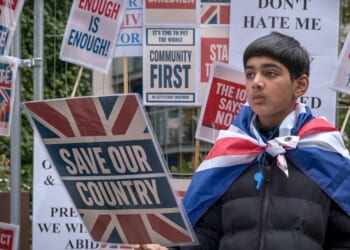
Amid the sea of flags of St George, wooden crosses were held by marchers, led from the stage in a chant of “Christ is King” and the Lord’s Prayer (News, 19 September 2025).
Bishops in the Church of England have offered a different interpretation of events. “Any co-opting or corrupting of the Christian faith to exclude others is unacceptable, and we are gravely concerned about the use of Christian symbols and rhetoric to apparently justify racism and anti-migrant rhetoric,” the bishops in Southwark said in the days leading up to the carol service.
”The far Right has often sought to wrap itself in flags or symbols, which belong to us all, and now they are seeking to do it with Christmas,” the Bishop of Kirkstall, the Rt Revd Arun Arora, warned.
Attention has been drawn to the contrast between publicity for the carol service — which promised that it was “not about politics, immigration, or other groups. It is about Jesus Christ — fully and completely,” and the emails sent by Mr Robinson to his supporters.
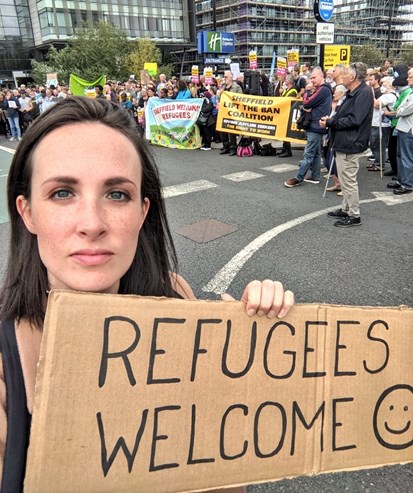 CHRISTIANS FOR A WELCOMING BRITAINHolly-Anna Peterson, as part of Christians for a Welcoming Britain, outside a hotel accommodating asylum-seekers
“The left-wing elites are waging a ruthless war on Christianity, tearing down our crosses and silencing our prayers in the name of their globalist agenda,” one communication warned. “Lefty cities like Sheffield (which has a Muslim mayor), have cancelled their Christmas lights this year . . . our Christian heritage demands we fight back with unyielding resolve.”
The carol sevice was “a rally for our values, a beacon of hope amid the chaos of mass migration and cultural erosion that threatens our way of life”.
It is uncontested that Mr Robinson’s aim is, in the words of a recent post on social media, to “De-Islamise Western nations”. “Islam being in the West is like mixing oil and water,” he wrote two days after the concert. “It’s never going to work. We need to be fearless and brave.”
But a focus on individuals, or the far Right, can obscure developments in the more mainstream political landscape. A poll commissioned by the Ahmadiyya Muslim Association UK and conducted last year found that 41 per cent of the respondents felt that Muslim immigrants had a “negative impact” on the country, while 53 per cent thought that Islam was “not compatible with British values”.
In The Church, the Far Right, and the Claim to Christianity, the Muslim writer Shenaz Bunglawala refers to a Pew Center report of 2018 (Being Christian in the West) which showed that 45 per cent of church-attending Christians believed that Islam was “fundamentally incompatible with the UK’s culture and values”, compared with 42 per cent of the general population.
“One of the notable features of mainstream political discourses concerning Robinson is that he is typically presented as vaguely unsavoury, bigoted or racist rather than focusing too much on his anti-Muslim or anti-Islamic views,” Professor James Crossley, academic director of the Centre for the Critical Study of Apocalyptic and Millenarian Movements, at Cambridge University, observes in the book. “One reason is precisely because there are striking overlaps between Robinson and leading politicians on the issue of Islam and Muslims, even if the rhetoric is typically softened when associated with politicians.”
IN PROFESSOR CROSSLEY’s view, the popular audience associated with the far Right in the UK has changed in recent years. In a society that that has become increasingly progressive on the issue, “race does not work as it once did and so the rhetorical emphasis on ‘religion’ is a deliberate, mostly opportunistic, move.” The historian Rita Chin has written about a “new racism” in immigration and integration debates in Europe, with a shift to categories of religion.
In the UK, the grooming-gangs scandal and convictions of asylum-seekers charged with sexual crimes are part of the political landscape in which Labour ministers have called for better data on ethnicity and crime and greater transparency in police statements. Anti-racist campaigners highlight that two in five men arrested in the wave of riots after the Southport stabbings in 2024 had previously been reported for domestic abuse.
The argument made by politicians that concern about Islam is justified is shared by some in the Church. Mr Robinson “is not a racist”, the Revd Sam Norton, Vicar of Backwell with Chelvey and Brockley, in the diocese of Gloucester, and a former Brexit Party candidate, told the Irreverend podcast in December. “He has concerns about Islam.”
Such concerns were not without basis, Mr Norton suggested. “Because our society thinks religion is just a hobby . . . they are completely blind to how Islam is developing and growing in this society.” Among his recommendations was that the immigration system award extra points to migrants who were Christian: “They are at a more fundamental level compatible with the inheritance that we’ve got that we are trying to protect.”
An advocate of “civic nationalism” as the only bulwark against dangerous forces, he described how the response of Church of England leadership to the Unite the Kingdom movement had left him “frustrated. . It does not understand what it means to have patriotism. . . I see the hundreds of thousands of people who turned out for the Unite the Kingdom march in September as sheep without a shepherd and, dear God, don’t we need . . . at least one bishop who is prepared to love them. . . We have this inchoate sense of Christianity, ‘Feed us,’ and they are like children asking for bread who are given stones. The House of Bishops is throwing stones at them saying ‘You are wicked people.’”
THE view that the response of the Church to the marches has been alarmist is shared by Danny Kruger, the former Conservative MP for East Wiltshire, who defected to Reform UK last year.
Speaking in a webinar, “Christ and Country in our Politics”, organised by the Good Faith Partnership in December, he said: “I might be completely wrong about this, and we have a terrible threat of Christian nationalism: far-Right people masquerading as Christians who are suddenly going to rise up and start attacking us, or something.
“I just don’t accept the premise that we have a major problem in people adopting Christian iconography in what are essentially political marches, and, in a sense, I honour them for doing so. They are trying to make the point that the foundations of this country are Christian, its institutions are, and there is real value in that.”
There was a need to “address the root cause” behind the march, which was “economic, and also a spiritual malaise”, he suggested. “I am personally more concerned about the things that the people on those marches are concerned about, which is the growth of Islam, and the growth of this aggressive anti-Christian secularism. . .
”I think we should be embracing this revival that is happening, and the fact that lots of young men are coming to church is a very encouraging development and not one to clutch our pearls over.”
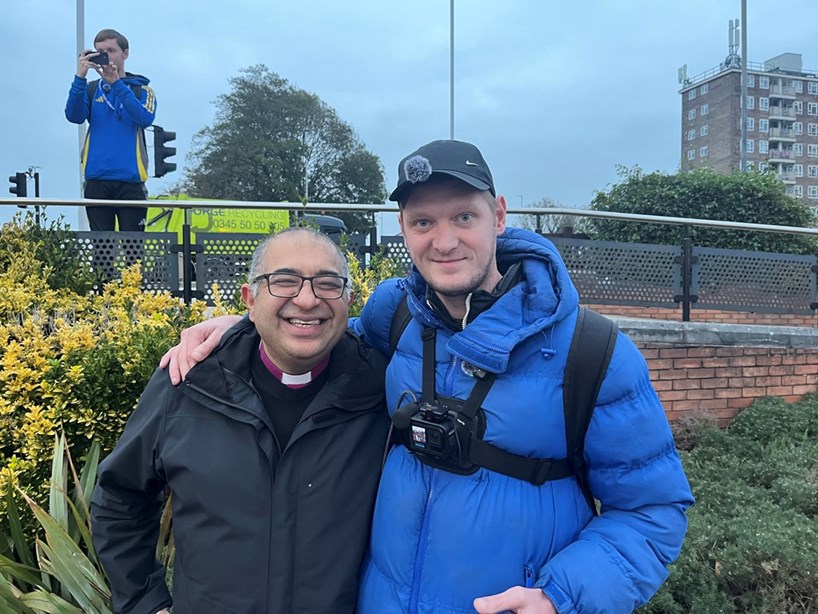 ARUN ARORABishop Arora with an anti-immigration protest organiser
He was a Christian and “nationalist in the sense that I believe in nations, and particularly believe in our nation”, he said. “And I believe the God we worship is the God of nations: he’s interested in nations; and the Hebrew people, the nation of Israel, are the template from which all nations derive, particularly ours.”
THE former Labour MP for Dagenham Dr Jon Cruddas is far less sanguine about the current religious-political climate. “Religions are being mobilised politically around questions of identity through various ethno-nationalist movements that seek to divide,” he told the webinar.
“We need an honest discussion of what comes with this: a new language of racial superiority, geographical separation, a drumbeat of forced migration even for settled citizens . . . In contrast to what Danny said, we’ve recently seen flags used as signifiers of racial purity and exclusion, intimately linked to preserving a certain religious heritage.”
Amid protests organised by UKIP under its “Mass Deportations Tour”, anti-immigration sentiment is growing. A YouGov poll last summer found that 45 per cent would support “admitting no more new migrants, and requiring large numbers of migrants who came to the UK in recent years to leave”.
The Reform UK party, which has pledged to freeze immigration and deport up to 600,000 migrants over five years, has led in the polls since last year. In an illustration of the shifting of the so-called Overton window — that is to say, the range of ideas and arguments acceptable to the general populace at any given time — Mr Robinson has boasted that politicians are now “parroting” what he has been saying for 15 years.
IT IS a climate affecting not only asylum-seekers or recent arrivals, but people who have lived in the country for years, or have been born here. The Team Rector of Hodge Hill in Birmingham, the Revd Dr Al Barrett, reports that many members of his congregation who are of African or Afro-Caribbean heritage feel “deeply unsafe and threatened” when they see the St George’s flag on streets.
Suggestions that previous waves of immigration met with little hostility have come as news to those who grew up in the latter half of the 20th century. Born in the 1970s to British-Asian parents in Birmingham, Bishop Arora recalls growing up “at a time when you had to look out for the colour of people’s socks to check if you were safe”; red socks were the signifier of the Anti-Paki League. “As a ten-, 11-year-old starting secondary school, these were things you had to learn,” he recalls. “You had to learn the places where it was not safe for you to go.” At football matches, “Ain’t no black in the Union Jack” was chanted.
He became an active anti-racist campaigner. On New Street Station, he was once warned that he was on a hit list of the neo-Nazi group Combat 18. Planning a Europe-wide anti-racist conference in the early 1990s, he had to be escorted home by police after a meeting was attended by skinheads who signed in as “A. Hitler, six million not-dead”.
He shares the belief, expressed by other people of colour, that “this feels like ’70s, ’80s now. You talk to the health-care chaplains in Leeds, and they will tell you about what the staff are feeling. This is bad now.”
BISHOP ARORA is among the most vocal critics sounding the alarm about Christian nationalism. Their error, he suggests, is “trying to elevate the flag over the faith . . . rather than understanding that our citizenship begins with our baptism, and it’s a citizenship of the Kingdom of God, and that is the Kingdom we seek to serve, and that any politics is secondary to that”.
For months, he has attended anti-migrant protests in Yorkshire. “Week in, week out, I am talking to the people who are out there who support Tommy, but they do so because they feel unheard and overlooked, and, fundamentally, the challenge for the Church is to provide them with that space to be heard and known and understood,” he says.
But he challenges defenders of Christian nationalism to consider “the kind of stuff that that leads to: the acts of abuse, the dehumanising, the violence, the graffiti — all the things that stand in polar opposite to the gospel”.
Holly-Anna Petersen was motivated to set up Christians for a Welcoming Britain, a WhatsApp group to which about 90 people now belong, by “increasing acts of intimidation against asylum-seekers and people of colour”, including attacks on hotels.
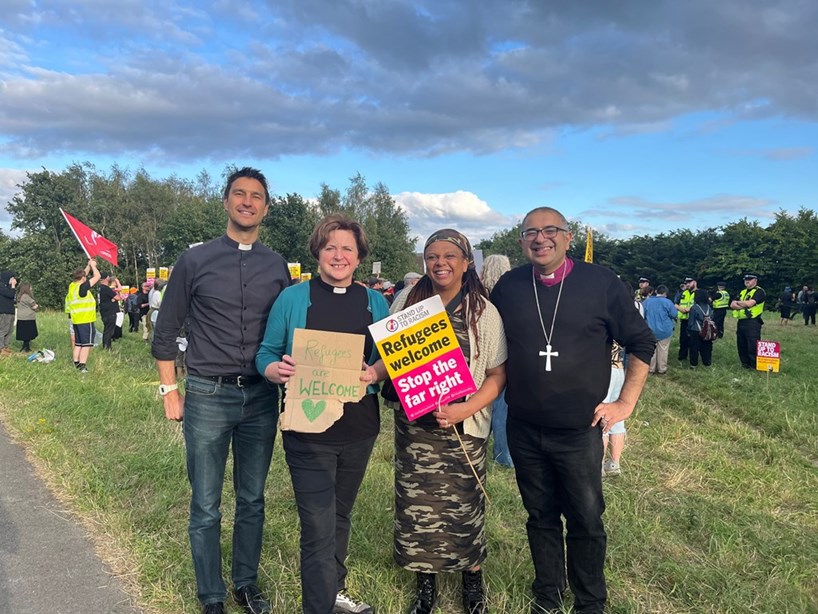 ARUN ARORABishop Arora with clergy colleagues in the diocese of Leeds at a counter-protest outside a hotel hosting asylum-seekers
Members of the group have served as a “supportive presence” outside hotels housing asylum-seekers, in which women and children are visibly afraid, she reports. “Many have come over to the UK because they have experienced traumas or torture that we can’t even imagine.” But fearful, too, are “many people of colour. . . It is clear that more people feel emboldened to express racism because of what they’re hearing on the news.”
Before Christmas, the group held a demonstration in partnership with the Better Story group in front of St Paul’s Cathedral (News, 19 December), which showed Mary, Joseph, and Jesus in a dinghy: “a reference to the fact that, soon after the birth of Jesus, the family was forced to flee to Egypt.”
The group is also “trying to listen and understand people’s perspectives who are falling into an anti-refugee mindset”, Ms Peterson says. “From speaking to people on the streets, it’s clear that there are a lot of people feeling left behind, desperate, and forgotten.” A narrative that “scapegoats refugees as taking resources unfairly means [that] those with wealth and power can continue to accumulate money and influence without public scrutiny”.
EPISCOPAL commentary on the current climate has prompted the accusation that the Bishops are “out of touch” with the nation. It was the term used by Nigel Farage last year when he was asked about likely criticism of his plans to deport migrants who crossed the Channel illegally. It prompted the Bishop of Leicester, the Rt Revd Martyn Snow, to admit that there was “a grain of truth” in the claim.
While the Church could not “remain silent in the face of inhumane policies or populist fearmongering”, he was aware of “faithful Christians sitting in our pews who support tighter border controls not out of hatred, but out of sincere concern for social cohesion, pressure on public services, and the pace of cultural change in their communities. Dismissing those concerns outright risks pushing these people further from the Church they love.”
Last year, a report on “the implications of projected population growth for the UK’s demographic future”, Don’t Stop Thinking About Tomorrow, by the Common Good Foundation and the Centre for Policy Studies, noted that the net average population increase over the past few years had been running at more than 500,000 per year, equivalent to a city the size of Sheffield — mainly through work visas and students. Further growth at this scale was not, it observed, “a prospect the majority of British people welcome”.
“Far-Right populism is very much part of a backlash against a set of policies and politics that we’ve had for 20 to 30 years that has over-emphasised mobility as opposed to stability, over-emphasised the free market and the centralised state rather than a lot of the institutions that make up our social and everyday economy and life, and over-emphasised diversity at the expense of solidarity,” Dr Adrian Pabst, a German scholar of religion and a political theorist argued on a recent episode of Radio 4’s Moral Maze.
“Whilst I don’t think any far-Right candidate or government has got an answer to that insecurity that we are living through, I think that that insecurity is very real, in cultural as well as economic terms.” Fear of “undocumented immigration” was shared by many immigrant communities, he said.
ADVISING Mr Farage is Dr James Orr, Associate Professor of the Philosophy of Religion at the Faculty of Divinity, at Cambridge University. The champion of “a politics of home”, he chairs think tank the Centre for a Better Britain (“a Better Britain is a nation that embraces its history, identity and culture”) and plays his part as a convener in conservative political circles, hosting guests such as Jordan Peterson and enjoying a friendship with the Vice President of the United States, J. D . Vance.
Speaking to GB News last year, Professor Orr said that it was “plausible” that Britain might become a Muslim-majority, or Muslim-plurality, country by the end of the century, with consequences for freedom of speech, religion, and conscience. The solution, he suggested, was to “arrest and preferably reverse mass unvetted immigration” from those parts of the world that did not take those rights “as seriously as we do”, referring to Pakistan and Afghanistan, which had “backward moral cultures”. He lamented the use of the anti-extremism Prevent programme to target a “completely confected phenomenon — namely the far Right”.
He offered a more detailed account of his views in December, in an interview with John Anderson, the former Deputy Prime Minister of Australia. For most of England’s history, he suggested, “we have not even had to think very much about what our values are, because we have a remarkably settled people, with a shared universe of norms . . . one law, one language, one Church.” This was no longer the case, as a consequence of “mass demographic change at a speed and scale that is unprecedented in our long history”.
THE defection of Mr Kruger — whose warning to MPs about “two religions moving into the space from which Christianity has been ejected” went viral last year — and Professor Orr’s involvement with Reform have both been cited as evidence that Christian nationalism is set to take hold in the UK in the way that it has in the United States.
Debate has arisen about the nature of this philosophy, which is defined by Britannica as “ideology that seeks to create or maintain a legal fusion of Christian religion with a nation’s character” — a “relatively new” term that described a “historically common” phenomenon. Mr Kruger is not alone in pointing to history, theology, and the constitution, in defending it.
On Moral Maze, the Revd Chris Wickland, pastor of the Living Word Church, who appeared alongside Mr Robinson at the September march, argued: “Through 1400 years of Christianity in this nation, it actually has been, for the most part, Christian nationalism. A state-run Church whose head is the King. . . I’m not a nationalist who’s a Christian: I’m a Christian that’s got a heart for his nation from a Christian perspective.”
“If we really want — as I do — to arrest the drift towards intolerance, the C of E must embody a more hopeful patriotism, grounded in neighbourhood and unconditional charity,” the Bishop of Ramsbury, Dr Andrew Rumsey, says.
“My starting point for this is that there is no experience of God outside of a culture. In other words, we have to reckon with space and time — and, therefore, with particularity.” There is, he suggests, “no way of loving the world in abstract, or in general. . . Everybody loves it in particular, and you learn to love the world by learning to love bits of the world. The job of the Church, it seems to me, is to translate love of God and love of the world in each particular place, which involves different scales of engagement, affection and allegiance.”
The Church of England was “formed in explicitly national terms”, he observes. “There is, to the conservative conversation, a bizarreness about the national Church being coy about this when the St George flag is also our Church’s flag, flying from our steeples.
“We were formed in a turbulent polity that gave coherence to an emerging nation state. Unless you see that as being an entirely non-providential or regrettable accident . . . I think you’ve got to reckon with the fact. In the C of E, we aren’t nationalist, but we are national, and I think that we don’t know quite how to do that at the moment without qualifying it away.’
Part of the problem, he suspects, is that “political liberalism” has been the “formative outlook” of most bishops, including him. It is, he suggests, a philosophy that, “for all its benefits, is inherently globalising and cautious of national boundaries, for all sorts of reasons”.
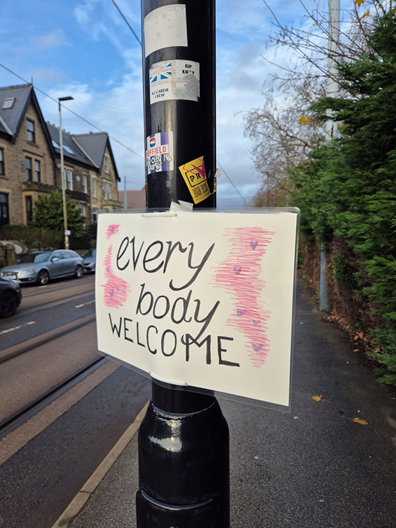 CHRISTIANS FOR A WELCOMING BRITAINCHRISTIANS FOR A WELCOMING BRITAIN
Yet discomfort with the national is rarely expressed towards other local boundaries, such as the European one, he says. For the English, their history is “particularly freighted with cultural guilt, imperial guilt, much of which is right to feel”. While this needs to be “worked through with appropriate penance”, he would like to see this “expressed with love . . . just as one would within one’s own family”.
He is not a proponent of nationalism, which “makes ultimate what actually is penultimate”, he emphasises. “A nation is only a provisional thing.” And when it comes to Reform, he “strongly doubts” that it holds the answers to the creation of an inclusive patriotism. Instead, it offers, he fears, “a defensive and uncharitable approach towards the incomer and the stranger”.
But he is also wary of being “too swift to denounce the coming to faith of those with whom we profoundly disagree” and of “a certain kind of liberal consensus around church life, which risks closing ranks around our ‘ownership’ of the Lord. . . Christian faith will, thank goodness, crop up absolutely anywhere, and we never have control over where the Holy Spirit is going to blow. We’ve got to balance that with speaking out for what our Church believes and contend for it . . . — all without pretending that we possess Christ.”
THE Revd Luke Larner is Priest-in-Charge of St Andrew’s, Luton, in the Bury Park area, where much of Mr Robinson’s English Defence League activism took place. The densely populated parish of 23,000 is approximately 75 per cent Muslim, while the small Christian community is mostly made up of people from Kashmiri, Bengali, and Pakistani backgrounds. It is also economically deprived.
He has been expecting the migration of Christian nationalism across the Atlantic for more than a decade and is “very nervous about this specific linking of patriotism and faith”, citing 1 Peter and “this idea that we are strangers and pilgrims and aliens in strange lands”.
There are aspects of his heritage which he is proud of, he says, but he remains wary of painting in “broad brushstrokes” the country’s history. “Like any nation, like any system of powers and structures hierarchies, there’s going to be injustice and human interest in the midst of it.”
His parish has its challenges, he says. “We don’t make any bones about saying it’s a tough neighbourhood, not an easy place to live, and not an easy place to raise a family.” There are now “only a few of us rattling around” in the grand church building designed by Sir Giles Gilbert Scott in the 1930s when the area was flourishing. “The average person to come through our doors in any good week will be a hijab-wearing Muslim woman coming to one of our community activities.”
It is a statistic that reflects the church’s commitment to building relationships locally with teachers, the GP surgery, and local councillors, which has helped to bring down barriers and address “a lot of misunderstanding in both directions”. There is, he reports, “a real sense of solidarity and shared struggle for social justice”.
Events such as the Unite the Kingdom march have generated fear locally, he says. Friends who used to laugh at their parents for keeping homes in Pakistan “because one day they’ll kick us out” are now glad that they did so.
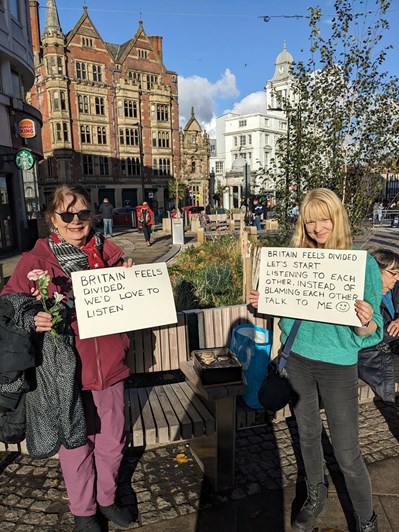 CHRISTIANS FOR A WELCOMING BRITAINAn outreach event organised by Christians for a Welcoming Britain
But Mr Larner has also faced challenges in his own family. His son, the only white Christian in his class at school, and one of two out of 120 in his year, has been on the receiving end of “anti-Christian sentiment from a minority of kids in the school”, which he attributes to misunderstanding.
The Unite the Kingdom events have also had an impact on his own experience as a priest. “Guess what happens to someone like me when a guy dressed up as an Anglican bishop standing next to Tommy Robinson starts spouting vile Islamophobic hatred? . . . People see I’m in the same cassock, and therefore tensions start to rise.”
Most of the white working-class residents he talks to are “very cynical” about Mr Robinson, he says. But he is also aware that there will be people from churches in Luton who have been to the rallies, and is aware of a rise in support for Reform among trade-union members.
“The reality is life is hard for white working-class people, the same as it is for all the other working-class people in our communities that are not white, and I think it is very, very easy to manipulate the anger,” he says. “People have been doing this for hundreds of years.”
EIGHTY miles north of Mr Larner’s parish in Luton is Hodge Hill, which includes a large historically white working-class council estate and suburbs whose residents are now almost entirely of Pakistani heritage. Like Bury Hill, it is grappling with economic inequality, with one of the highest levels of child poverty in the country.
“I think part of an inclusive patriotism for me would be about seeing England as a patchwork of localities where people, whatever path has brought them there, can feel pride in their localities in their places,” says Dr Barrett, who says he has been influenced by Dr Rumsey’s writing. An important focus has been “widening and deepening people’s access to green spaces and rivers and that sense of, this is our land. . . It belongs to all of us.”
Too much land and wealth have been “privatised and hoarded into the hands of a few”, he argues. “We need to find ways of sharing it more equitably; of nurturing common ground in a really earthy way, as well as in that metaphorical sense that we need spaces in which people can encounter each other across difference.”
At the parish church, the St George’s flag flies with pride, but so do the flags of every other country. Many of his Muslim neighbours are “proud to be English”, he says, and feel at home and rooted there. “But at the same time there is this rhetoric in politics and media nationally, that makes them feel profoundly unwelcome and unsafe.”
He shares concern voiced by Bishop Arora about right-wing media. In November, he raised concerns at his diocesan synod about the Church’s connections to Paul Marshall, the co-owner of GB News who is also a donor to several C of E institutions, including the Revitalise Trust based at Holy Trinity, Brompton.
In 2024, Mr Marshall deleted all of his posts on X (formerly Twitter) after an investigation highlighted that he had liked and retweeted anti-Muslim tweets. One “liked” tweet read: “If we want European civilization to survive we need to not just close the borders but start mass expulsions immediately.”
ST GEORGE’S DAY falls on 23 April. Parish clergy have made clear that, for many in their communities, the flag that will fly from many church towers has become a source of fear. Bishop Arora and others are already thinking about ways to articulate the inclusive patriotism that many in the Church are reaching for.
While net migration has fallen sharply in recent years — by 78 per cent in the past two years — and may even enter minus figures this year, it is likely to remain a salient political issue in the local elections in May. When it comes to a General Election, polls indicate that Reform will become the largest party. It is an outcome that some Anglicans, including Professor Orr and Mr Kruger, will be eagerly working towards.
Mr Robinson is planning a “Unite the West” rally on 16 May with the slogan: “Four Nations. One Kingdom Under God”, an event shared online alongside calls for the deportation of “invaders”.
Amid theological and political discussion of the nature of Christian nationalism, Mr Larner is conscious of Muslim parishioners who are afraid for their children to travel into central London.
Nevertheless, he has been inspired, he says, by the stories that he has collected of the response in northern communities to the Southport riots: “stories of white working-class grandmas putting their arms around people in the local Muslim community, building solidarity, working together. . . I think they’ve grasped something of the Spirit and of God that is sometimes missed and is not heard.”