Long after the sitcom Schitt’s Creek ended in 2020, it would not have been abnormal to catch me talking like a certain one of its characters in casual conversation. The show, about a wealthy family effectively exiled to life in a motel after the government seizes their assets, is teeming with weirdos. There are the townies, of course. How normal can you really expect someone to be after growing up in a place named “Schitt’s Creek”? And there are the Roses, that fallen family, who—with the exception of the dad, as every comedy needs a straight man—are the absolute kookiest of them all. Especially Moira.
Moira Rose, the soap opera actress, unlikely matriarch, and purveyor of ludicrous garments, wigs, and turns of phrase, is gone. And by that I mean Catherine O’Hara, the actor who brought her to life, died last week. The two were inseparable to me. You often catch glimpses of the familiar when watching characters onscreen: a mannerism that evokes a loved one, an archetype that reminds you of that dreadful ex, a quality that (un)comfortably makes you feel you are looking in a mirror. Moira, though, was singularly absurd—so unapologetically herself and free from ordinary social expectations in a way I had never seen before and knew I would never see again. There was no one like Moira Rose, and so there was no one like Catherine O’Hara.
First, there was the accent, that voice you’re still liable to hear me invoking to this day. I don’t know if I can describe it well, but I’ll give it a whirl: It was as if a Mid-Atlantic accent, a Cockney accent, and a Southern accent had a baby—posh with its tall vowels, harsh with its hard emphases, long with its relentless drawl. It also kind of sounded like she had cotton in her mouth, for whatever that’s worth. In other words, it is not an accent that occurs naturally on the global cadence spectrum. Moira, a.k.a. O’Hara—O’Rose? Rose’Hara?—concocted it out of thin air. Why speak like normal people, like people expect you to speak, when you can speak like Moira Rose?
The results were delightfully chaotic. During one memorable sequence, Moira leverages her celebrity to film an advertisement for a local vintner. It’s not every day a former Sunrise Bay star moves to Schitt’s Creek, after all. She struts into the shot—”If you like fruit wine as much as I do,” she tells the camera, chewing every word—before it becomes clear she cannot, under any circumstances, pronounce the winery owner’s name, Herb Ertlinger. The vowels are too narrow for her yawning twang to spit out in such quick succession. Also, she’s plastered.
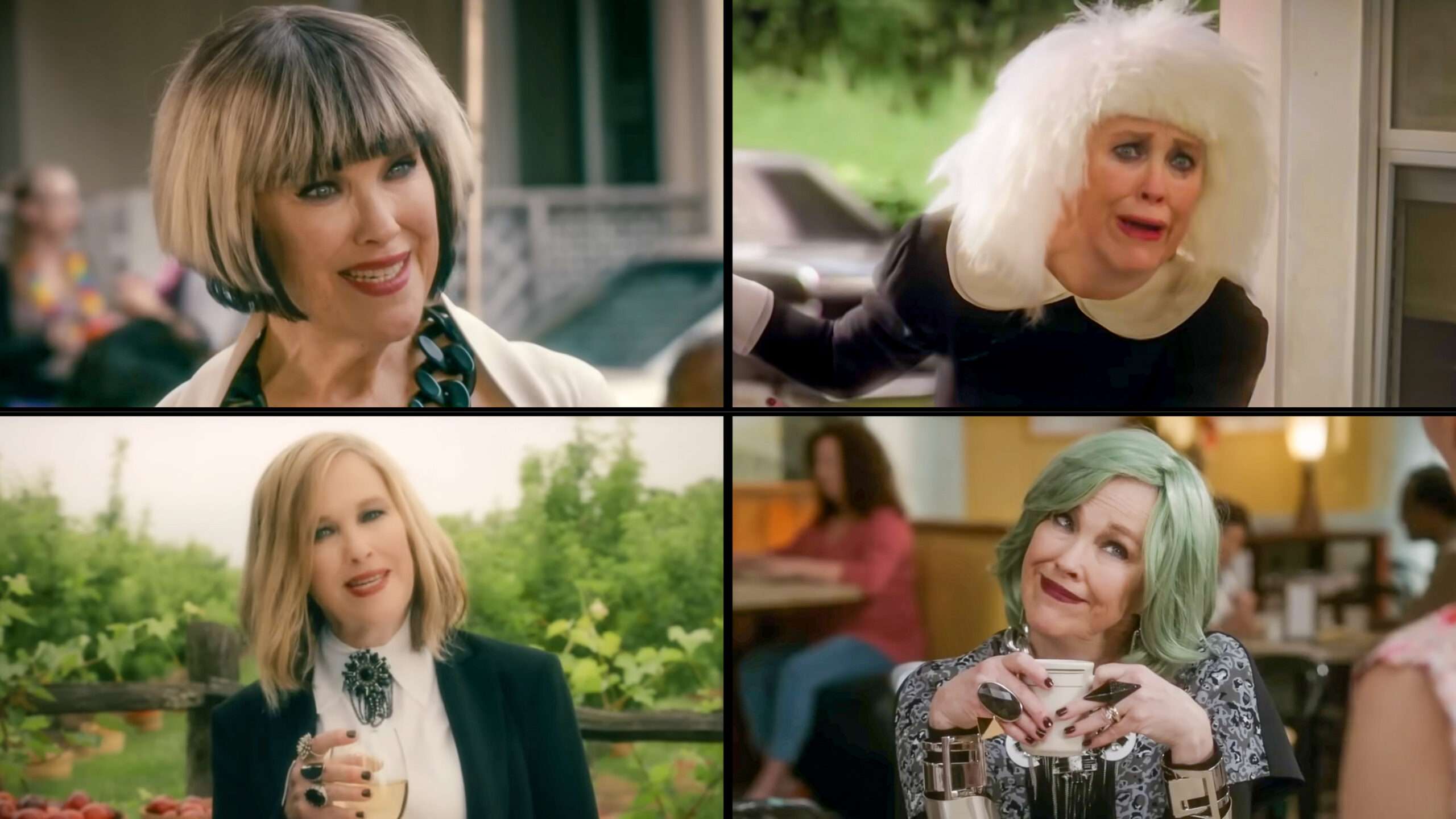
Then there were the wigs. I initially thought to analogize them to the rainbow, but that would be understating the situation—Moira’s collection, which was O’Hara’s idea, was so inexhaustible that I would not know how to classify many of the shades on a color palette. Bubblegum pink? Icy-broccoli green? She was undeterred by style conventions; we will call my favorite look, a snowy white bob that developed a mind of its own during a Moira-esque bluster of emotion, Einstein chic. If you asked Moira, though, they all had minds of their own. She treated them as her daughters, or her “bébés,” each with a personality that she could embody fully via osmosis. “Maureen does not like to be manhandled,” Moira cautions a townie who tries to make contact. Ah, Maureen, the dame who’s blonde on top and raven underneath. She knows what she wants.
Maureen, of course, was Moira—not the other way around. They all were, because they were all her creations, different shades of her near-limitless individualism, her refusal to be constrained by arbitrary norms. They were paired, naturally, with an outrageous wardrobe, which looked like what you’d get if the lead in-house designer at White House Black Market had a psychotic break. She used words like “pettifogging” and “bombilating.” She likened her son’s behavior in a tense moment to that of a “disgruntled pelican.” She did not hide the ball: “What you did was impulsive, capricious, and melodramatic,” she once instructed her daughter, “but it was also wrong.”
Why was Moira the way she was? Was it pure, unbridled confidence? There was some of that. Was she simply detached from reality? There is freedom to be found in delusion. Was it a never-ending performance, driven by ego and insecurity? Her star was waning, a tragedy made worse by the fact that it never reached the stratospheric heights she intended.
Despite O’Hara’s success, I imagine she related to that inner doubt on some level, particularly as a lifelong student of one of the most merciless art forms: comedy. But the truth is that nearly everyone can relate to Moira. Who doesn’t cosplay their own life in one way or another? Perhaps the familiar glimpse we see in the character—penetrating that singular absurdity—is one of the most universal experiences: a desperate need to be liked.
And yet I frankly don’t really care what the answer is. I loved Moira less because of who she was than because of how she came to be. O’Hara could have easily mounted a cliché. The aging prima donna isn’t groundbreaking territory—hello, Norma Desmond. Instead, she stitched together something remarkably peculiar, something self-serious that demanded not to be taken seriously. I marveled at that accent, the product of unrestrained creative liberty. Meanwhile, I avoided watching O’Hara in interviews; I didn’t want to believe she spoke without it. Never have I been so enthralled by a performance while so acutely aware of the actor behind it.
I don’t know how Moira’s story ends, because I didn’t finish Schitt’s Creek. Watching those final episodes would have required accepting it was over. There would be no additional dialogue with that otherworldly Moira accent. There would be no more Moira zingers, costume changes, or surprises. There would never be someone so distinctly and deliciously unhinged. I definitely won’t be finishing now.