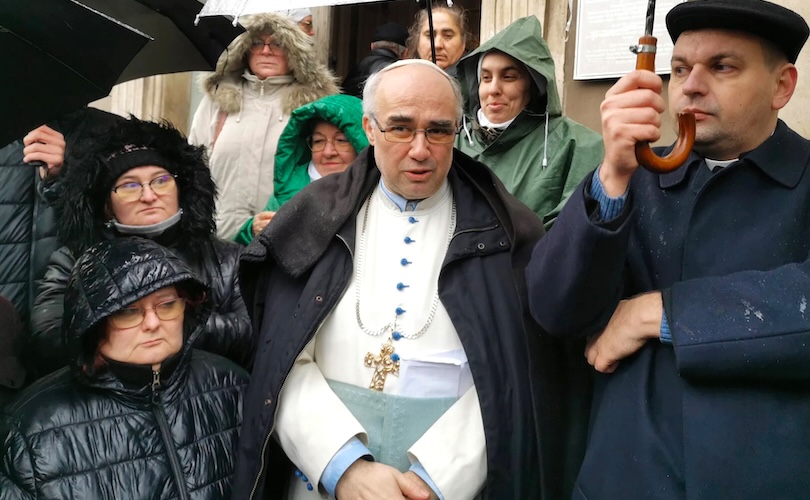
“For a long time, Rudolf Anzelm Fejes and his supporters stared down the bailiff; in the end the City Hall resolved the stalemate—temporarily.”
“They wanted to arrest him, but they feared the crowds” – (Mt 21:46)
“In post-regime-change Romania, no ecclesiastical dignitary has yet been evicted live, under camera crossfire, from his own home and at the same time from his official, contractually recognized workplace.”
– Account of an eyewitness to the events of Feb. 23, 2026, in Oradea, Romania.
“Finally, the order comes: ‘Surrender the basilica!’ I reply: ‘Emperor, it is not lawful for me to surrender the basilica, nor is it right for you to receive it. No law entitles you to violate the house of a private individual, do you think that you may seize the house of God?’”
– St. Ambrose
ORADEA, Romania (Lepanto Institute) — For three hours, a Catholic abbot in Romania faced down the police, awaiting their arrest at the steps of his abbey church for having refused to hand over the property of a 900-year-old monastery to the Masonic lobby within the local government.
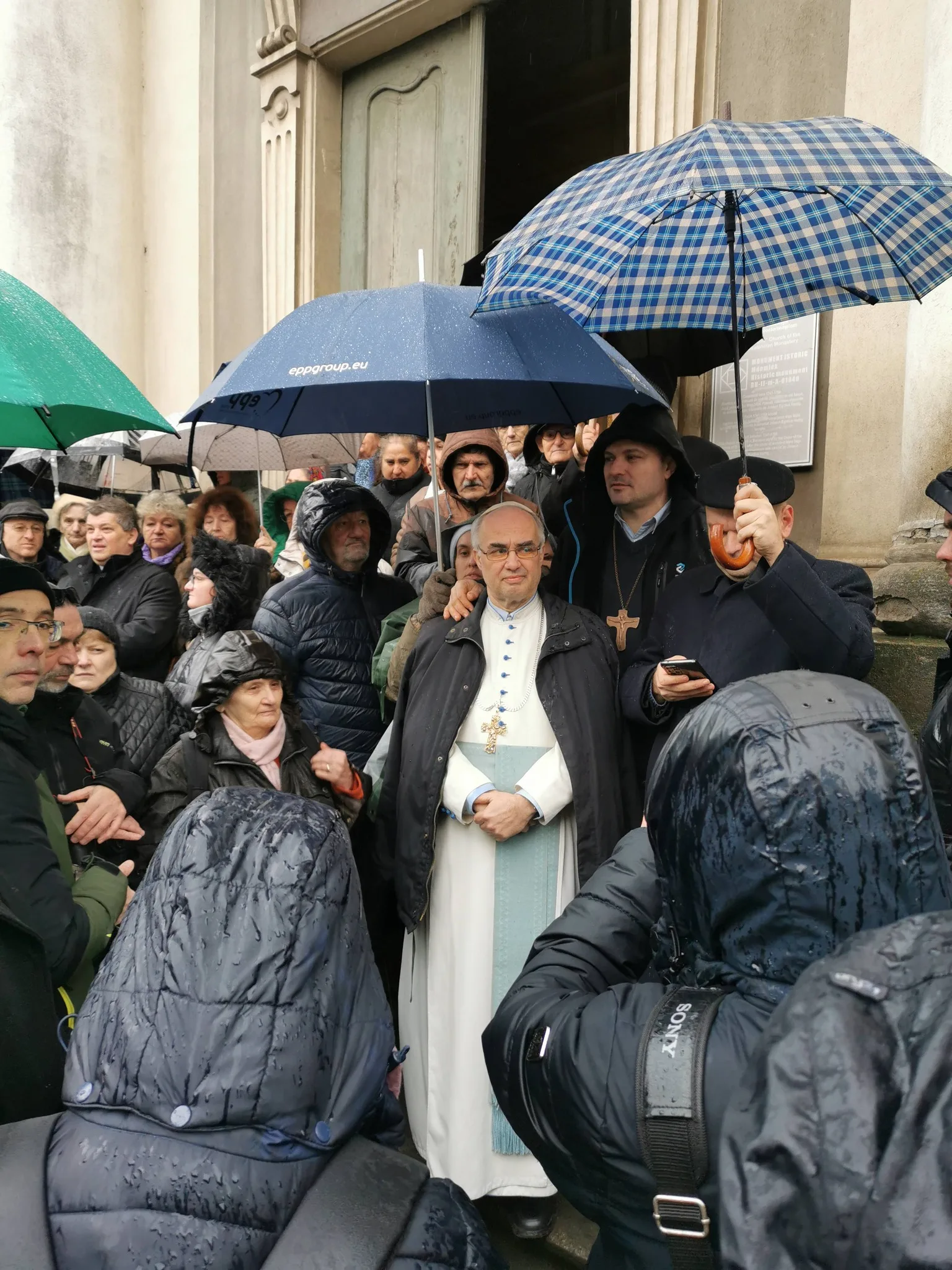
On Februry 23, 2026, Norbertine Abbot Anzelm Fejes stood at the entrance of his abbey church, dedicated to Our Lady of Sorrows, in Oradea, Romania, openly awaiting arrest by the gendarmes, following the announced eviction of the abbot from his own monastery, scheduled for 10:00 am that morning by city authorities.
Crowds of Catholic faithful showed up to the abbey church, however, surrounding Abbot Anzelm in a show of support to protect him against the Masonic lobby of Oradea, which sought the abbot’s eviction in order to seize the property of the centuries-old Catholic Norbertine monastery.
With the story making international headlines, local authorities gave the order to police to stand down and postpone the abbot’s eviction, in what locals called an unexpected and long prayed-for “miracle.”
The Lepanto Institute assisted in highlighting the plight of Abbot Anzelm, making known his situation to members of the United States government and ecclesiastical authorities in Rome.
The abbot’s defense of Church property against seizure by the state hearkens to the famous examples in Church history of saints and bishops standing up to powerful government authorities in defense of the rights of the Church.
One such episode took place during Lent of 386, when St. Ambrose of Milan refused to surrender any of his churches to the Emperor Valentinian, who threatened seizure of several basilicas in Milan, demanding that they be handed over to the Arian heretics of the city.
Like St. Ambrose, Abbot Anzelm placed himself in harm’s way in defense of the Church, risking arrest rather than hand over to evil men what belongs to God.
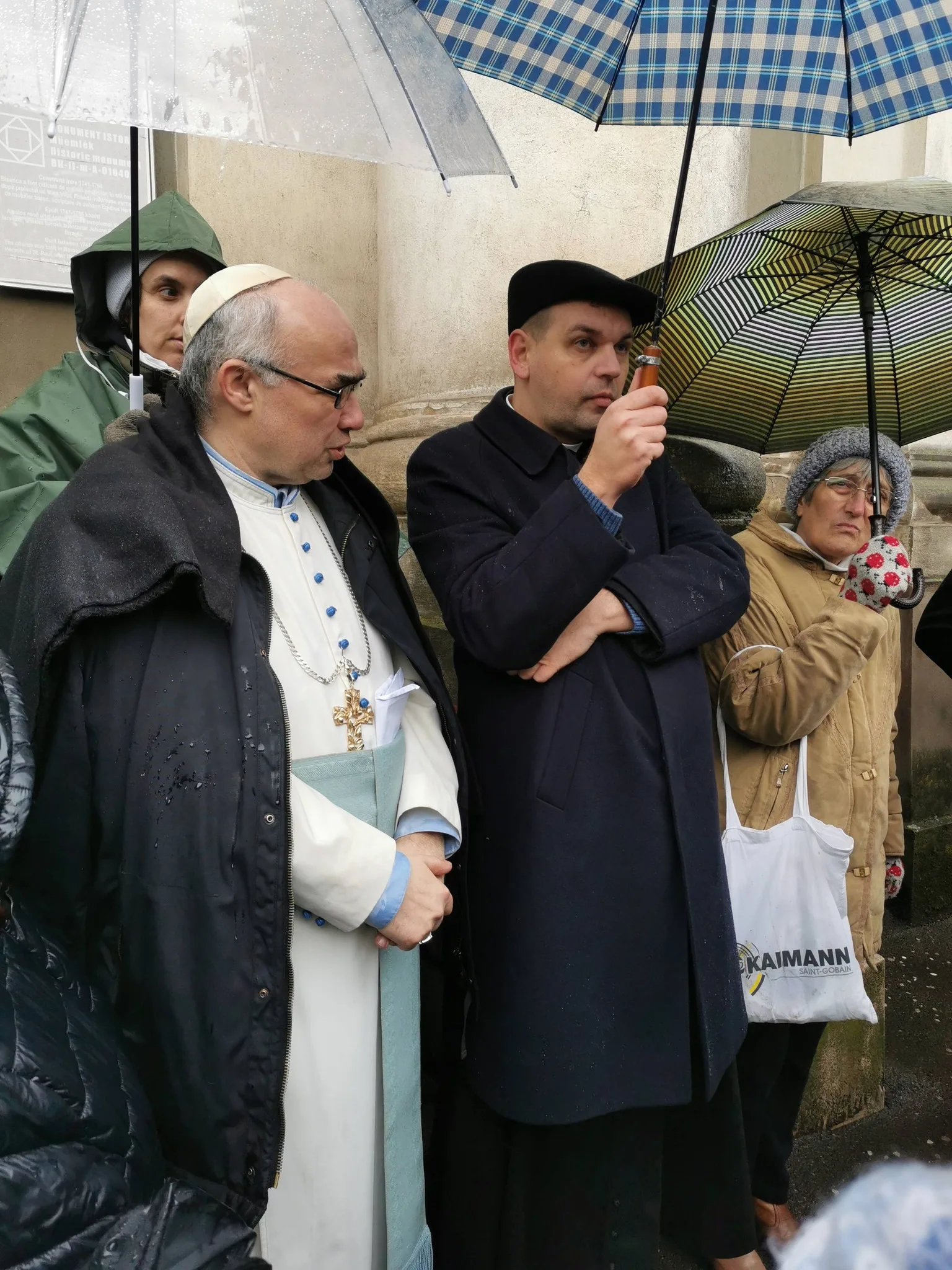
A calm and strong resolve
Just before exposing himself openly to local authorities on the steps of his church, Abbot Anzelm had prayerfully offered Mass within. After giving the final blessing, he told those present, “From this moment on, I do not know how things will develop,” asking them to pray.
As the faithful recited the Rosary, the abbot calmly took questions from the media within the sacristy. According to one journalist present, Abbot Anzelm “stood before the cameras in the sacristy—from where they want to evict him—without the slightest trace of the outside world’s agitation on him. Behind his calmness and gentle smile there was a dignified, rock-solid composure, the kind only the deepest inner faith and the quiet certainty of truth can give a person.”
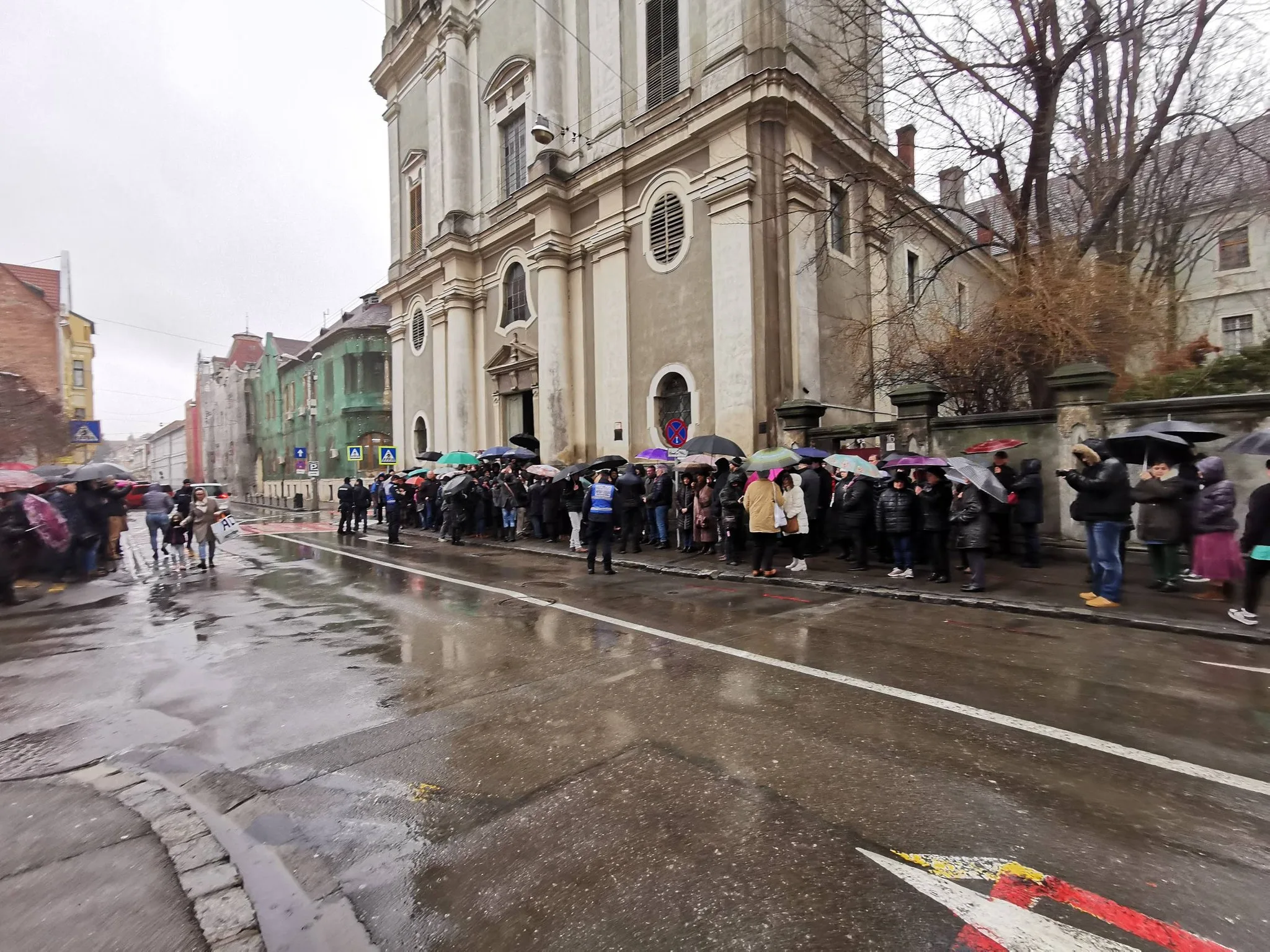
The abbot was just preparing to answer a question about what measures the international leadership of the Premonstratensian order was planning when the door opened and one of the faithful signaled that two gendarmes had arrived at the church door – “they’re looking for Father Abbot.” The abbot and his entourage proceeded through the church within a ring of faithful, and then the abbot waited on the church steps, in pouring rain, for the fulfillment of his fate. For now the gendarmes were asking the crowd –growing on both sides of the street and reciting the Rosary – not to stand in the roadway. Several people prayed in tears, while the priests placed their hands on the abbot’s shoulders.
 Three-hour wait in the rain
Valer Marian, an Orthodox Romanian and former senator in the Romanian Parliament, was also present in Oradea that day to offer legal assistance to the abbot. He described the scene:
In torrential rain and penetrating cold, at the appointed time more than 200 believers gathered on both sidewalks in front of the Monastery of Saint Stephen, the First Martyr, and the adjoining church, Our Sorrowful Mother. They prayed and expressed solidarity with Abbot Anzelm.
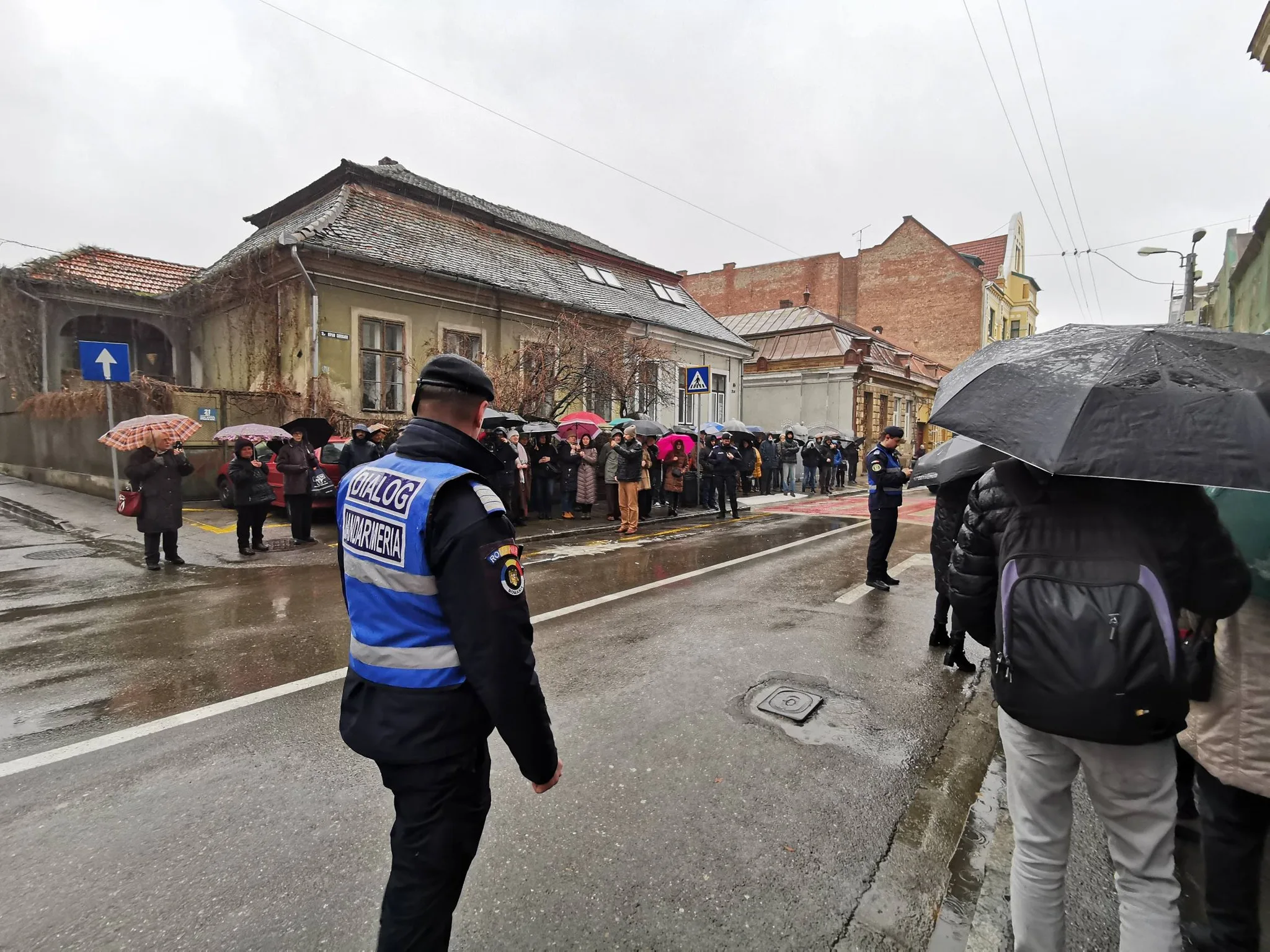
From the state authorities, about 30 gendarmes were present—one third visible and two thirds lurking nearby. A traffic police crew and at least one SRI team were also present. The event drew the interest of 10–12 journalists from newspapers and TV stations in Romania and Hungary, including journalists from the government mouthpiece Magyar Nemzet in Budapest.
Another eyewitness to the day’s events described the tension of the three hours of waiting, which finally saw the city and police relent in the face of the crowds:
The rain had no intention of stopping, just as the abbot did not budge from his place, while he continued giving interviews. A full hour passed in tense waiting. The faithful waited, the abbot and his close circle waited, the gendarmes waited, the secret and not-so-secret police waited, the plainclothes and uniformed law-enforcement officers waited, the journalists waited, interested passersby waited—and the bailiff waited as well, across the street.
“He’s waiting for us to get tired and go home, and we’re waiting for him to give up,” several people said, but neither side yielded an inch. Another half hour to an hour passed, when journalists indicated that Oradea City Hall had issued a statement postponing the enforcement of the eviction measure against Father Rudolf Anzelm Fejes from a property owned by the municipality.
They justified the decision by saying that classes had restarted at the Mihai Eminescu National College, and that some of the rooms subject to eviction, in certain cases, overlap with the spaces where educational activities take place. Carrying out Monday’s measure would therefore have directly affected the uninterrupted running of the educational process. City Hall noted that the postponement is exclusively administrative and temporary in nature. The eviction procedure remains in force and will be carried out at a later date to be determined, in such a way that disruption of students’ and teachers’ activities can be avoided, with respect for the legal framework and the public interest.
Neither the crowd nor the abbot believed the office; Rudolf Anzelm Fejes said on the spot that he would remain in front of the church and wait until he received an official notification of the postponement of the eviction. The waiting continued, but when the bailiff left the scene, some of the people—frozen to the bone and soaked—also gave credence to the statement and slowly left the area.
“We’ll be here next time too,” they said as they departed.
A history of persecution in Oradea
This was not the first time Abbot Anzelm had faced persecution for defending the rights of his abbey. Indeed, the calm and strong composure of his deep faith seems to have been born from the endurance of many sufferings over the years.
According to one journalist, the abbot explained that “recently his living conditions have been significantly worsened by the fact that, at his place of service, he is subjected to daily psychological terror and harassment by the authorities.”
Additionally, the abbot reported an increased hostility from local neighbors. According to the journalist, “As one example of the social tension and agitation directed against him, the abbot recalled an incident in a nearby grocery store during which two people attacked him between the shelves, and, according to him, one of the shop’s employees ordered the attackers out of the store. Another time, they poured acid over his car.”

St. Ambrose and Valentinian’s demands
The persecution of the Norbertine abbot over the desired seizure of his abbey’s property by the state carries striking parallels to the standoff that took place during Holy Week of 386 in Milan, when St. Ambrose opposed the Emperor Valentinian II over his demand that a basilica be seized from the Catholics and handed over to the Arians.
In a letter to his sister about the ordeal (Epistola 76), St. Ambrose writes,
The demand now was not just for the Portiana, that is a church outside the walls, but for the New Basilica, one which is within the walls, and larger. The first thing was that some men of illustrious rank, counts of the imperial consistory, met me with the demand that I should both surrender the basilica, and see to it that the people did not cause any disturbance. I replied, correctly, that a temple belonging to God cannot be handed over by a bishop.
The following day there was an acclamation of support in the church. No less a man than the praetorian prefect arrived there. He started to urge us to withdraw at least from the Portian Basilica. The people protested. We parted, with the prefect saying that he would report to the emperor.
On the following day, which happened to be a Sunday, after the lessons and the sermon, when I had sent away the catechumens, I was teaching the Creed to a number of candidates for baptism in the basilica of the baptistery. There I received the report that as soon as it became known that they had sent palace officials to the Basilica Portiana, and that they were putting up imperial hangings, a section of the people began to flock there. I stuck to my duty, however, and began to celebrate Mass.
St. Ambrose’s response
The saintly bishop stood strong in the face of the emperor’s demands. Refusing to hand over any church, he instead offered to sacrifice his own life and property, should Valentinian demand either. What belonged to God, however, could not be handed over.
St. Ambrose writes,
I myself was being pressed by the counts and tribunes to agree to an immediate handover of the basilica. They said that the emperor was exercising his legal rights, since all things were subject to his authority. I replied that if he was after what belongs to me, that is, my land, my money, any right, no matter what, that was mine, I would not resist – even though everything of mine really belongs to the poor. But the things that are God’s, I insisted, were not subject to the power of the emperor.
‘If my family property is what is wanted, come and take it; if my person, I will offer it. Do you want to drag me off to prison? Or to execution? I am ready. I will not surround myself with a defensive wall of my people, nor will I cling to the altar, begging for my life: much more gladly, in defending the altar, I will become a sacrifice.’
Yes, I was terrified when I learned that military men had been sent to seize the basilica of the Church, for I feared that their appropriation of the basilica would be accompanied by carnage, which would result in the ruin of the city as a whole. I kept praying that I might not survive the cremation of so great a city, perhaps of all Italy. I shrank from the odium of being the cause of bloodshed. I offered my own throat.
Soldiers surround the churches
Valentinian then set about deploying troops to surround and seize by force the churches he wanted. Undaunted, St. Ambrose continued instructing catechumens and offering the Mass, teaching the large crowds of faithful who kept continual vigil to sing the Psalms in order to pass the time.
The faithful filled the churches under assault for three days and nights, rallying to St. Ambrose’ defense and preventing the emperor from carrying out his designs. Eventually, the emperor’s own soldiers came over to St. Ambrose’ side and Valentinian’s plans were foiled.
As St. Ambrose recounts,
I spent the whole day in the Old Basilica. From there I took myself home, to rest, so that if anybody wished to deport me he would find me ready. The next morning before dawn just as I had set foot outside my doorstep, the basilica was occupied by the troops that had surrounded it.
The word was that the military enjoined on the emperor that if he wished to come out (to attend church), he would have the opportunity. They themselves, however, would attend him only if they saw that he was associating with the Catholics, otherwise they would go over to the crowd called by Ambrose. Not one of the Arians was brave enough to come out, since there were none of the citizens there, a few from the imperial household, and a number of Goths.
I could tell from the groans of the people that the church was surrounded. But during the reading of the lesson word was brought to me that the Basilica Nova too was filling up with our people; the crowd seemed bigger than when they had not been under duress; a shout had gone up for a Reader.
To be brief: the very soldiers who appeared to have taken possession of the basilica, learning that I had given instruction that they were to be kept from joining the congregation in the Eucharist, started to come here to our service. At the sight of them there was panic among the women; one of them rushed forward. The soldiers themselves, however, were declaring that they had come to prayer, not to battle. The people raised a cheer. They kept demanding – with such restraint, with such steadfastness, with such loyalty – that we should march to that other basilica. In that basilica too, it was said, the people were demanding my presence.
Ultimate standoff with the emperor
In a final confrontation on Holy Thursday of 386, Valentinian issued an ultimatum, demanding the immediate surrender of one of the churches. Rebuking the emperor for his adherence to the Arian heresy, Ambrose stood his ground and utterly refused.
Finally, the order comes: ‘Surrender the basilica!’ I reply: ‘Emperor, it is not lawful for me to surrender the basilica, nor is it right for you to receive it. No law entitles you to violate the house of a private individual, do you think that you may seize the house of God?’
The argument put forward is that everything is permitted to the emperor, that the world is his. I reply: ‘Do not make trouble for yourself, emperor, by thinking that you have any sort of imperial right over things that are God’s. Do not exalt yourself. If you wish to rule for any length of time, be subject to God. It is written: What is God’s to God, what is Caesar’s to Caesar. Palaces belong to the emperor, churches to the bishop. The jurisdiction entrusted to you is over public buildings, not over sacred ones.’
The statement is repeated that the emperor had sent word: ‘I too am entitled to have one basilica’. I reply: ‘It is not lawful for you to have it. What business have you with an adulteress? For she who is not married to Christ in lawful marriage is an adulteress.’
Soon after the news came that the emperor had ordered the troops to withdraw from the basilica, and that the money, which they had been fined, was to be returned to the merchants. Imagine the happiness of all the assembly at this moment, the cheers of all the people, the thanksgiving!
Now it was the day on which our Lord gave himself up for us, when we are released from penance in the Church. Vying to bring the news, soldiers rushing towards the altars make it known with kisses, the symbol of peace. Then I realized that God had indeed smitten ‘the worm that came at dawn, so that the whole city might be saved’.
It is perhaps not unfitting that during the Lenten fast, when the Church recalls the persecution and threats that those in power leveled against Our Lord Jesus Christ, culminating in His betrayal, arrest, trial, and death, God allows his servants to be tested by a like persecution and threat of arrest.
It is likewise perhaps not accidental, that when the faithful rally to the side of their shepherds, God delivers his servants and thwarts the designs of evil men. As with Christ in the temple and St. Ambrose in Milan, so now with Abbot Anzelm in Oradea, “They wanted to arrest him, but they feared the crowds” (Mt 21:46).
Reprinted with permission from the Lepanto Institute.