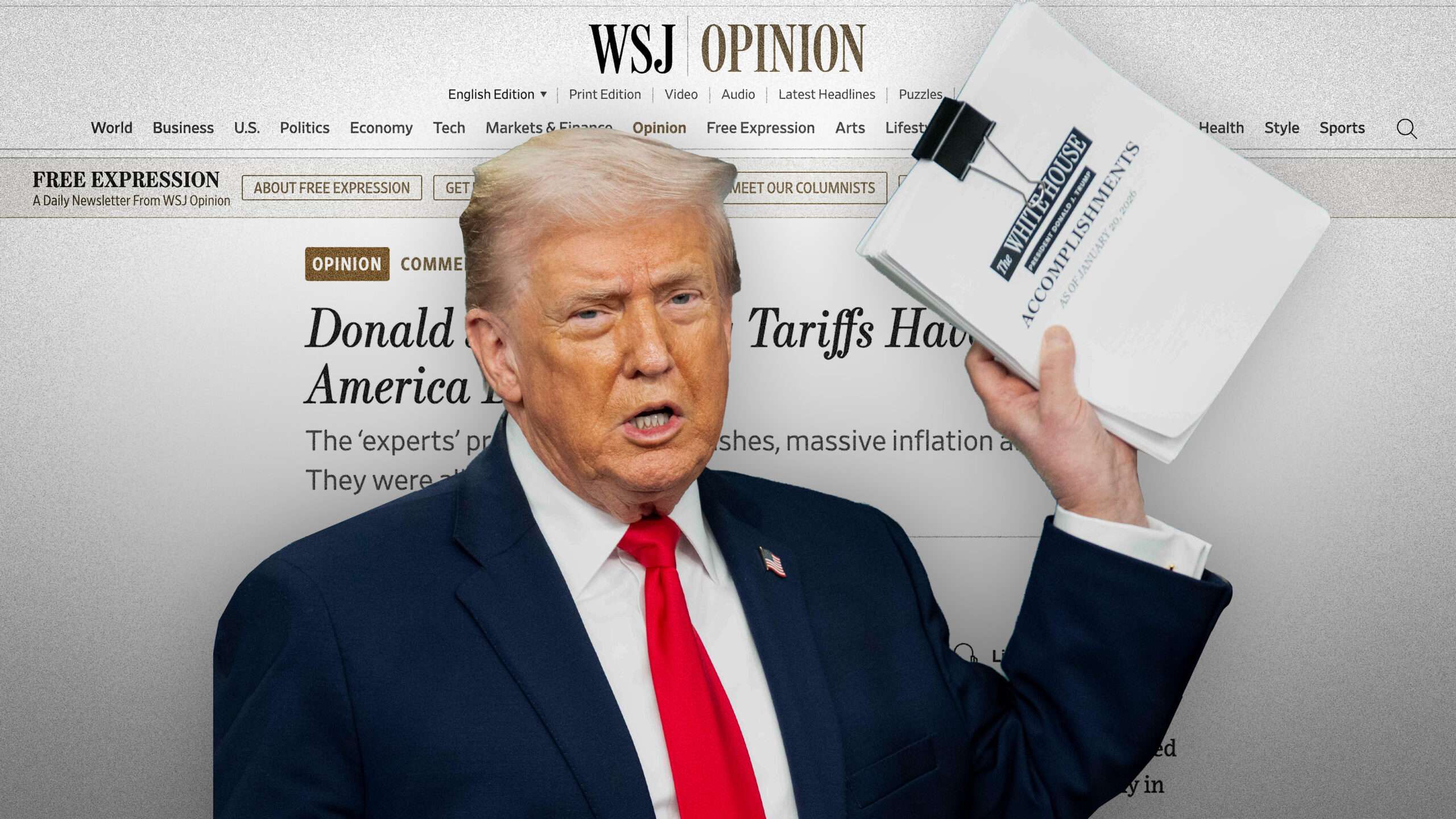
President Donald Trump argued in a Saturday Wall Street Journal op-ed that his myriad tariffs have boosted America’s economy without causing the harms that many economists predicted. “We have proven, decisively, that, properly applied, tariffs do not hurt growth—they promote growth and greatness, just as I said all along,” Trump claimed.
That conclusion rests on misleading claims, inaccurate data, and logical fallacies. Here are the three most egregious examples.
The trade deficit. Trump’s op-ed claims that he has “slashed our monthly trade deficit by an astonishing 77%.”
That would be astonishing. But in reality, the Census Bureau reported last week that the trade deficit increased—not decreased—by nearly 37 percent in November, the most recent month for which data are available. Through the first 11 months of 2025, the trade deficit was 4 percent higher than it had been in 2024. That is literally the opposite of what Trump is claiming.
It’s somewhat astonishing that the Journal allowed such a wildly misleading claim to appear in its pages. Someone really should have fact-checked this before it went to print.
Who pays the tariffs? “According to a recent study by the Harvard Business School,” Trump wrote, foreign producers and middlemen “are paying at least 80% of tariff costs.”
In fact, the paper he cited concludes that “tariffs led to both rapid and gradual retail price increases.” The study found that “prices began rising within days of the March announcements and continued to increase steadily over subsequent months,” and also that “imported goods rose roughly twice as much as domestic goods relative to pre-tariff trends.”
There is no getting away from this fact: tariffs are pushing prices higher. The Harvard Business School, Trump’s favorite source on the matter, recently noted that prices for imported goods are up 9.7 percent from their pre-tariff trends, while domestic prices are up 4.4 percent. Those increases have added an estimated 1 percentage point to inflation as measured by the consumer price index.
So the next time Trump is complaining that the Federal Reserve won’t lower interest rates, remember that the main reason the central bank is keeping rates higher is that inflation is still over 2 percent—but it would be significantly lower if not for Trump’s tariffs.
Economic collapse? “When I imposed historic tariffs on nearly all foreign countries last April, the critics said my policies would cause a global economic meltdown,” Trump wrote. That meltdown didn’t occur, so that must prove the president right and his opponents wrong.
This is not the gotcha moment that the president seems to believe it is. Trump repeatedly backed down and eased tariff threats in the face of negative shocks from both the stock market and the bond market. The “Liberation Day” tariffs announced on April 2 were postponed a week later after a huge stock market sell-off, and those that were later imposed were at lower rates. A threatened 130 percent tariff on Chinese goods never materialized. No wonder “TACO“—”Trump Always Chickens Out”—entered the political and financial lexicon last year.
As the Yale Budget Lab’s data show, Trump raised the average U.S. tariff rate from less than 3 percent to more than 25 percent with his Liberation Day tariffs and other moves in the first half of 2025. But those rates declined in the second half of the year and settled around 17 percent. That’s still very high, but not as high as it could have been—so it makes sense that the consequences were less severe.
And if the bar for success is “I didn’t crash the global economy,” then…congratulations, I guess? That’s not really something to brag about, and it certainly doesn’t excuse Trump from the economic damage that his (lower, less extreme tariffs) have done.
Beyond the factual problems with these arguments, Trump’s op-ed suffers from his recurring (and at this point unsurprising) misunderstanding about how tariffs work.
Economists will tell you that tariffs are effectively wealth-transfer mechanisms that take money from consumers and businesses (and anyone else trying to buy tariffed goods) via taxes. Unlike in more direct wealth-transfer systems, the beneficiaries aren’t paid with tax revenue, but protected industries gain the ability to charge higher prices because of the higher cost of imported goods and because they face less competition.
That reality undermines the entire premise that tariffs can “bring America back,” because tariffs can’t do anything for America as a whole. At best, they will benefit a relatively small set of American businesses at the expense of many other people.
In this case, the sectors of the economy that are supposed to be benefiting from Trump’s tariffs—manufacturing and other forms of industrial production—aren’t even realizing those benefits, because higher prices on raw materials make it more difficult to manufacture things. For example: American businesses are now paying much higher prices for aluminum than manufacturers elsewhere in the world. That’s a good way to discourage manufacturing, not to promote it.
Trump is clearly unwilling or unable to understand those trade-offs, and it is hopeless to believe he’ll ever change his mind. It is up to others to stop him.