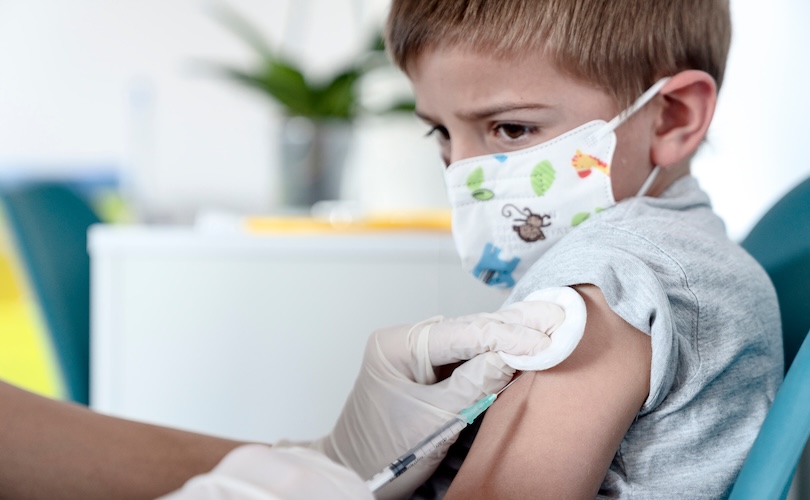
(LifeSiteNews) – The U.S. Department of Health & Human Services (HHS) announced on Monday an overhaul of the federal childhood immunization schedule, reducing the number of vaccine recommendations for children from 17 to 10.
“Last month, President Trump asked me to review the immunization schedules of other developed nations and consider their best practices,” Deputy HHS Secretary Jim O’Neill announced. “I had productive conversations with my peers in the health ministries of Japan, Denmark, and Germany. Scientists at FDA, CDC, NIH, CMS, and ASPE also contributed to a scientific assessment and recommendation, in addition to enlightening conversations about evidence gaps and randomized trials. I’m grateful to all of them for their excellent work.”
“Parents who think that more than 80 doses per child is too many may now consider giving their children the ten vaccines in the international consensus of 20 nations, plus the varicella vaccine,” he added. “For other diseases, [the CDC] recommends immunization for high-risk groups or through shared clinical decision-making when population-wide benefits cannot be clearly defined.”
“All vaccines that were covered by insurance under the prior schedule remain covered,” O’Neill assured the public. “Children can still receive the same vaccines at no out-of-pocket cost through private insurance and federal health programs.”
According to a fact sheet released by the U.S. Centers for Disease Control & Prevention (CDC), the new recommendations endorse “all vaccines for which there is consensus among peer nations.” Specifically, the government will continue to recommend that all children receive vaccination against “diphtheria, tetanus, acellular pertussis (whooping cough), Haemophilus influenzae type b (Hib), Pneumococcal conjugate, polio, measles, mumps, rubella, and human papillomavirus (HPV), for which there is international consensus, as well as varicella (chickenpox).”
Additionally, recommended HPV vaccine doses have been reduced from two to one, although questions remain as to why it is still being recommended at all, given HPV is a sexually transmitted disease that cannot be acquired through casual contact.
Still, the revised schedule came as welcome news to Americans who feel the medical establishment pushes too many vaccines on their kids, as well as those who believe a broader review of vaccine safety is needed, especially after the controversy with the COVID-19 shot. As LifeSiteNews has extensively covered, a large body of evidence indicates those shots carry significant risks.
The federal Vaccine Adverse Event Reporting System (VAERS) reports 38,913 deaths, 221,872 hospitalizations, 22,420 heart attacks, and 29,097 myocarditis and pericarditis cases as of December 5, among other ailments. VAERS submission are not proven cases on their own, but in 2022 CDC researchers recognized a “high verification rate of reports of myocarditis to VAERS after mRNA-based COVID-19 vaccination,” leading to the conclusion that “under-reporting is more likely” than over-reporting.
An analysis of 99 million people across eight countries published in the journal Vaccine last year “observed significantly higher risks of myocarditis following the first, second and third doses” of mRNA-based COVID shots, as well as signs of increased risk of “pericarditis, Guillain-Barré syndrome, and cerebral venous sinus thrombosis,” and other “potential safety signals that require further investigation.” In April 2024, the CDC was forced to release by court order 780,000 previously undisclosed reports of serious adverse reactions, and a study out of Japan found “statistically significant increases” in cancer deaths after third doses of mRNA-based COVID-19 shots, and offered several theories for a causal link.
Most recently, studies published in the International Journal of Infectious Diseases and International Journal of Medical Science raised the possibility of the shots carrying risks of not only respiratory diseases but even kidney injury.
Ever since, many have intently watched and hotly debated what President Donald Trump would do about the situation upon his return to office, given that the first Trump administration’s Operation Warp Speed initiative prepared and released them in a fraction of the time any previous vaccine had ever been developed and tested. Though he never backed mandates like former President Joe Biden did, for years Trump refused to disavow the shots to the chagrin of his base, seeing Operation Warp Speed as one of his crowning achievements. At the same time, during his latest run he embraced the “Make America Healthy Again” movement and its suspicion of the medical establishment more broadly.
So far, Trump’s second administration has rolled back several recommendations for the shots but not yet pulled them from the market, despite hiring several vocal critics of the COVID establishment and putting HHS under the leadership of Robert F. Kennedy Jr., America’s most prominent vaccine skeptic. Most recently, the administration has settled on leaving the current jabs optional but not supporting work to develop successors.
In a July interview, U.S. Food & Drug Administration (FDA) Commissioner Marty Makary asked for patience from those unsatisfied by the administration’s handling of the shots, insisting more time was needed for comprehensive trials to get more definitive data. The FDA has reportedly begun acknowledging child deaths caused by the shots, but at the same time the Trump Justice Department is in court arguing against the revival of a whistleblower’s lawsuit against Pfizer.