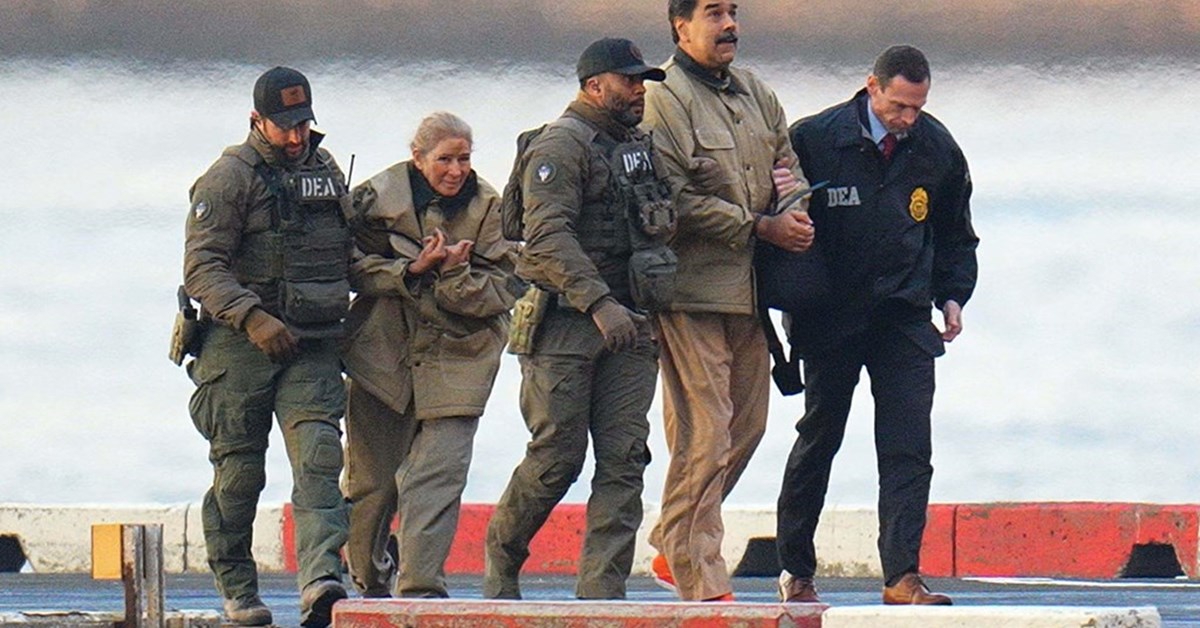
DON’T say you weren’t warned. One headline this week declared: “Trump’s coup in Venezuela didn’t just break the rules — it showed there aren’t any.” That is wrong. There are rules — just not the ones that we assumed.
It is true that President Trump increasingly displays the traits of a malignant narcissist. He tries to silence critics from judges to journalists, and destroys parts of the federal government which oppose him. He turns the law on opponents in undisguised acts of revenge. He mocks the disabled and posts cartoons of himself defecating on his opponents. Some psychiatrists suggest cognitive decline.
But President Trump’s behaviour is not totally random. At his inauguration last January, he promised that the United States would “regain respect” on the world stage — not through alliances or shared values, but through tariffs and theatricalities: claiming that the Panama Canal should be “taken back”, and rebranding the Gulf of Mexico as the “Gulf of America”.
Critics dismissed this as America First bluster. But the publication of his National Security Strategy in November elevated this to a coherent policy. It explicitly introduces a “Trump Corollary” to the Monroe Doctrine, which, in 1823, asserted US primacy over all the Americas. Then it was designed to ward off European influence. Today’s “Donroe Doctrine” is more concerned about not just Chinese and Russian interference, but also “narco-terrorism”, migration, and other perceived threats to what he calls the Western hemisphere.
This is not chaos: it is doctrine. It largely abandons the language of values, democracy, and the rules-based international order. In November, it was largely reported for caricaturing Europe as a continent of unstable minority governments that suppress opposition and undermine liberty — an accusation that reads like parody coming from an administration engaged in its own subversion of democratic norms.
But it had implications for governments from Greenland to Central and South America. The US has a long history of imperial intervention in its “backyard”: the seizure of half of Mexico’s territory in the 19th century; occupations of Haiti and Cuba; covert coups and dictatorships supported across Latin America during the Cold War; the invasion of Panama in 1989 to capture Manuel Noriega, a former CIA ally. President Trump is not inventing American imperialism: he is reviving it, with relish.
What is new is how far he may be willing to go. The document reframes economic power as national security. Greenland is not mentioned — just as Cuba and Colombia are not. But Trump allies have laid the rhetorical groundwork for a takeover of the island. After the raid on Venezuela, a map of Greenland overlaid with the Stars and Stripes appeared online with one word: SOON. When Mr Trump says something, Marco Rubio has warned, he means it.
Annexing territory from a NATO ally would be way more radical than any Latin American intervention. But Mr Trump knows that no European state can stop him by force. He is gambling that NATO needs the US more than he needs NATO.
European leaders should resist the temptation of easy moralising. The future of NATO will depend on cooler heads, strategic partnerships, and a containment policy rooted in realism rather than outrage.
The rules exist. Donald Trump has written them down. Don’t say you weren’t warned.