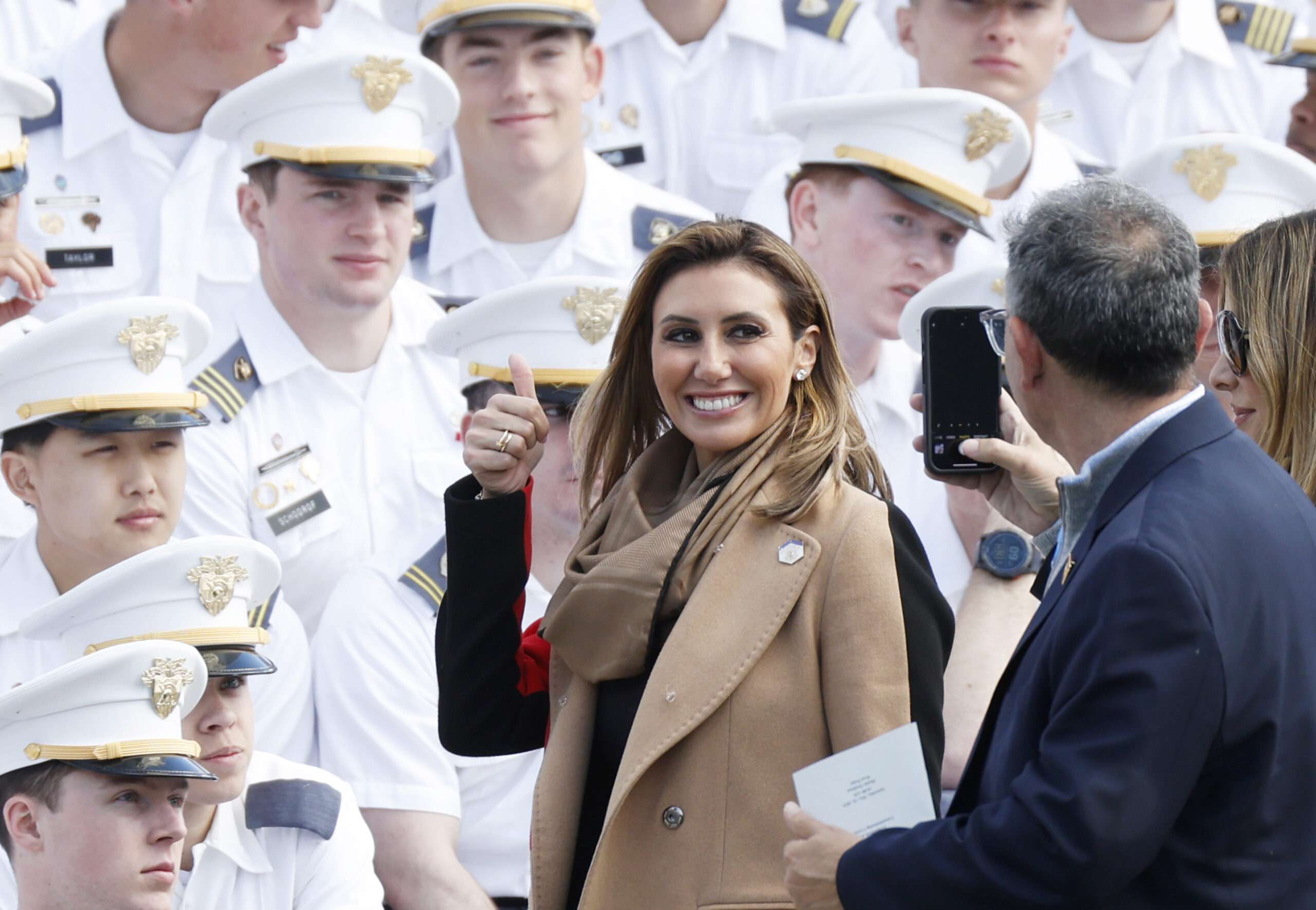
Alina Habba said she was the acting U.S. attorney for New Jersey. President Donald Trump and Attorney General Pam Bondi agreed. All three were wrong, the U.S. Court of Appeals for the 3rd Circuit ruled this week.
That unanimous decision, which was issued by a three-judge panel that included two George W. Bush appointees, highlights a disturbing pattern of conduct that extends beyond New Jersey to New York, Virginia, New Mexico, Nevada, and California. In one state after another, Trump has sought to install loyalists as U.S. attorneys without the Senate approval required by the Constitution’s Appointments Clause.
Habba’s case illustrates the absurd lengths to which Trump has gone in attempting to evade that requirement. After U.S. Attorney Philip Sellinger resigned in January, his first assistant automatically assumed the duties of his office, which John Giordano, now the U.S. ambassador to Namibia, briefly took over as interim U.S. attorney before Bondi replaced him with Habba in late March.
Three months later, Trump nominated Habba, who had served as his legal spokesperson from 2021 to 2025, as U.S. attorney, which would have required Senate confirmation. But Habba’s chances looked iffy given her lack of experience in criminal law, opposition from New Jersey’s two Democratic senators, and her record of frivolous pro-Trump litigation, which resulted in a $938,000 penalty that a federal appeals court upheld last month.
Under federal law, an interim U.S. attorney can serve no longer than 120 days unless the judges of the district approve an extension. But instead of allowing Habba to remain in that position, the District of New Jersey’s judges chose Desiree Grace, a career prosecutor who was then the first assistant U.S. attorney.
Bondi overrode that choice by firing Grace. On July 24, Trump withdrew Habba’s nomination as U.S. attorney, Habba resigned from her position as interim U.S. attorney, and Bondi appointed her as first assistant U.S. attorney based on the theory that she would then automatically fill the vacancy left by Sellinger’s resignation.
“It is apparent that the current administration has been frustrated by some of the legal and political barriers to getting its appointees in place,” 3rd Circuit Judge D. Michael Fisher dryly observed in this week’s decision, which addressed challenges brought by three criminal defendants. But that frustration, the appeals court ruled, could not justify the Trump administration’s attempts to skirt the law.
“Habba is not the Acting U.S. Attorney for the District of New Jersey by virtue of her appointment as First Assistant U.S. Attorney,” Fisher wrote, “because only the first assistant in place at the time the vacancy arises automatically assumes the functions and duties of the office” under the Federal Vacancies Reform Act (FVRA). In fact, Habba was doubly disqualified under the FVRA because she had not served as first assistant for at least 90 days and had been nominated for the permanent position of U.S. attorney.
The 3rd Circuit rejected Bondi’s attempt to avoid those difficulties by appointing Habba as a “special attorney”—a maneuver it said was precluded by a provision describing the FVRA as “the exclusive means for temporarily authorizing an acting official” unless another statute “expressly” allows an alternative. Under the government’s theory, the appeals court noted, “Habba may avoid the gauntlet of presidential appointment and Senate confirmation and serve as the de facto U.S. Attorney indefinitely.”
The president tried something similar with Lindsey Halligan, another former Trump lawyer with no prosecutorial experience. The president picked Halligan to replace Erik Siebert as the U.S. attorney for the Eastern District of Virginia after Siebert proved insufficiently enthusiastic about prosecuting two Trump nemeses: former FBI Director James Comey and New York Attorney General Letitia James.
Last month, a federal judge dismissed the indictments that Halligan had obtained against Comey and James after concluding that her appointment violated the 120-day limit on interim U.S. attorneys. Trump could have avoided that embarrassing setback if he had not been so keen to avoid legal limits on his powers.
© Copyright 2025 by Creators Syndicate Inc.