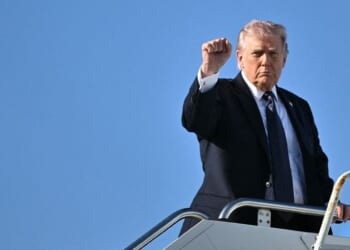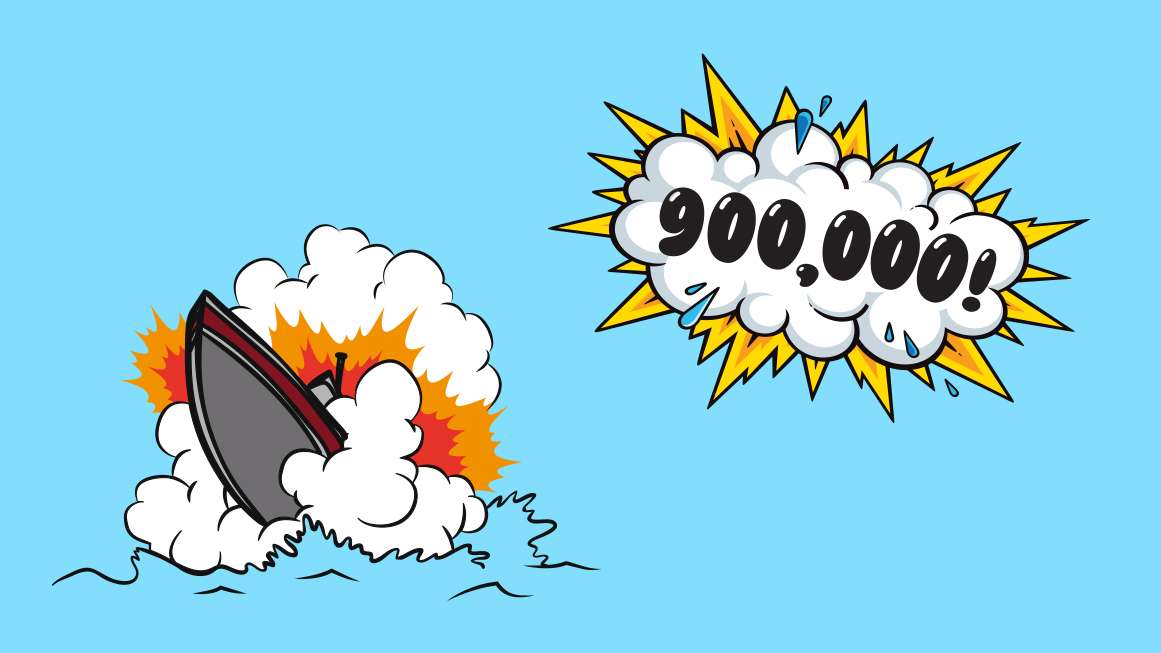
Every time the U.S. military blows up a suspected drug boat, President Donald Trump claims, it saves “25,000 American lives.” As of late January, Trump’s deadly campaign against cocaine couriers had destroyed 37 vessels in the Caribbean and the eastern Pacific, killing 126 people. According to Trump’s math, he had already prevented 925,000 U.S. drug deaths—11 times the total recorded in 2024.
Although Trump has repeatedly touted that improbable estimate, the basis for it remains fuzzy. But it seems to derive from several empirical and logical errors.
First, Trump conflates cocaine, the drug allegedly carried by those incinerated boats, with fentanyl, which is much more likely to be implicated in drug deaths, accounting for 60 percent of the 2024 total. “The boats get hit, and you see that fentanyl all over the ocean,” Trump erroneously claimed at a press conference in October.
Second, Trump imagines, contrary to more than a century of experience with drug interdiction, that traffickers do not compensate for intercepted shipments by sending more. When drugs are seized or destroyed, he thinks, the total supply available to Americans is reduced by that amount.
Third, Trump assumes that any given amount of drugs would be evenly divided into lethal doses, each of which would be consumed in one sitting by a different person. Attorney General Pam Bondi relied on the same plainly unrealistic assumption when she absurdly claimed that the Trump administration had saved “258 million lives” during its first 100 days by intercepting fentanyl shipments.
That breaks down to more than 77 million lives saved per month, which is even more impressive than Trump’s claim about the impact of his new, more violent anti-drug strategy, which by his calculation was saving a mere 185,000 lives per month. But Trump implicitly contradicted Bondi’s brag when he described the conventional approach to drug interdiction as “totally ineffective”—his rationale for resorting to summary execution of suspected smugglers. If the traditional strategy of seizing drugs and arresting smugglers was “totally ineffective,” it did not save any lives, let alone prevent three-quarters of the U.S. population from succumbing to fentanyl overdoses.
Trump thinks obliterating drug boats and their crews with missiles will work better. But prohibition creates a powerful financial incentive for delivering drugs to American consumers, and there are many ways to do that. Given that reality, there is no reason to think Trump’s lethal version of drug interdiction will be any more effective than the less murderous strategy that prevailed prior to September 2, when he started treating criminal suspects as “combatants” who can be killed at will, from a distance and in cold blood.
Two months after Trump confused cocaine with fentanyl, he declared the latter substance “a weapon of mass destruction” (WMD)—another drug-fueled fantasy. That designation was hard to reconcile with federal law, which defines WMDs to include “any weapon that is designed or intended to cause death or serious bodily injury through the release, dissemination, or impact of toxic or poisonous chemicals.”
The fentanyl implicated in U.S. drug deaths is not a “weapon.” It is a psychoactive substance that Americans voluntarily consume, either knowingly or because they thought they were buying a different drug. Nor is that fentanyl “designed or intended” to “cause death or serious bodily injury.” It is designed or intended to get people high and to make drug traffickers rich in the process. Even when dealers knowingly pass off fentanyl as heroin or Percocet, that is a far cry from setting off a dirty bomb or lobbing mustard gas.
Trump nevertheless claims “illicit fentanyl is closer to a chemical weapon than a narcotic” because “two milligrams, an almost undetectable trace amount equivalent to 10 to 15 grains of table salt, constitutes a lethal dose.” But that observation also applies to licit fentanyl, which medical practitioners routinely and safely use as an analgesic or sedative.
Illicit fentanyl poses a special risk because it magnifies the uncertainty caused by prohibition, which creates a black market where drug composition is highly variable and unpredictable. The proliferation of illicit fentanyl was likewise a product of prohibition, which favors highly potent drugs because they are easier to smuggle. And by cracking down on pain medication, the government made the situation even worse, driving consumers to replace reliably dosed pharmaceuticals with much iffier drugs.
Trump is oblivious to all of this. That’s why he thinks the solution to the hazards posed by prohibition is more aggressive enforcement of prohibition.
This article originally appeared in print under the headline “Trump Math Is a Drug- Fueled Fantasy.”