Painting raffled for boiler
THE Friends of St Mary’s, Woodbridge, in Suffolk, are offering raffle tickets to win a painting, Fireworks above the Sea, by the Suffolk-born artist Maggi Hambling, with the hope of raising £10,000 towards the £200,000 needed to replace its boiler. Nick Cottam, who chairs the Friends, told the BBC that the PCC wanted to install a low-carbon heating pump, which would also help toward the Church of England’s net zero target. “Our old gas boiler gave up the ghost last year, and since then we’ve been trying to get the permissions and work out what system might work in our church,” he said. “We’re going for a low-carbon heat-pump system, which is going to cost something over £200,000.” About £30,000 has been raised so far by a variety of methods.
Mullally reveals letters of support from women
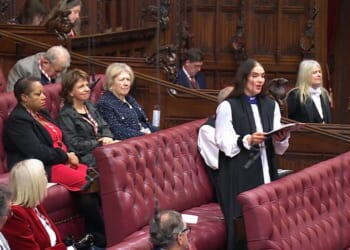
IN A Radio 4 interview with the former Prime Minister Theresa May, the Archbishop-elect of Canterbury, the Rt Revd Sarah Mullally, said that she had had “hundreds and hundreds of letters of support from women” since her nomination was announced in October (News, 10 October). Bishop Mullally, the current Bishop of London, said that one female priest had told her that it was the first time that she had felt “affirmed” in the Church. People were returning to Church with a “hunger for relationships away for social media”, Bishop Mullally suggested. Asked about the Church of England’s safeguarding record, she said that safeguarding “was at the heart of the Christian gospel” and apologised for failings. Progress has been made over the past ten years, with survivors’ voices augmented and greater professionalism in Church processes, she said. The interview, which also covered Bishop Mullally’s “principled opposition” to the legalisation of assisted dying, is available on BBC Sounds.
Churches join in prayer after sea deaths
THE churches in Withernsea, East Yorkshire, came together last week after an incident in which two people were killed after being swept out to sea. A third person remains missing. Police said that 15-year-old Grace Keeling had been hit by a wave while standing on steps leading down to the beach, last Friday. Her mother, Sarah, and passers by, including Mark Ratcliffe, entered the water in an attempt to save her. Sarah was killed, and Mr Ratcliffe died after being pulled unconscious from the water. Grace remains missing. A curate of St Matthew’s, Withernsea, the Revd Clive Hall, told BBC News that the mood in the town was sombre. Clergy from the town’s five churches had converged on Withernsea Methodist Church, which is near the beach, as a focal-point for those wishing to pray.
‘No words’ to describe deadly Boxing Day fire
A HOUSE fire in Stroud, Gloucestershire, which killed two children and their mother, was “an absolutely terrible tragedy” that had “impacted people deeply”, the Rector of St Mary Magdalene’s, Rodborough, the Revd Peter Francis, said. He told Sky News that opening the church for prayer was the “little that we can offer” after Fionnghuala Shearman and her two daughters died in the fire. Mrs Shearman’s husband, Tom, survived, after repeatedly trying to get back into the house to save his family. In a statement released on New Year’s Day, Mr Shearman said that his family had “had its very core, its very essence, ripped from it in the most violent way”.
St Martin 2026 awards now open
THE Sandford St Martin Awards, which celebrates programmes that explore religion, belief, ethics, and spirituality, have opened for submissions for 2026. The categories include journalism, radio and audio, television and video, and young audience. The deadline for entries is just before midnight on 30 January. Finalists will be announced in March and winners will receive their prizes at a ceremony at Lambeth Palace in June.
Lincoln Cathedral undergoes a ground-penetrating radar
LINCOLN CATHEDRAL is the first cathedral to be “completely mapped” by ground-penetrating radar (GPR), its archaeologist, Dr Jonathan Clark, told the BBC on Tuesday. The technology avoids costly and disruptive excavations by using electromagnetic waves to map features hidden beneath the ground. The survey took two weeks and the results are expected in the spring. Archaeologists hope that the survey will help explain what the original Norman building looked like. “It’s like slicing through a cake. You’re seeing lots of different layers and lots of different periods,” Dr Clark said.