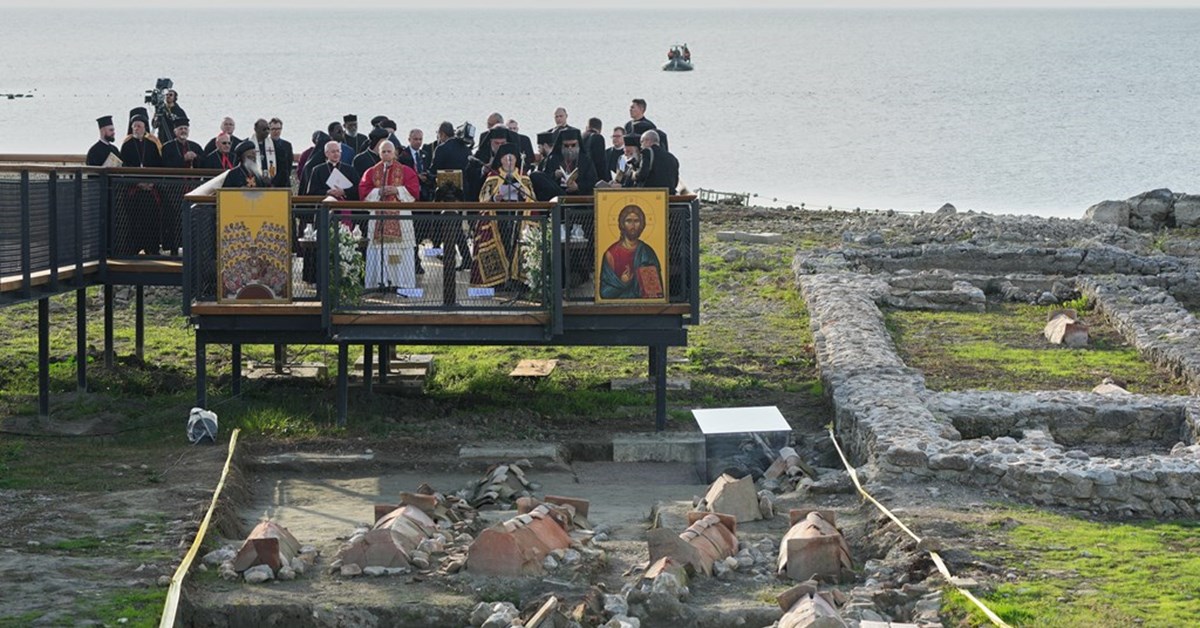
STANDING in Iznik, Turkey, last Friday, at what is believed to be the site of the First Ecumenical Council of Nicaea, which gave birth to the Nicene Creed, Pope Leo, the Ecumenical Patriarch, and other church leaders celebrated the Council’s 1700th anniversary (News, 14 November).
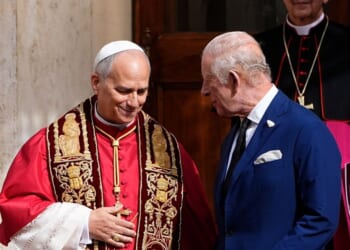
After a short procession next to the recently uncovered foundations of the ancient Basilica of St Neophytos, believed to stand on the site of the church that hosted the Council in 325, the Pope expressed his gratitude to the Ecumenical Patriarch, Bartholomew of Constantinople, for his “great wisdom and foresight” in offering to commemorate this significant occasion jointly there.
The Pope suggested that the longing for full communion among Christians was inherently connected to “the search for fraternity among all human beings”. He urged everyone to “overcome the scandal of the divisions that unfortunately still exist, and to nurture the desire for unity for which the Lord Jesus prayed and gave his life. The more we are reconciled, the more we Christians can bear credible witness to the gospel of Jesus Christ, which is a proclamation of hope for all.”
On the shores of Lake Iznik, the church leaders, including Armenians, Copts, Protestants, and Anglicans, participated in an ecumenical prayer.
In his welcome, Patriarch Bartholomew said that the joint commemoration was not only about remembering the past, but was to “bear living witness” to the faith upheld by the Fathers of Nicaea.
Before visiting Turkey, in his first international trip, Pope Leo had issued a new apostolic letter, In Unitate Fidei (“In the Unity of Faith”), focused on retracing the path to unity, once visible to all Christians.
“The Nicene Creed does not depict a distant, inaccessible, and immovable God who rests in himself,” the letter says, “but a God who is close to us and accompanies us on our journey in the world, even in the darkest places on earth.”
The letter, in 12 sections, describes the Creed as a “basis and reference point for [a] journey” of unity and reconciliation by all Christians.
The papal visit, originally to be made by Pope Francis last spring, was postponed owing to the late Pope’s ill health.
On Saturday, his successor visited St George’s Patriarchal Church, Istanbul, where he attended a doxology with Patriarch Bartholomew and signed a joint declaration to strengthen unity and work towards the restoration of full communion between them.
“Following the example of our venerable predecessors, and heeding the will of our Lord Jesus Christ, we continue to walk with firm determination on the path of dialogue, in love and truth (cf. Eph 4:15), towards the hoped-for restoration of full communion between our sister Churches,” the statement read.
The declaration also expresses a shared desire to agree on a common date for Easter.
After his four-day trip to Turkey, the Pope flew to Lebanon for the second leg of his tour. Roughly one third of the 5.7 million population are Christian; most of them belong to the Maronite Church, which is in full communion with Rome.
Speaking to journalists on his flight to Beirut on Sunday, the Pope said that he had discussed current peace efforts in Gaza and Ukraine with the President of Turkey, Tayyip Erdogan, noting Ankara’s capacity to play a greater part, given its ties with Kyiv, Moscow, and Washington.
The Vatican continue, the Pope said, to support a two-state solution for Israel and Palestine, which he described as “the only solution” for a lasting resolution to the conflict.
The Pope also referred to the continuing diplomatic efforts in Ukraine, noting that concrete peace proposals were now on the table.
“Blessed are the peacemakers” is the central theme of the Pope’s visit to Lebanon, which faces ongoing instability. A recent Israeli air strike on an block of flats in the southern suburbs of Beirut killed a Hezbollah senior member and four others, despite a ceasefire agreement signed last November.
In Beirut, the Pope told Lebanese authorities that peace came when people looked beyond their divisions and continued in dialogue. “Peace becomes that abundance which will surprise us when our horizons have expanded beyond every wall and barrier,” the Pope said. “Mutual dialogue, even amid misunderstandings, is the path that leads to reconciliation.”