THE Book of Kells is an illuminated Gospel book of indeterminate date and authorship which is currently housed at Trinity College, Dublin. Recently, it has been digitised, making it possible to make sense of many of the pages referenced by Victoria Whitworth in her close reading which appear without accompanying illustration or, more irritating, are separated from the relevant text; the famed Chi-Rho page (f.34r) is illustrated in full at page 192 (without an index entry) but not discussed until pages 231-34.
When was the volume compiled? We are only left to think between 750 and 820. Where was the book written? We do not know, but Gaelic Scotland (Iona), Pictish Scotland (Portmahomack), or Northumbria (Lindisfarne) are suggested.
Was it the work of one scribe, using multiple writing styles, or of two or more? We do not know. Whitworth inclines to recent scholarship (2015, Donncha MacGabhann) that argues for two, a “Master-Artist” and a “Scribe-Artist”. The quite different artistic styles of the four-symbol pages that precede three of the Gospels (Matthew at f.27v, Mark at f.129v, and John at f.290v; Luke’s is missing) might encourage readers to think that more than two hands are at work.
And what was it for? Processional display or monastic use? We do not know; the vellum is inferior to that of the Lindisfarne Gospels and it appears not to be an obvious text for lectio divina. Lindisfarne preserves the Jerome/Damasus Vulgate (c.400) throughout, but Kells has unexplained variant readings from both the Vulgate and the widely received Latin Old Version, especially in Matthew.
Interpolations occur at the conclusion of the longest parable (chapter 25, 45) and, in the Institution Narrative, the sacred words at the breaking of the bread are amended (chapter 26, 26). Why and by whom?
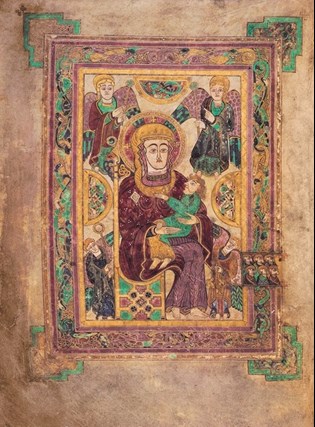 EVANGELIAR VON KELLS, FAKSIMILE VERLAG, LUZERN, 1990Madonna with Child, with angels, on f.7v of the Book of Kells. From the book
I was disappointed to find no mention of Coptic art or consideration of what might link the decorative design of Kells (and other Insular Gospel books) with Egypt. The fifth-century chapel interior of the Coptic Red Monastery at Sohag would have been well known to Irish monks visiting Upper Egypt.
The elements of knotwork, interlacing, zigzags, and rich colouring, as well as the hieratic pose of the saints, are common to both. Might this explain the pose of the Virgin and Child (f.7r), said to be the earliest image of the Virgin in a Western manuscript? Archaeological evidence shows that Coptic monks lie buried in Ulster, and there is literary evidence that guidebooks to the Holy Land and Egypt were available to Irish monks.
An assiduous publisher would ensure that a corrected paperback edition, with identifying figure numbers for the copious illustrations, appears in time for Ireland’s presidency of the European Council, even if this author does not resolve the enigma.
Canon Nicholas Cranfield is the Vicar of All Saints’, Blackheath, in south London.
The Book of Kells: Unlocking the enigma
Victoria Whitworth
Apollo £35
(978-1-78854-180-0)
Church Times Bookshop £31.50