THE impact of the Tudors on Wales, England, and Europe is known to every school pupil in Britain: King Henry VIII and his succession of wives, his part in the Reformation that spilt the continent, and the Church of England that emerged from and has somehow survived these turbulent beginnings.
Visitors will soon be able to see where it all began, in the 1400s: the family church of the Tudor dynasty. No need to book, queue, or register months in advance: the medieval St Gredifael’s, Penmynydd, on Anglesey, is to become the newest addition to the collection of buildings maintained by the Friends of Friendless Churches (FoFC). Yet this marks a big improvement in the church’s fortunes: it has been closed for more than ten years. The FoFC, with the help of an anonymous benefactor, are to carry out repairs and reopen it for visits and occasional acts of worship.
Wales’s religious heritage is disappearing, or being sold off, at possibly the fastest rate since the Reformation. According to the National Churches Trust (NCT), 25 per cent of historic churches and Nonconformist chapels in Wales have closed in the past decade. The National Churches Survey, published by the NCT in October, found that those who ran nearly ten per cent of places of Christian worship in Wales believed that they would “definitely” or “probably” not be open for worship in five years’ time.
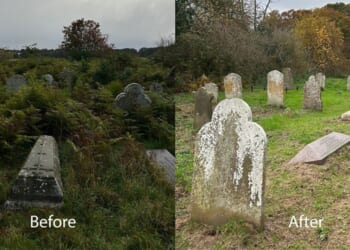
Dwindling congregations and soaring maintenance bills have resulted in congregations’ merging, relocating, or closing their buildings, and the auctioning or demolition of churches. A handful, such as St Gredifael’s, are saved by heritage charities such as the FoFC.
The collapse of weekly worship patterns has been felt in Wales especially acutely. Yet what is risk is more than bricks and mortar, pulpits and fonts. “Much of Wales’s cultural memory is in danger of being forgotten,” the NCT warns. A rich chapter in Welsh history could be lost unless deliberate steps to safeguard it are taken now.
Last year (News, 12 September 25), the chief executive of the Royal Commission on the Ancient and Historical Monuments of Wales (RCAHMW), Christopher Catling, declared the situation “the biggest crisis since the Dissolution of the Monasteries in terms of the potential loss of this massive, extended collection of architecture and art, from stained glass and textiles to sculptural art and monuments”.
What is at risk is not the “great works of art”, Mr Catling says, but the totality — items such as a Mothers’ Union banner from the 1930s — that collectively make up what he calls “a resource for writing the history of Britain”.
WHEN Henry VIII ordered the monasteries dissolved, many ecclesiastical treasures ended up in private hands. The transfer today is more gradual. Many buildings and their contents have also entered into private ownership, and the journeys of such artefacts are traceable online.
If a congregation is shrinking and cannot see a future for itself, closing its church is a last resort, the director of property services for the Church in Wales, Michael Plane, explains. Such a building could become a pilgrim church that is left open and hosts up to six services a year; it could be used for worship by another recognised Christian denomination; or it could be converted into community facilities, homes, or a business space.
“Over the past ten years, 101 former Church of Wales churches have been sold, either freehold or on a long-lease arrangement,” Mr Plane says. The decision is the congregation’s, after a process of discernment with their archdeacon.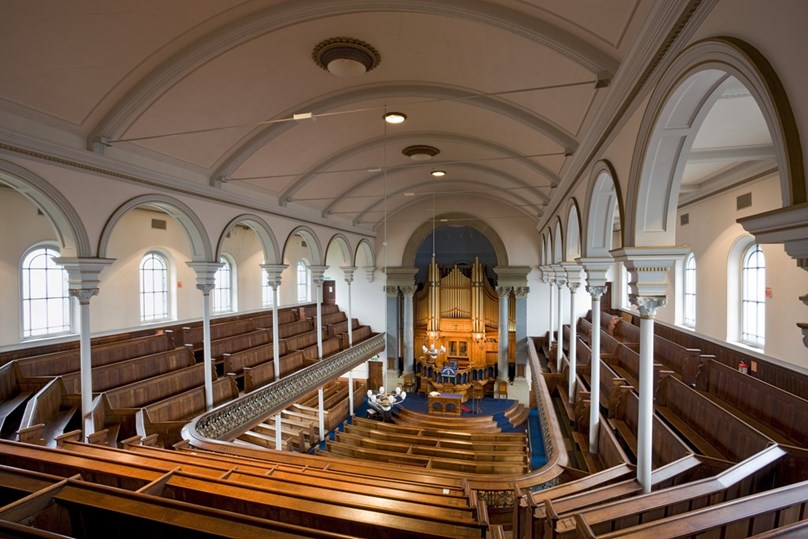 © Crown Copyright: Royal Commission on the Ancient and Historical Monuments of WalesZion Baptist Chapel, Newtown, is one of a few Grade II* listed chapels in Wales. Designed by George Morgan of Carmarthen and opened in 1883, the building was fully surveyed by the Commission in 2024 before the chapel was sold at auction. The project seeks to ensure that opportunities for such recording work are made more widely available
If the building is not going to be reused as a place of worship, a dismantling begins: the lectern, altar, or war memorial could accompany the worshippers to the congregation that they are joining; the organ could find a new home through the charity Pipe Up; a ring of bells could go to another parish. “The registers go to the nearest open church. The ancient registers go to the archives office. . . We make sure that everything has as much opportunity to have an ongoing life as possible.”
Of the sacramental items, “if an altar table isn’t going to be used any more as an altar . . . we would normally take the approach of, ‘Does somebody want to buy it?’” Mr Plane says. Parishes are urged to pursue the best price. “EBay, or similar auction sites, are an acceptable alternative.” The money that the Church in Wales receives from closing a church helps other churches to stay open. And, even if it is an online buyer or a reclamation site, the process involves recording where items end up.
Removing fittings from a listed church or chapel requires permission from Cadw, the Welsh Government’s heritage office. Taking them from an unlisted Church in Wales church still requires adhering to the Church’s stipulations about disposal.
Although there are detailed procedures to follow, the question where items end up is a problem, Mr Catling says. “There’s a limit to how many chalices you need. . . Increasingly, the inventories tend to be saying things like, ‘Will remain in the church.’” But if the church is to be developed, such objects either get sold by the developer or end up in a skip. “It breaks my heart,” he says. The items that he describes as having “real value” are the stained glass or the memorials, which are location-specific.
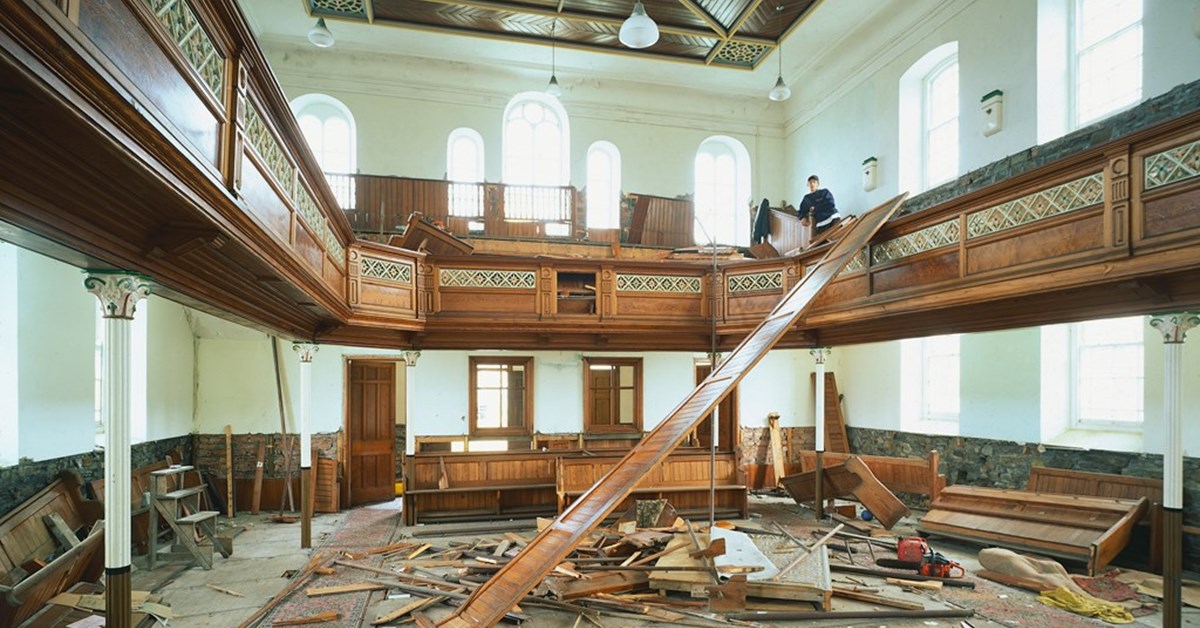
WHILE some fixtures and fittings may go to another congregation, plenty do not: reclamation websites offer religious items from hymn boards to pulpits and balconies. Rikki Gallop, the director of Gallops Architectural, in Crickhowell, Powys, says that his firm has dismantled interiors of chapels and churches and upcycled or sold the timber. He has also sold gargoyles, doorways, mouldings, and carved stonework. Most items date from the turn of the past century; fonts go for £400 to £800, and tend to end up in people’s gardens.
Meanwhile, at least £450,000-£500,000 of the Church in Wales’s money is spent each year on insuring and maintaining its 90 closed churches, and inspecting them every month to ensure that they are safe. They sell them on long leases with lease clauses in place, or freehold with covenants in the sale documentation and deed of transfer, to ensure that the buildings cannot be put to inappropriate use.
A thorough prune of churches and chapels in Wales could be seen as a long-overdue acknowledgement of social changes that happened decades ago. But the buildings, for all their costs, have an ongoing significance. “For those of us who aren’t from a gentrified background, the only places that you can actually go and tangibly sense where your ancestors were baptised or married, or eventually buried, is in the body of their local parish church,” says Mr Gallop. “Church in Wales churches hold the stories of all people in those villages and communities, going back as far as you can go.” They are a democratic social history of the country, which is “unique, but incredibly fragile”. Shutting a church feels like a bereavement, he says.
WELSH chapels have their own story to tell, be they Calvinistic Methodist (later the Presbyterian Church of Wales), Wesleyan Methodist, Baptist, Independent, or part of smaller denominations. “Wales really took on Nonconformity in a way that nowhere else did,” Susan Fielding, the RCAHMW’s senior investigator for historic buildings, says.
The influence of Nonconformity in the 19th and 20th centuries extended into education and political, cultural, and social history, she says. In addition to the Sunday services, there were debating societies and scripture groups that demanded literacy and biblical understanding. “They offered something pretty much every single night of the week. There were things for people of all ages,” Ms Fielding says.
The tight-knit community that this created was strengthened by chapels’ use of the Welsh language at a time when the official language of Wales and the workplace was English. “They were very involved in the development of trade unions; they very much worked on behalf of the working man,” she says.
Dr Tanya Jenkins, trust manager of the charity Addoldai Cymru (the Welsh Religious Buildings Trust), says that one of the 11 redundant Welsh chapels that her charity looks after contained a bust of Karl Marx; another had a library containing the Qur’an. Nonconformity played a “huge part” in the success of the Liberal Party in Wales, she says, and, musically, the chapels were a seedbed of hymns and choirs, of singing festivals and eisteddfodau (arts festivals).
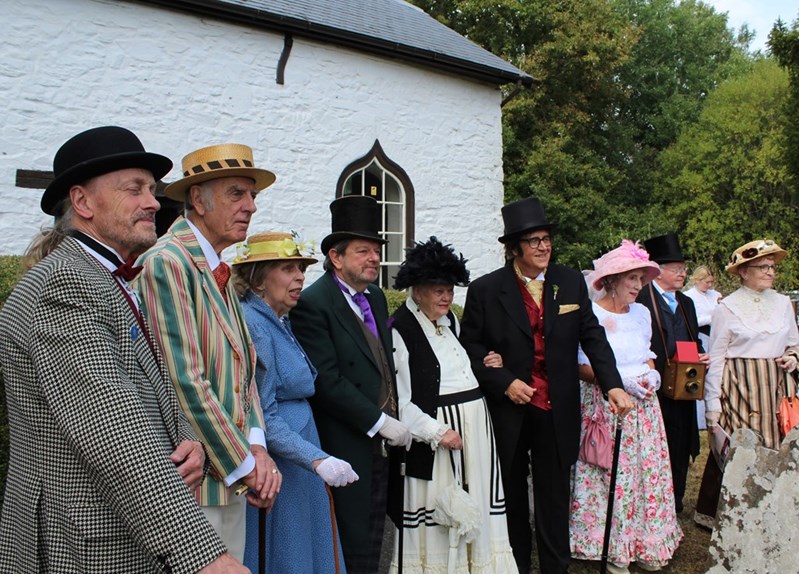 Sue ColeCaebach Chapel, Llandrindod Wells, in Powys, pictured in the background, is in the care of Addoldai Cymru, and hosts a service on the final day of the town’s Victorian Festival each year — for which those attending come suitably attired — as well as services at Christmas and Easter
Welsh Nonconformity boosted the cause of Welsh nationalism through the influence of Liberal politicians such as David Lloyd George. One casualty of this, however, was the part of the Church of England which would form the Church in Wales, in 1920. A that point, it was shorn of its legal status and much of its income: it was disendowed of monies, which were diverted to secular bodies, and it could no longer collect tithes.
Welsh Nonconformity and chapel attendance has been declining since the 1950s, however, and an oft-repeated statistic is that one place of worship closes every week. Ms Fielding says that the commission’s database so far counts 6484 chapels, or closer to 10,000 if you include those built on the site of an earlier one. Of these, “maybe 1500” are open today. Some chapels were originally built not because of high worshipper numbers, but because of splits within congregations. Mr Gallop sounds a pragmatic note. “There were villages in the South Wales valleys that had four; it’s unsurprising they’ve become defunct.”
Chapels have been overlooked by heritage experts because, Ms Fielding explains, they have been considered “the poor relation of heritage” — dating only from the 18th or 19th centuries, being “a mishmash” of styles, and having been designed and built by the congregation or minister. Chapel theology ruled out murals or carved fonts that would years later attract the attention of the heritage sector. (Some 73 per cent of open Church in Wales churches are listed; only 47 per cent of functioning chapels are.)
TODAY, shrinking chapel congregations are especially vulnerable. Chapels tend to be sold freehold. Their congregation may be unable to afford legal advice and may not want to make the building look unsaleable. One former chapel in Carmarthenshire has been reopened as a museum of the paranormal. Restrictive covenants are sometimes used, but Ms Fielding is aware of “far more chapels which have been converted to nightclubs, bar, restaurants and so on”.
Estate agents’ websites list former chapels, sometimes for less than £50,000, owing to high ongoing costs. The chairman and director of the auctioneers and estate agents Halls, Allen Gittins, says that every year his firm sells at auction five or six Welsh chapels, which may be converted for residential or office use.
“A number of the chapels we sell have the pulpit, altar, and balustrades still in situ,” he says. Residential conversions often keep these, “to retain the original feel”. Rural chapels can require a lot of work: “They generally don’t have any form of heating, but sometimes have mains water, electricity, and drainage,” he says.
Taller chapels may accommodate a second floor, or a mezzanine, and a Sunday-school room provides more usable space. Chapels, he says, “look good value for money, and they’re very often in nice, rural spots”. There is no public access once the chapel is sold, but, if there is a graveyard attached, its freehold will be sold at a peppercorn rent, and the new owner must maintain it for visitors.
Mr Catling acknowledges that there is an excess of churches and a ready market to repurpose them as much-needed housing. “The issue for me is access,” he says. “I don’t mind if a church is converted to an architect’s office, or a library, or whatever it be, provided that people who would like to get access to study it, or just to enjoy it, can do so.”
Helping older places of worship to open their doors to visitors is viewed as important by the heritage sector. NCT has teamed up with the Welsh Government’s tourism office, Visit Wales, to add notable churches and chapels to hiking routes. Mr Catling says that those who have welcomed visitors have found warm reactions from locals who had never ventured in before, and from members of the diaspora “who want to see where their great-grandparents are buried”.
He also favours organised tours to places of worship, and bookable experiences such as kayaking around Anglesey and visiting its churches, which were halted by the pandemic, and congregations’ working with communities to find extra uses for the building, such as hosting “choirs, crèches, nurseries, shops, post offices, and cafés”.
Mr Plane says that the arrival of an energetic new archdeacon or priest sometimes prompts a congregation to request that a church be reopened: three, he says, have reopened in the past year.
A few buildings have been “saved” from developers because of their historical significance, although their future still has to be worked out. Take the chapel where the hymn tune, latterly a rugby anthem, Cwm Rhondda (“Guide me, O thou great Redeemer””) was first heard. After the proposed sale of the Grade II listed Hopkinstown Chapel in Pontypridd reached the news, including Radio 4’s Today (News, 1 August 2025), donations totalling £72,300 poured in — more than the £47,500 required to buy it from the Baptist Union of Wales.
Yet, even when local surveyors and architecture students at Cardiff Metropolitan University are offering their services for free, and local solicitors are offering theirs at a reduced rate, a further £180,000 will be needed for repairs. Rhian Hopkins, a local resident who is co-ordinating the chapel project, is now looking into Welsh Government and NHLF grants to cover the extra costs.
Ms Hopkins and four others have registered as a private limited company, whose objectives include celebrating the chapel’s heritage, encouraging the use of Welsh, and providing a space for community well-being and local businesses. Uses could also include hosting occasional religious services.
Another church linked to the rousing melody, however, is not faring so well. The Welsh words most often sung to the Cwm Rhondda tune, “Wele’n sefyll rhwng y myrtwydd”, were written by the religious poet Ann Griffiths (1776-1805), who is buried in the graveyard of St Michael’s, Llanfihangel-yng-Ngwynfa, in Powys. Last year, a petition to halt its sale gained more than 1000 signatures. The Church in Wales agreed to postpone auctioning it so that further discussions could take place.
But, Mr Plane explains, the petition hasn’t led to any material outcome. Ann Griffiths’s story is told a few miles down the road, in the Ann Griffiths Memorial Chapel, which reflects her shift to the Calvinist Methodist movement. “We have to find a new use for it,” says Mr Plane, speaking of St Michael’s. “We inspect it every month, we still have to insure the building, and that’s several thousand pounds a year. . . The Church in Wales doesn’t have the resource to open it up as a heritage site.”
WHERE visiting is no longer possible, heritage experts can create a public record by carrying out a state-of-the-art survey before a sale. Ms Fielding was part of a team that visited the landmark Zion Baptist Chapel, in Newtown, Powys, before it was sold by Halls at auction in autumn 2024 to a buyer who wants to turn it into “a people’s palace”.
The team carried out a full photographic survey of 380 images, a photogrammetric survey using a drone, and laser-scanning of the chapel inside and out, publishing the results online. Her team, however, can carry out only about four or five such labour-intensive surveys a year.
It is hoped that data on more chapels will be captured by the Royal Commission, thanks to a £150,000 NLHF grant to bring together denominations and congregations, conservation and planning officers, architects, museums, archives, and heritage organisations to develop strategies for protecting chapel heritage. This could then lead to a further £1.25-million grant to carry out a national survey that would map active, closed, and converted chapels, capturing data on their sustainability, architectural value, and the status of nationally protected heritage assets.
The charity Addoldai Cymru already has a list of 140 Grade I and Grade II* listed chapels most deserving of preservation as chapels, and uses criteria defined by UNESCO to rank their architectural or historical significance, so that resources can be prioritised for them, should they be declared redundant. Because of the current rate of chapel closures, “more iconic buildings are now becoming redundant, but funding constraints curtail the number of buildings we are able to acquire,” Dr Jenkins says.
Like Addoldai Cymru, the FoFC want to save places of worship from disappearing into private hands. The Church in Wales discusses with the FoFC and Cadw any listed closed or closing churches, and the FoFC determine which buildings are a priority for them. They look after churches that are “redundant, remote, and remarkable”, and half their buildings — 36, including St Gredifael’s, Penmynydd — are former Church in Wales churches.
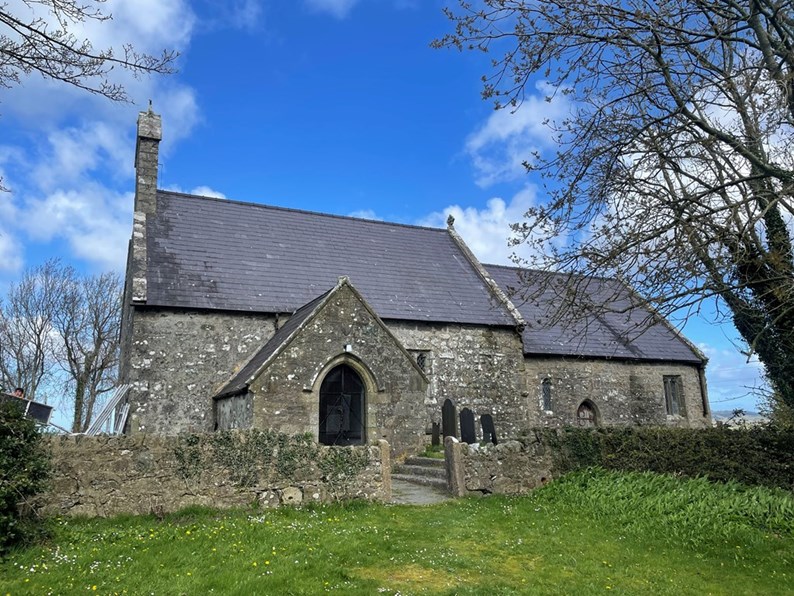 Michael PlaneSt Gredifael’s, Penmynydd, on Anglesey. The trustees have recently agreed to transfer it to the care of the Friends of Friendless Churches
The churches, complete with fittings, are handed to the FoFC, who restore them and reopen the buildings with the help of local volunteers. The buildings remain consecrated and can host up to six services a year, for life events or festivals. The deputy director of the FoFC, Agata Eltman, says that some of their churches are too remote for repurposing as a community centre. “They fulfil their function just by existence,” by offering a place “just to go and just be”, she says.
There is scope for more collaboration among those batting for Welsh religious heritage. Mr Catling sees a need for a top-level commission of church and state stakeholders to develop a national strategy for the future of churches and chapels. He describes the status quo as “very messy, very random”.
Meanwhile, if some heritage items end up on a reclamation site, this may not signal a congregation’s demise. Mr Gallop says that he sold a carved oak roodscreen for a church that was partitioning off an area for midweek activities — and it was bought as a theatrical prop. Pews are sometimes sold by congregations who want to install carpets and stackable chairs to make their church or chapel more inviting. Fixed seating, he says, harks back to the days when they it was designed to keep people sitting upright. Ms Fielding says that the Commission wants to help people to get away from the view of chapels as “dour places” and to remember the social and cultural life that they offered.
It seems inevitable that many leaky buildings will have to be repurposed or sold while experts work to devise a national strategy to identify and safeguard the most important buildings and stories. That a medieval church of national, even international, significance should be classed as “friendless” jars, as does the Church in Wales’s having to spend hundreds of thousands of pounds of its annual budget on unused buildings.
Promoting the cultural memory of churches and chapels in Wales as places of heritage, community, and empowerment could enable their spiritual legacy to benefit and inspire those around them.