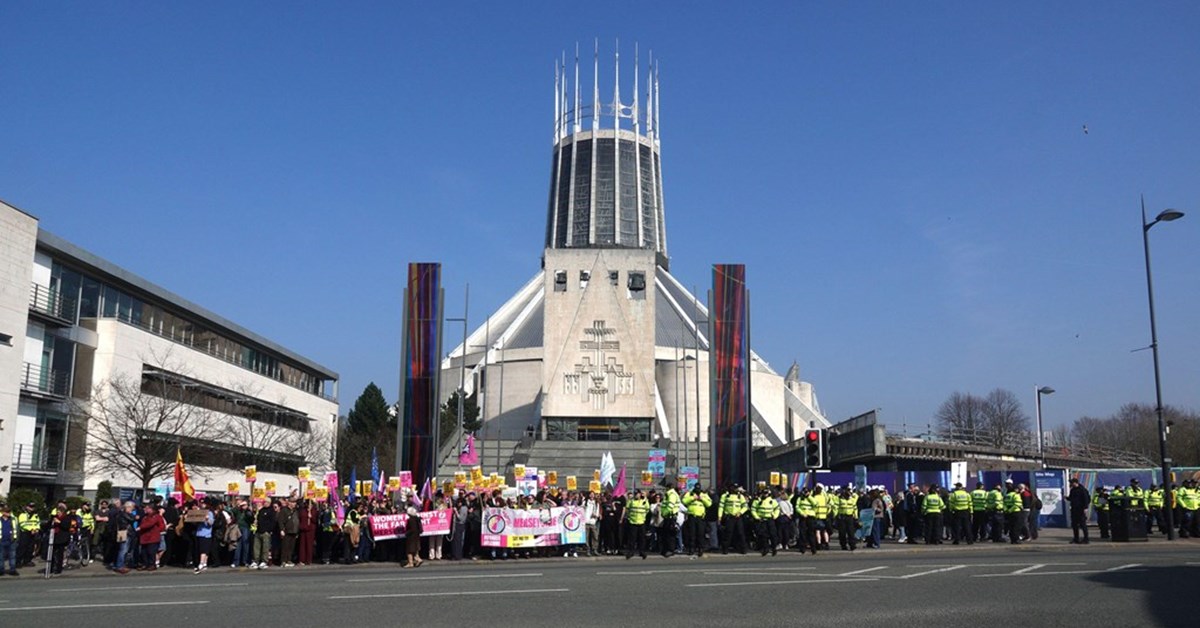
HUNDREDS of anti-racist counter-protesters effectively thwarted a UK Independence Party (UKIP) “Walk with Jesus Rally” in Liverpool on Saturday. Church leaders from across the city had condemned the planned rally (News, 19 March).
UKIP had invited its supporters to “Stand for Christ in Liverpool during Lent”. But a counter-protest, organised by Merseyside Stand Up To Racism, gathered outside the Roman Catholic Metropolitan Cathedral on Saturday morning, several hours before the UKIP rally was due to begin.
The Liverpool Echo reported that Nick Tenconi, the UKIP leader, arrived at approximately 12.45 p.m., and that at 1 p.m. there appeared to be about 50 UKIP supporters in attendance.
The newspaper reported that there were “a number of skirmishes, until police re-established a divide”. Merseyside Police said that six people were arrested, three of whom were taken into custody.
Chief Superintendent Zoe Thornton said: “As a police force, we must uphold everyone’s rights to protest peacefully, while also aiming to keep the peace and ensure the public are safe.”
The rally was announced by UKIP on social media on 23 February, and, on 4 March, the cathedral’s Dean, Mgr Anthony O’Brien, issued a statement saying that the cathedral had not given its permission for the rally to use its piazza.
The Interim Bishop of Liverpool, the Rt Revd Ruth Worsley, the Dean, the Very Revd Dr Sue Jones, and the Roman Catholic Archbishop, the Most Revd John Sherrington, were among the signatories of a joint statement in which the city’s churches distanced themselves from the event. “We wish to clearly and unequivocally state that this event has been organised independently of the recognised Christian community on Merseyside and resist any suggestion that it speaks on our behalf,” the statement said.
Also signed by Methodist, Baptist, Salvation Army, United Reformed, and Evangelical church leaders, the statement continued: “Liverpool has a proud history of resilience, solidarity and loving its neighbour. Often described as ‘the world in one city,’ it is a place shaped by generations of people from many nations, cultures and faiths who have built a shared life together. . . Our calling is not to sow discord, but to build bridges; not to exclude, but to welcome; not to inflame fear, but to practise compassion. . . At a time when voices of isolationism can seem loud, we have chosen to raise our voice for the common good.”