IN THE programme What Is Quantum? (Radio 4, 30 December), Marnie Chesterton travelled to the remote German island of Heligoland — worth a documentary in its own right — to get the world’s sharpest quantum physicists to explain their bewildering field in layman’s terms. They gather on the island because it was to here that Werner Heisenberg fled hay fever in 1925, so finding the space for fresh thinking that allowed him to rewrite the laws of physics.
Chesterton’s early declaration that “I’m not a physicist, but I’m not stupid” reflects most reactions to a branch of science that has proved successful in application, but frequently defies instinctive understandings of time, space, and causation. The editorial device was to allow her to ask only one question: “What is quantum?”
One lesson from the programme is that everything is entangled, in ways that are not yet explicable. This should influence how Christians talk about God.
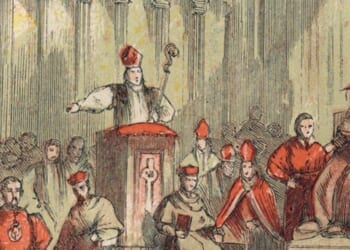
I’m always sceptical when Sunday Worship (Radio 4) is not an actual act of worship, but, none the less, I enjoyed the Epiphany edition, which explored the 500th anniversary of the Bishop of London’s burning of copies of William Tyndale’s New Testament outside St Paul’s Cathedral.
The Revd Dr Diarmaid MacCulloch, Emeritus Professor of the History of the Church in the University of Oxford, took a classic liberal Protestant view of those events, seeing Tyndale as primarily a liberator of the layman, ending the stultifying clerical intellectual stranglehold. Dr Paula Gooder took the Archdeacon of Liverpool, the Ven. Dr Miranda Threlfall-Holmes, to the Wren Library to see one of only three surviving originals of the Tyndale Testament, complete with tiny woodcut illustrations. We even had a trip to Cheshire to learn of Churches Together in Lymm’s Tyndale 500 Festival.
There were Bible readings, Christian music, and even the odd bidding, but this was actually a documentary. C’est magnifique, mais ce n’est pas la prière!
The Deputy Prime Minister and Justice Secretary, David Lammy, is one of several senior government figures to wear their devout Anglicanism on their sleeves. He related to Sunday (Radio 4) his parents’ journey around various denominations before settling in North London Anglo-Catholicism, which launched him towards becoming a Peterborough Cathedral chorister — one of the first Black choristers in the country — in the age of Aled Jones (Features, 17 April 2020).
Mr Lammy identified himself as a communitarian Christian Socialist in the tradition of R. H. Tawney. If there is a real vibe shift towards Christianity going on, then it is as visible as much in the comfort with which senior Centre-Left politicians such as Mr Lammy, Wes Streeting, and Sir Ed Davey discuss their faith, as it is in the high-profile conversions among right-wing intellectuals.
None the less, I think some bishops would be quicker to call out a politician’s claim that their Christian faith was a reason for advancing proposals as controversial as those to abolish most jury trials if it came from the political Right.