The following is an edited transcript excerpt from The Michael Knowles Show.
* * *
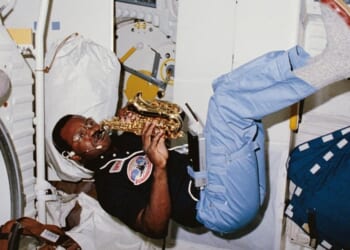
Val Kilmer is dead. Hollywood now wants to put him in another movie anyway.
Not through footage he had already completed. Not through a role he finished before his death. Through artificial intelligence.
We are told this is a tribute. It is not a tribute. It is necromancy.
Yes, necromancy. And no, that is not just a melodramatic way of saying I dislike the technology. Taking a dead actor, reconstructing his face and voice with AI, and then putting words in his mouth is not ordinary filmmaking. It is an attempt to conjure a human presence from beyond the grave. Not the man himself, of course, but his image, his shade, his likeness. That is exactly what makes it so grotesque.
I know the objection. No, it’s not. Necromancy would mean literally bringing someone back from the dead. This is just technology. This is just creating an image that looks and sounds like him.
No. That is not really what necromancy has ever meant in practice.
When people go to a psychic and try to conjure the dead, they are not expecting a flesh-and-blood man to walk back into the room. They expect a voice, a shadow, a movement, a shape, an apparition. They expect an image that gives the illusion of presence. That is what they are after. And that is exactly what this technology offers: not resurrection, but simulation. Not life, but a convincing imitation of it.

That is why the distinction does not save it. It condemns it.
A human being is not merely a face, or a voice, or a recognizable pattern of speech. A man is not reducible to a catalog of gestures and expressions that can be fed into a machine and reproduced on command. A man is body and soul. A body without a soul is a corpse. A soul without a body is a spirit. A digital imitation is neither. It is not the man. It is not Val Kilmer.
Val Kilmer lived, and then he died. That is the truth. And when you start creating AI performances that ask audiences to forget that truth, you are doing more than making a movie. You are teaching people to deny death.
That is one of the deepest temptations of modern life. So much of liberal modernity is about denying mortality, denying limits, denying the fixed realities of the human condition. It is about gathering to ourselves powers that do not belong to us. It is about pretending we can master time, history, memory, identity, even death itself. It is about maximizing human autonomy until man no longer receives the world as a creature under God, but tries to re-engineer it as his own private project.
Paramount Pictures/Sunset Boulevard/Corbis via Getty Images
That is what makes this more than a Hollywood gimmick. This is not just another strange special effect or another morally neutral technological advance. It is part of a much larger effort to flatten reality and replace it with manipulation. It invites us to believe that the dead are not really gone, that personhood is just data, that memory can be commercialized into presence, and that all boundaries exist to be crossed so long as the software is good enough.
And it will get good enough. That is part of the problem. If the technology improves, people will look at that screen and think, on some level, that they are really seeing Val Kilmer. Maybe not literally. Maybe they will know, abstractly, that it is AI. But emotionally, imaginatively, culturally, the effect will be the same. The dead man will appear to live again. And when that happens over and over, decade after decade, it will change the way we think about death itself.
It will teach us that death is not a real rupture, merely a technical inconvenience. It will teach us that the dead remain available for reuse. It will teach us that a person can be broken down into commercially exploitable fragments and then reassembled whenever a studio wants one more performance. That is dehumanizing enough when done to the living. Done to the dead, it becomes something darker.
We should not do this.
There are living actors — plenty of living actors. If you want a performance, go find a living man to give one. If you want to honor the dead, then honor them as dead. Remember them. Pray for them. Be grateful for the work they already gave the world. But do not digitally ventriloquize them and call it art.
And this applies beyond Hollywood. The same impulse that says we should build AI versions of dead actors is the impulse that refuses to accept mortality at all. It is the same impulse that wants to summon, recreate, simulate, and control what ought to be received with humility. It is the refusal to let the dead remain dead, and the refusal to let the living remain creatures rather than aspiring gods.
So no, I do not think this is harmless. I do not think it is merely clever. And I do not think Christians, or anyone with a sane understanding of human dignity, should shrug and accept it as inevitable.
Don’t talk to your dead father as though he were still here. Pray for him. Don’t ask a machine to conjure the likeness of the dead so that you can pretend mortality has no claim on us. Speak to the living. Love the living. Live among the living.
Leave the dead in peace.