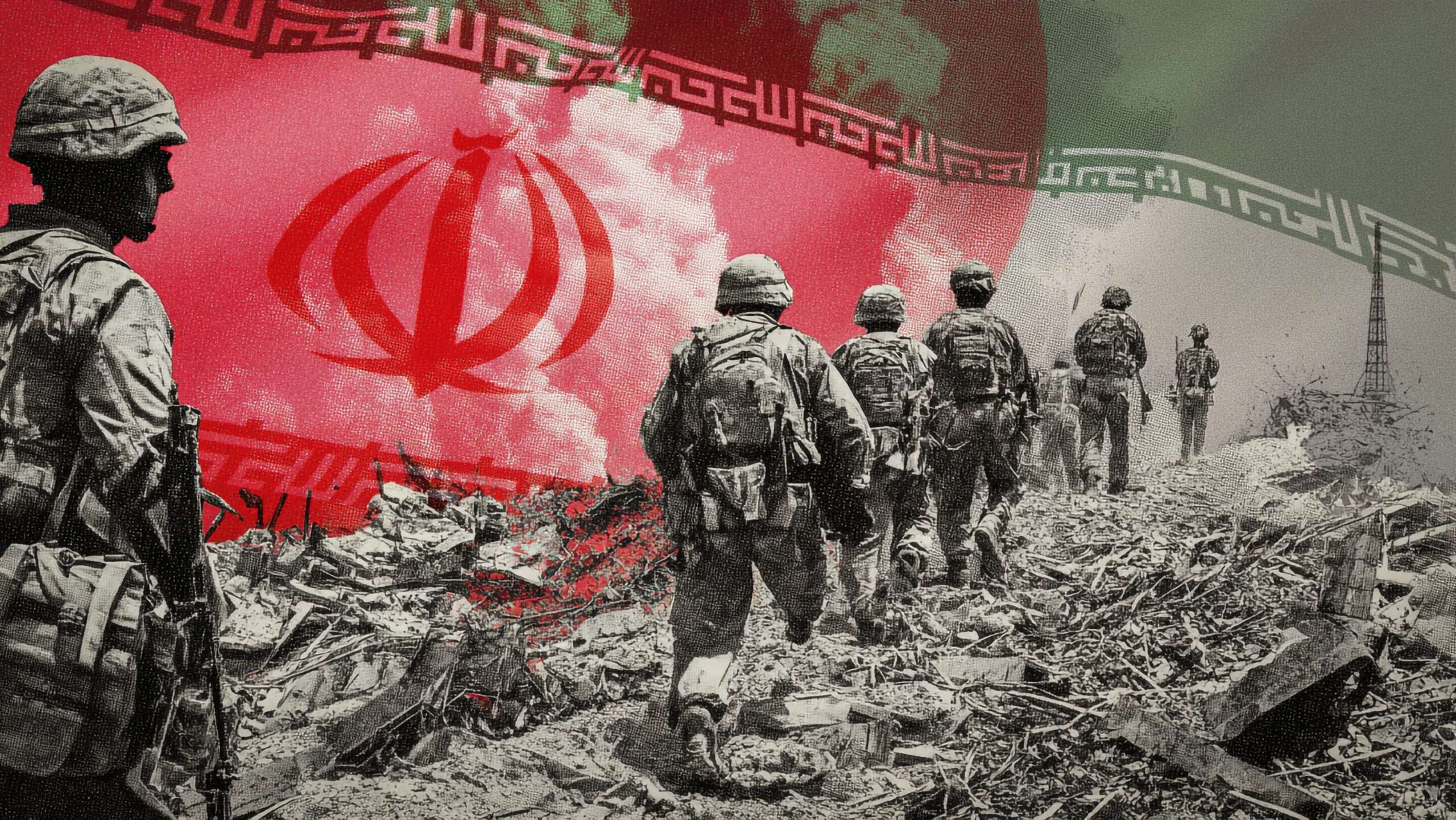
On February 28, President Donald Trump announced “major combat operations” to eliminate “imminent threats from the Iranian regime,” marking the beginning of a bombing campaign known as Operation Epic Fury.
April 29 will mark the 60th day of a war that Trump initially guessed would last only four to five weeks. Under the War Powers Act of 1973, the president must formally seek congressional approval for the war or request a 30-day extension. If he fails to do so, he is legally obligated to terminate all military efforts.
But there is a way around that political and legal problem: Avoid calling it a war. In the weeks since the bombing began, Trump allies have contorted themselves into linguistic pretzels to avoid using the dreaded w-word.
Calling it everything from “strategic strikes” to “combat operations,” Republicans have stopped short of deeming Operation Epic Fury an official war.
“I don’t know if this is technically a war,” said Sen. Lindsay Graham (R–S.C.). Graham, who has lobbied for war against Iran for decades, also told NBC’s Meet the Press that the current military goal “is to change the threat, not the regime”—whatever that means.
“We’re not at war right now,” said House Speaker Mike Johnson (R–La.), insisting that this existential battle has “a very specific, clear mission and operation.”
“I wouldn’t call this a war as much as I’d call it a conflict that should be very short and sweet,” said Sen. Tommy Tuberville (R–Ala.). Yet just a few seconds earlier, he stated, “This is not your Democrat war. This is President Trump’s war.”
The gold medal for verbal gymnastics, however, goes to Sen. Markwayne Mullin (R–Okla.). Mullin, whom Trump recently appointed as the new Homeland Security Secretary to replace the outgoing Kristi Noem, shrugged off a journalist’s question about the possibility of pursuing more diplomatic measures with Iran.
“This is war, and we are taking out the threat,” Mullin asserted.
Seconds later, another reporter asked the senator if he would concede that the United States is, indeed, at war. Mullin pivoted, saying, “We haven’t declared war.” When the group of reporters cited his original “this is war” statement, Mullin awkwardly acknowledged the discrepancy as “a misspoke [sic].”
The president has also had his own gaffes. Trump has routinely called this war an “excursion,” a phrase that implies more of a leisurely family getaway than a bombing raid. Trump likely means “incursion,” but correcting him is a “fool’s errand,” according to his aides.
To be fair, the Trump administration hasn’t entirely shied away from calling this a war. In fact, the word has appeared in countless briefings and press conferences. After all, this is the administration that successfully rebranded the Defense Department, returning the agency to its original—and more accurate—name: the Department of War.
However, the administration has struggled to define what kind of war this is.
Initially, it suggested this was a preemptive war. “If we didn’t preemptively go after them before they launched those attacks, we would suffer higher casualties,” said State Secretary Marco Rubio.
But then the rhetoric shifted toward something longer-term, but don’t you dare call it “regime change.”
“This is not 2003,” said War Secretary Pete Hegseth. “This is not endless nation-building under those types of quagmires we saw under Bush or Obama.” Hegseth also earlier asserted that the Iran war is “not a so-called regime change war.”
The administration’s hesitance to use the labels “forever wars” and “regime change” makes sense, considering Trump’s past dovish messaging.
“Great nations do not fight endless wars,” Trump said during his 2019 State of the Union address. “I’m not going to start a war,” declared the self-proclaimed “Peace President” during his 2024 victory speech. “I’m going to stop wars.”
But the president has been hinting at a war that sounds oddly similar to other yearslong boondoggles in Afghanistan and Iraq. Trump celebrated the Iranian war as “the beginning of a new country,” hinting at protracted occupation or regime change in Iran. According to him, regime change is “the best thing that could happen.”
And when questions arise about the scarcity of American munition stockpiles, he insists that there’s no end in sight. “Wars can be fought ‘forever,'” he posted on Truth Social.
Yet with no end in sight, the American mission in Iran remains unclear. Is the objective to simply destroy Iran’s nuclear capabilities, or will the Trump administration seek the unenviable task of rebuilding a completely toppled Iran?
Call it what you will, Operation Epic Fury—and its lack of clarity—thrives on these rhetorical acrobatics. The longer this war persists, the harder it becomes to pretend that it is simply a limited attack.
This intentional militaristic ambiguity is far from new. The United States boasts a long history of avoiding official declarations of war, as Reason jokes about in a recent video, “Is It War?”
The last time the U.S. formally declared war occurred on June 4, 1942, against Hungary, Bulgaria, and Romania—the lesser-known Axis-aligned countries. Ever since, U.S. presidents, eagerly seeking alternative legal routes to bypass Congress, have often twisted language to justify military aggression abroad.
For example, President Harry Truman called the Korean War a misnomer. “We are not at war,” he insisted during a 1950 news conference. (Can it truly be the “Forgotten War” if it was never a war in the first place?)
Instead, Truman framed the conflict as a “police action.” This rhetorical revisionism enabled U.S. military engagement to fall under the purview of the United Nations and its “collective security enforcement”—another altruistic-sounding euphemism that downplays the war’s 5 million deaths, most of which were civilians.
The war’s ending also lacked clarity. The Korean Armistice Agreement, signed by the United States (on behalf of the U.N.), China, and North Korea on July 27, 1953, only approved a ceasefire. South Korean President Syngman Rhee refused to sign because the agreement left the country divided.
Neither side signed a formal peace treaty. To this day, the conflict remains a tense stalemate between the two countries, divided by a 155-mile buffer zone inaccurately named the Demilitarized Zone (DMZ). Considering the sizable amount of landmines and troops fortifying the area, the DMZ is arguably the most militarized zone in the world.
The Vietnam War carried on this shifty linguistic tradition with its own deceptive origin. Again, Congress never declared war; instead, it passed a resolution based on a fictitious event. On August 4, 1964, the crew aboard two U.S. destroyers falsely claimed that North Vietnamese vessels had attacked them while gathering intelligence from the Tonkin Gulf, and the National Security Agency fabricated the evidence to back the falsehood.
President Lyndon B. Johnson (LBJ) reaffirmed the misinformation during a national address the following night, stating, “Two U.S. aircraft were lost in the action.” Making clear that he “seeks no wider war,” LBJ beseeched Congress to support his military efforts in the region, citing the Southeast Asia Collective Defense Treaty, which the U.S. Senate ratified in 1955, as the legal authority.
Two days later, Congress passed the Tonkin Gulf Resolution. The resolution granted LBJ the authority to “take all necessary steps, including the use of armed force, to assist any member or protocol state of the Southeast Asia Collective Defense Treaty requesting assistance in defense of its freedom.” It never mentions the word “war.”
Formal war declarations became increasingly problematic in the aftermath of the terrorist attacks on September 11, 2001.
The attack’s perpetrators, Al Qaeda and the Taliban, were non-state actors who had transcended the traditional machinations of warring nation-states. Congress seemed confounded about how to retaliate against an organization not beholden to a sovereign nation.
Enter the 2001 Authorization for the Use of Military Force (AUMF), a 60-word resolution granting President George W. Bush sweeping powers and absolving Congress of the responsibility of formally declaring war against a specific country. The AUMF nearly passed unanimously, if not for the sole dissent by Rep. Barbara Lee (D–Calif.).
Although initially focusing military operations in Afghanistan, the AUMF also became the legal justification for future military entanglements in Yemen, Somalia, Syria, Pakistan, and Iraq. The Watson School of International and Public Affairs found that the AUMF served as the legal justification for American counterterrorism operations in 22 countries. So long as the United States could link a territory to “associated forces” aiding and abetting terrorism, the AUMF provided the legal cover to attack it.
Not only did the AUMF’s ambiguous language allow American forces to go anywhere, but it also sanctioned a wider variety of tactics outside of the legal boundaries of international law. Formal war declarations against belligerent countries trigger international laws, such as legal protections for prisoners of war. However, under international law, the same protections don’t exist for non-state actors, allowing for indefinite detention, as is the case at the infamous military prison at Guantánamo Bay.
The Bush administration, slowly but surely, swapped the phrase “global war on terror” with “global struggle against violent extremism.” The semantic shift was likely a judgment call by Defense Secretary Donald Rumsfeld. “I don’t think I would have called it the war on terror,” he said during a 2006 interview. “Because the word ‘war’ conjures up World War II more than it does the Cold War. It creates a level of expectation of victory and an ending within 30 or 60 minutes of a soap opera. It isn’t going to happen that way.”
Even in the eyes of hawks, war is not a means to an end but rather a preferred state of being intended to carry on in perpetuity.
Few people are as qualified and well-versed in the deceptive language needed to justify war as former Vice President Dick Cheney.
“It’s one thing to adopt the euphemisms that suggest we’re no longer engaged in a war,” Cheney said during a speech that criticized President Barack Obama’s military strategy in the Middle East. “These are just words, and in the end, it’s the policies that matter most.”
Cheney is partially right. Scrutinizing language seems nitpicky compared to the actual policies that initiate and escalate wars of choice. However, dancing around the truth enables those in positions of power to forgo the minimal legal limitations that keep them in check.
This is why the Framers of the Constitution sought to curtail the executive branch’s authority to wage war. But the United States has drifted away from that framework, replacing formal declarations of war with open-ended authorizations that have weakened the constitutional balance.
Not only has Congress abdicated its constitutional role in declaring war, but it has also recently blocked legislative efforts to exercise it. This past month, three different resolutions to rein in Trump’s war powers in Iran failed.
That leaves the executive branch with broad room to wage war without clearly naming it as such. Once that becomes normal, the line between “operations,” “strikes,” and war itself grows easier to blur.