Satellite records indicate that there was a sharp uptick in global temperatures in 2023, followed by a steep decline by 2025:
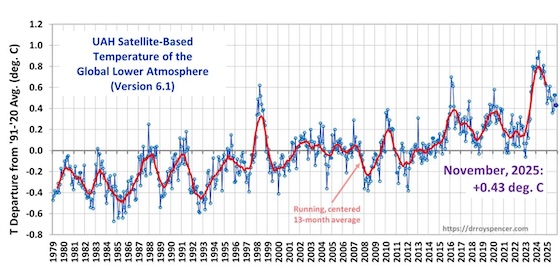
Warmists were ecstatic over the 2023 increase, which they attributed to “climate change.” (It makes no sense to say that a change was caused by change, but put that aside for the moment.) As to the subsequent decline, they were almost entirely silent.
It seemed obvious to me that the most likely explanation was the extraordinary eruption of the Hunga Tonga underwater volcano in January 2022. That eruption, unprecedented in recorded history, sent vast quantities of water vapor into the atmosphere. Water vapor is, of course, the principal greenhouse gas.
That hypothesis is confirmed in this article by Javier Vinos. It is long and detailed, but fundamentally it makes the point that an unprecedented leap in temperatures requires an extraordinary cause; while, likewise, the sharp subsequent decline must be accounted for and not simply ignored:
We have been fortunate to witness the largest climate event to occur on the planet since the advent of global satellite records, and possibly the largest event since the eruption of Mount Tambora in 1815. It is clearly a naturally occurring, externally forced climate event. However, mainstream climate scientists are not treating it appropriately. This is because climate science does not function like other sciences and is subject to strong confirmation bias. The first step to learning from the 2023 event is accepting its exceptional nature, which many fail to do.
***
According to Occam’s razor, a climatic event of unparalleled magnitude in modern records requires an exceptional cause. The factors responsible for normal climate variability are insufficient. The only extraordinary factor preceding the 2023 event was the explosion of the Hunga Tonga underwater volcano.
***
For anyone who is not committed to the explanation of climate change due to the radiative properties of greenhouse gases, the Hunga Tonga eruption is currently the best explanation for the 2023 climate event. In July 2025, I analyzed that “if Hunga Tonga is responsible for the 2023-24 warming event, a clear prediction is that we should observe most of this warming disappear in 3-5 years.“[21] This projection does not arise from any of the other considered causes. By December 2025, four years after the eruption, this prediction had come true: the ocean temperature anomaly in November was only 0.05°C higher than in November 2021, before the eruption. 90 % of the ocean warming from the 2023 climate event has disappeared.
Follow the link for details. The last lesson I would draw is that the climate science industry is not just misguided but dishonest. Its seizing on the warming of 2023 without making any serious effort to understand it, and its failure to acknowledge the sharp subsequent drop in temperatures, are indicia of a political, not a scientific movement.