(This is Part 3 of a multi-part series. Part 1: Why We Fight Iran; Part 2: Why We Fight Iran: It’s the Economy, Stupid!)
If you spend any time on X, you will be swamped by accounts claiming that the U.S. attacked the Islamic Republic of Iran (IR) solely because Israel demanded it. You will find these accounts on both the political right and left. Many of them are sponsored by Chinese, Russian, and even Iranian foreign governments. Many of them are run by individuals who are afflicted with, and/or playing to, antisemitism.
The lack of historical knowledge from these accounts is breathtaking. They ignore the fact, as I described before, that since 1979, when the IR seized American hostages, the IR has been at war against the U.S. The IR has killed over a thousand Americans, has conducted countless terror attacks on the U.S. and U.S. interests, has screamed “death to America,” has planned to kill an American president, and has threatened the world economy multiple times. These X accounts also pretend that President Donald Trump is an easily fooled/bullied figure who follows the dictates of Israeli Prime Minister Benjamin Netanyahu completely, despite demonstrated examples of Trump successfully pushing Netanyahu to do something against Netanyahu’s own interest, such as occurred with the IR and Qatar. And these accounts also ignore the long-documented record of the President’s disgust and distrust of the IR.
Finally, none of these accounts seem to be aware that the U.S. and, indeed, all nations, have a national interest in bolstering the interests and security of their allies:
The survival of U.S. allies… is a vital American interest because our allies’ destruction, desertion, or abandonment would dramatically weaken America’s ability to protect its citizens and their interests. U.S. allies likewise contribute essentially to the U.S. pursuit of each of the other four vital interests, though in today’s world, preventing the emergence of a hostile hegemon in Europe or Asia and preventing a hostile major power from controlling the seas are perhaps America’s most immediate concerns.
Supporting U.S. allies in their own conflicts will both encourage those allies to return the favor and incentivize other nations to join alliances with the U.S.
Alliances, however, can lead to war.
A perfect example of this occurred during World War I. In WWI, Europe was divided into two alliances, the Allied Powers and the Central Powers, and a single assassination resulted in a bloody war that killed tens of millions and devastated the continent:
The original Allied powers united because of a web of bilateral treaties activated in the wake of Austrian Archduke Franz Ferdinand’s assassination by a Serbian nationalist on June 28, 1914. In a domino-like chain reaction, Austria-Hungary declared war on Serbia (July 28); Serbia’s protector, Russia, mobilized its forces to defend Serbia (July 30); and Austria-Hungary’s ally, Germany, declared war against Russia (August 1), which also necessitated declaring war against France (August 3). Germany’s plan for fighting France required it to first invade Belgium (August 3–4). Great Britain was obligated to defend Belgium, so it responded by declaring war against Germany (August 4). And as an ally of Great Britain, Japan declared war against Germany on August 23.
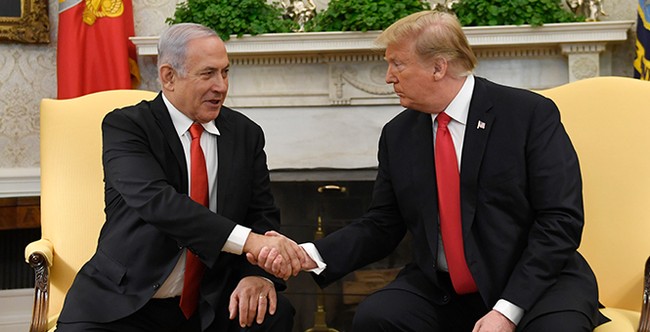
Today, the U.S. and Israel have an alliance. It is a unique alliance – “America does not exact hundreds of billions of dollars tribute to defend Israel the way it does with the wealthy Middle East clients, like the UAE, Saudi Arabia, and Qatar, but rather pays and arms her to help defend U.S. interests in the region.”
Israel has often defended U.S. national interests. In 1970, at the behest of the Nixon administration, Israel threatened Syria to cease its invasion of U.S. ally Jordan. In 1991, at the behest of the H.W. Bush administration, Israel did not respond to Scud attacks from Iraq during the first Gulf War so as not to threaten the coalition the U.S. had assembled with the Sunni Arab states. And in 2010, at the behest of the Obama administration, Israel agreed to a 10-month moratorium on “settlement” construction in Judea and Samaria—the first such moratorium since 1967—and backed the creation of a Palestinian Arab state.
So, in a Bizarro world where the IR never acted against U.S. interests, the U.S. would still have a national interest in supporting Israel in its conflict with the IR. Granted, the U.S. would probably not participate as strongly as it has here. But, as I said before, the U.S. is so deeply involved because other U.S. national interests also argue for the U.S. to degrade or destroy its enemy, the IR.
Therefore, the U.S. decision to attack the IR, targeting its troops and leaders for destruction, could deter, punish, and even destroy an enemy regime with a proven track record of killing or harming Americans, which certainly planned future attacks, and thus serves our national interest in supporting our strong ally Israel, which is also targeted by the IR.
Because of these three national interests, the U.S. has taken the lead in bringing the already declared war – in 1979, by the IR – to the regime of the Islamic Republic of Iran.
I hope this answers your question, Mr. Walsh.
Sincerely,
Adam Turner
PS: And there is one more thing to discuss. On January 2, 2026, after the Iranian protests against the IR had begun, President Trump wrote on Truth Social:
If Iran sho[o]ts and violently kills peaceful protesters, which is their custom, the United States of America will come to their rescue. We are locked and loaded and ready to go.
This was a “red line” set by President Trump.
After that post, the IR slaughtered at least 32,000 Iranian protestors.
The IR violated President Trump’s red line. If President Trump had not acted to enforce his red line, this would have dramatically weakened the U.S. and would have encouraged the IR and other hostile powers to test American resolve and create chaos and destruction throughout the world, which would be against the U.S. national interest.
And we know just how dangerous not enforcing a U.S. red line can be, Mr. Walsh. President Obama failed to enforce his 2012 red line concerning the Syrian regime’s use of chemical weapons. This demonstrated weakness supercharged the Islamist forces of ISIS and al-Qaeda. And it enticed our number one historical rival, Russia, to move into Syria.
Eventually, under new leadership, the U.S. was forced to intervene against ISIS to protect U.S. national interests. Under President Trump, during his first term.
And now, President Trump is intervening to protect the U.S. against an even deadlier enemy, the Islamic Republic of Iran.
Editor’s Note: For decades, former presidents have been all talk and no action. Now, Donald Trump is eliminating the threat from Iran once and for all.
Help us report the truth about the Trump administration’s decisive actions to keep Americans safe and bring peace to the world. Join RedState VIP and use promo code FIGHT to get 60% off your VIP membership.