AS LAST year’s now unimaginably dry spring was followed by a dry summer, the canals started to dry up — and the place to find water, but not too much water, was on England’s rivers. As we travelled up from Leicester on to the Trent, we knew that, to travel on a tidal river, an anchor would be essential, should, for any reason, the engine fail.
On the canals, travelling on still water, you are never more than a few feet from the bank. A tidal river, on the other hand, even without this winter’s exceptional rainfall, combines current with tidal flow and with wind. So we presented ourselves to the nearest chandler, and did the necessary calculations for a 58-foot steel narrowboat, which amounts to 17 tonnes to be held against wind and tide. They handed over a 20kg anchor, and another 20kg of chain: ten metres in all, with a further ten of rope.
The man behind the counter did his best to make the anchor more accommodating. He taped the hinged Danforth design so that you could lift it without the anchor breaking open, to maximise its hold. He sold us a rubber mat that we could lay it on so that it wouldn’t damage what was beneath. And he suggested that, if we borrowed an angle-grinder, we could cut off the crosspiece to make it more compact. It turns out that cutting into tempered steel is neither simple nor safe; so the anchor remains in its original configuration.
WE STAGGERED back to the boat and stowed it in the cratch — the seating area at the bow — where it takes up the whole side. I don’t want it there, but there is nowhere else to put it. From that place, it can be lifted into the water within a matter of seconds. When that happens, it will take half the paintwork off the side of the boat on its way down. I will have to stand clear to avoid being dragged over as the chain runs free. Once it’s over the side, I don’t know whether I will have the strength to pull it up again.
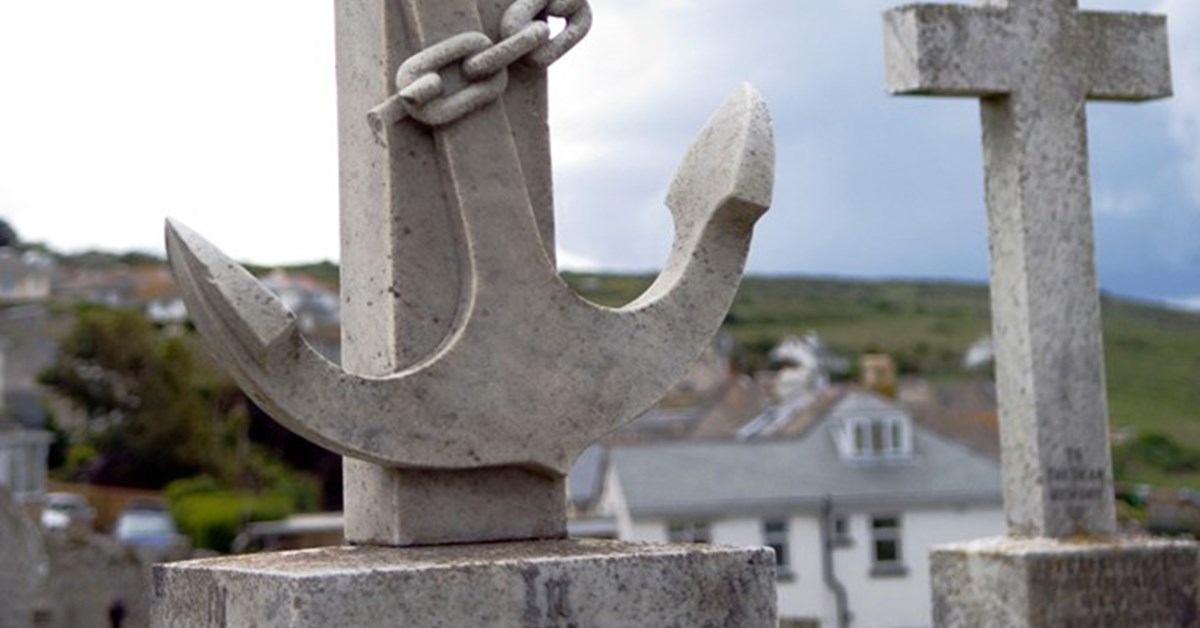
Everyone on the river has got an anchor. Everyone knows someone who has had to drop anchor to save themselves and their boat from being swept over a weir, or into a wall. My anchor has one purpose, which is to save my life. It occurs to me that this anchor is a lot like the cross: not wondrous, but brutal; less iconic than effective.
IN OUR churches, we have done our best to make ourselves comfortable with the cross. There is usually at least one cross within a sightline from just about anywhere in a church building, though time was when no Anglican church would permit such a symbol within a churchyard. I wear a cross. The liturgy reminds me what it was for, and who died on it. The repetition makes it familiar: it has become an accessory to faith.
The anchor is anything but that. The steel has not been finished or polished — why finish something which does its essential work in the dark? When I edge past it to pick up something, the crossbar glances against the back of my knee and tears the flesh open.
Its functionality is basic and dreadful: it is there to stop a 17-tonne boat dead in the water. There is no accommodation for anything else. It occurs to me that, when we focus on the person of Jesus on the cross and on his suffering, we can forget the functionality of the cross that killed him. The first Christians were not so distracted. Paul instructs the Ephesians to take the accusations flung at them by the powers and to nail them to the cross. The cross is a life-saver as well as a life-taker.
ON OUR way up the Trent before the Cromwell lock where it turns tidal, we paused in Newark. At a Sunday-evening service, the congregation sang confidently that their anchor held within the veil. It made me wince. My anchor deployed within the veil would shred it. Or is that the point of that odd, mixed metaphor from the Letter to the Hebrews? The veil needs shredding, and the anchor does that essential violent work.
I once heard a speaker claim that the cross stood at the centre of the Trinity — a startling image, which, at the time, I thought verged on the heretical. I saw the cross as a waypoint: a step on the path towards salvation. The anchor, ready at any point to save life, is closer to the speaker’s image: my God and my Saviour at the heart of the mystery.
John Griffiths is a Reader from St Albans diocese. He is somewhere on the waterways.