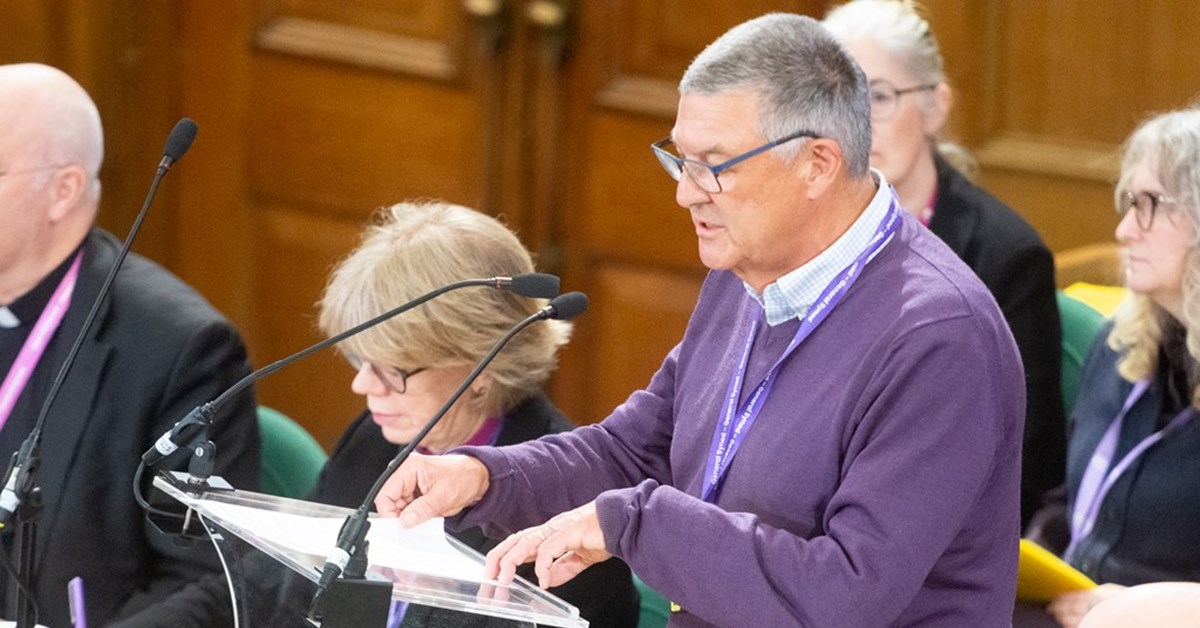
THE General Synod has recommitted to ending poverty in the UK, after a debate in which members heard personal stories of those who felt “hopeless and abandoned by society — and maybe even by God”.
The motion was moved by Mark Sheard (Archbishops’ Council), who reminded members that they were revisiting a debate at ran out of time at a meeting of the Synod last year. It had been led by the Church Urban Fund to mark the 40th anniversary of the Faith in the City report.
Mr Sheard urged the Synod “to be ambassadors of our Lord, who came to bring good news to the poor”.
He said: “The awful truth is that there are 14 million people living in poverty in our nation, one in five of our population. . . Each has their story, their own struggles, their own reason to feel hopeless and abandoned by society — and maybe even by God.”
The Revd Rachel Webbley (Canterbury) brought an amendment that would add a clause acknowledging how poverty affected people from ethnic minorities disproportionately. She urged the Synod to listen to those who had lived experience of racial patterns of poverty. “It is not about tokenism, it is about truth — allowing those who live in poverty to shape our response to it,” she said.
The Revd Andrew Mumby (Southwark) also urged the Synod to listen to those who had been systematically excluded. “Ending poverty requires us to confront its racialised nature,” he said.
Figures from the Runnymede Trust showed that Black-and minority-ethnic people were more than twice as likely to experience poverty, he said. “White poverty is devastating, black poverty is devastating, but, if we’re to do a thorough job . . . we have to listen carefully to the different causes of such tragic poverty.”
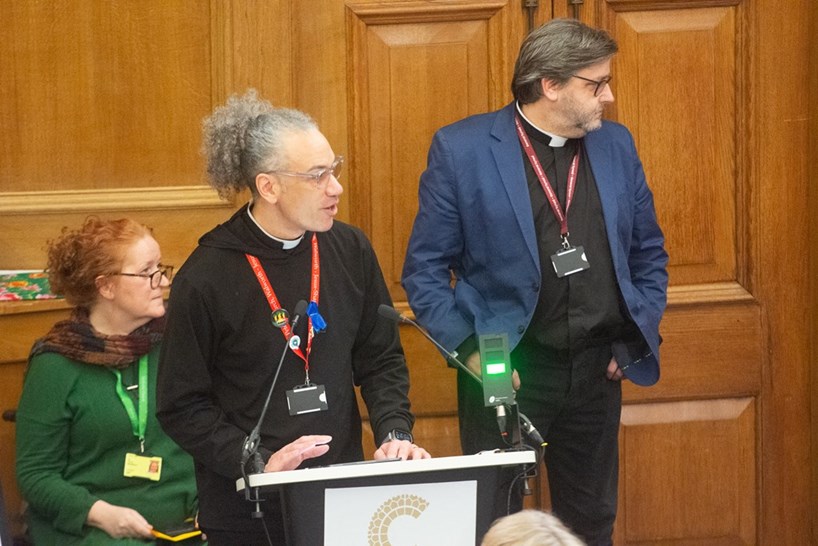 Geoff Crawford/Church TimesThe Revd Andrew Mumby (Southwark) urges the Synod to listen to those who have been systematically excluded
The Revd Alex Frost (Blackburn), however, spoke against the amendment. “Poverty is poverty,” he said. He emphasised that addressing poverty required action not just discussion. Telling people’s personal stories and speaking honestly could capture people’s imaginations, which, in turn, could inspire change, he said.
The amendment was carried.
Another amendment was brought by Emma Robarts (St Albans), which called for increases in national funding to provide more clergy in the poorest parishes. This was defeated, however.
The Revd Chantal Noppen (Durham) then brought an amendment on behalf of the Revd Robert Thompson (London), who was recovering from surgery and could not be present. She emphasised the importance of foodbanks that served multi-faith communities: “When hardship deepens, neighbours help neighbours”. She said that, in the North East, where she was based, it was still “deeply fractured” by the loss of industries.
The Bishop of Leicester, the Rt Revd Martyn Snow, supported the amendment because of its emphasis on interfaith work.
The amendment was carried.
Despite wishing to support the overall motion, the Revd James McCluskey (Chelmsford) opposed it, because he believed that the Synod could not fulfil it properly. Unless there was agency in parishes, “the promises that we’re making, we’re offering a stone, when we need to offer bread,” he said.
William Leeming (Young Adult) concluded the debate by supporting the motion and congratulating the achievement of the 1985 Faith in the City report, from which the Church was continuing to benefit. He encouraged the Synod to be “brave” and perform their moral duty of well-being and support.
The motion was carried.
It read:
That this Synod:
a) recognise and celebrate the enduring impact of the Archbishop of Canterbury’s Commission on Urban Priority Areas’ ‘Faith in the City’ report on Christian social action forty years after its publication, including through the work of Church Urban Fund.
b) affirm the value and necessity of listening to people within our congregations and in our wider communities who are experiencing poverty, learning from these insights, and embedding these views and experiences in the forming of the body of Christ.
c) give thanks for the work undertaken by Christian communities across the country to witness to the love of God, serve and strengthen their communities, and build partnerships towards a movement of love, justice and mercy, together
d) affirm the importance of listening to people with lived experience of poverty, and recognise that poverty in England disproportionately affects some Black and minority ethnic communities, encouraging the Church to take account of these realities in its pastoral practice, mission, and public witness;
e) recommit to ending poverty in all its forms and manifestations, whilst asking questions of ourselves, our political, society and business leaders about the unjust structures and decisions which cause and exacerbate poverty, in line with the third and fourth marks of mission.
f) recognise that in many areas of high deprivation poverty is experienced within multi-faith communities, and encourage the Church, where appropriate, to work ecumenically and in partnership with other faith groups in responding to poverty and supporting the wellbeing of local communities, while also encouraging the use of person-centred language when speaking about poverty—such as ‘people living in poverty’ or ‘people experiencing poverty’— and discouraging the use of objectifying terms such as ‘the poor’, so that poverty is understood as a condition affecting people within our shared communities rather than as a defining identity.