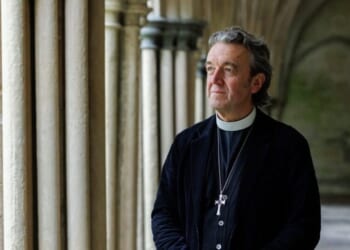
THE announcement of Bishop Sarah Mullally as the 106th Archbishop of Canterbury aroused inevitable public curiosity about the background and character of the first woman in the 1400-year history of the Church of England appointed to this key office. Who is the Archbishop? What can a former Chief Nurse bring to the Anglican Communion? Can she bring a healing touch to existing divisions and discord? Rapidly published exercises in biography have followed.
With Andrew Atherstone’s book, we are in safe hands. He has impeccable credentials, as the biographer, highly rated, of the previous incumbent, Justin Welby.
In his prologue, Professor Atherstone points out that the Archbishop’s life journey has now come full circle: from trainee nurse at St Thomas’ Hospital on the South Bank of the Thames to resident of Lambeth Palace. An eight-minute stroll has taken her 45 years to complete.
This comprehensively researched and clearly presented book charts that progress of faith from the ordinary to the extraordinary. Building on Christ as her firm foundation, the Archbishop has moved purposefully from a point at which, as a student, she began to explore her gifts in Christian leadership, through ordination as deacon, priest, and bishop, to the cusp of leadership of the worldwide Anglican Communion.
The author deals sensitively and perceptively with the uphill nature of that journey, setting out in detail the obstacles and trials that have faced women in ministry for more than 30 years. It also reveals the joys and encouragements that the Archbishop has experienced from mentors, colleagues and congregations in Woking, South Lambeth, Sutton, Salisbury, Crediton, and thence the City of London.
Atherstone brings a balanced objectivity concerning the controversial issues with which the Archbishop has had to deal. Whether it is in relation to the place of women in ministry, Living in Love and Faith, safeguarding, or medical ethical debates on assisted dying or abortion, he captures her consensual style, re-emphasising her principle of mutual flourishing when working with those of opposing views. Her thirst for social justice, inclusivity, compassion, evangelism, healing, and wholeness are threaded themes throughout the book.
There are challenging aspects of the Archbishop’s career and ministry on which I would have appreciated more focus. The personal implications of balancing being a wife and mother while managing high-level NHS management posts; part-time training as a self-supporting minister on top of all these other responsibilities; the dynamics of family interactions as a priest and bishop. While these are reported factually, a deeper evaluation could have offered valuable insights to those in ministry or exploring ministry, and their families and congregations.
Two sections of glossy plates add much to that personal dimension. I was particularly struck by a picture of Sarah Mullally and her husband, Eamonn, next to their bee hives (beekeeping is a hobby that they share). Eamonn is dressed from head to toe in full protective gear. Sarah is dressed in short-sleeved summer clothing — free to work unencumbered and obviously not afraid of being stung. Could this become a metaphor of her archiepiscopate?
The Revd Nick Goulding is Professor Emeritus of Pharmacology and Medical Education at Queen Mary University of London.
Archbishop Sarah Mullally: A biography
Andrew Atherstone
Hodder & Stoughton £22
(978-1-3998-2878-9)
Church Times Bookshop £17.60
Listen to an interview with the Revd Professor Andrew Atherstone about the book on a recent edition of the Church Times Podcast here