AS A teenager and a new Christian, I still remember the zeal and energy with which I explored the question what God wanted me to do with my life. The words of the poet Mary Oliver, “What are you going to do with your one wild and precious life?” reflected my deep longing that I might give all I had to serve the God who had, in the words spoken to me by the Bishop at my confirmation, called me by name and made me his own.
In those youthful days, discerning God’s will felt vital and complex, shaped by an unspoken fear that by making the wrong decision about what A levels to take or which university course to apply for, I might somehow miss God’s will and end up on completely the wrong path.
Into that intense and emotive time, I still recall the pithy words of a Church Army evangelist, Andrew Perry, when he came to visit the Christian Union at our sixth-form college and told us: “God is more concerned about who you are than where you are, and guidance is about knowing the guide.”
These words became a vital bedrock for my exploration of how I might live my life for God and ensured that, as I explored my vocation, I never lost sight of the primacy of my relationship with God.
As the years went on, I became more confident that God was inviting me to serve him through ordained ministry, even though I was young and female, and most of the priests that I knew were older and male. As I tussled with my growing sense of calling, I was reminded that my vocation was about being true to all that God had created in me, rather than trying to squeeze myself into a vicar-shaped box, as Parker J Palmer articulates well: “Vocation does not come from a voice ‘out there’ calling me to become something I am not. It comes from a voice ‘in here’ calling me to be the person I was born to be, to fulfil the original selfhood given me at birth by God.” (Let Your Life Speak, 1999).
It was significant that the moment I felt most conscious of God calling me to be
ordained was in the emotionally bruised time when I arrived home from my Church Mission Society gap year, when I had been working with the Orthodox Church in Russia. It had been a challenging time, practically, theologically, and spiritually, and there was much to process when I returned home.
It was as I sat in church, so aware of my brokenness, and brought all the complexity of the experience to God, that I was most conscious of God speaking into my heart: “I’m calling you to be ordained. I’m not calling you because you’ve got your theology all sorted, or because you’re strong or competent. I’m calling you, because I’m calling you, because I’m calling you. This is who I’ve made you to be.”
In the inevitable moments of impostor syndrome in the subsequent years that I’ve served in ordained ministry, I am often drawn back to that moment of brokenness, when God made clear that his call was not dependent on my particular gifts or skills, but on his call and faithfulness.
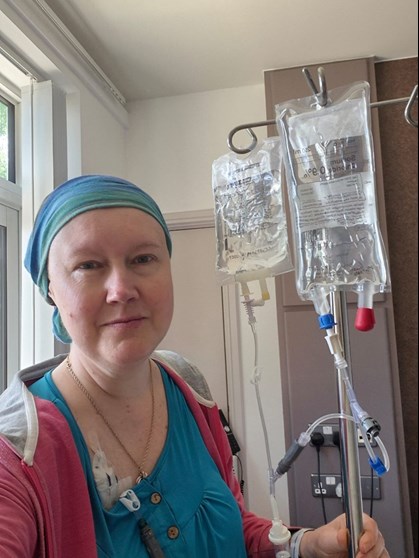 Lisa Barnett during a chemotherapy session in May 2025
As I went through the Church of England’s vocation processes, with their helpful reminder that our vocation is not just about our own sense of God’s call, but also the discernment and needs of the Church, I found myself articulating with increasing nuance the particular way that I sensed God inviting me to inhabit Anglican priesthood. It was about being a catalyst to enable the Church to be the Church more fully, supporting and encouraging the people of God to be ambassadors for Christ and a channel for God’s love in the world.
I valued the words attributed to St Catherine of Siena: “Be who you were made to be and you will set the world on fire.” I increasingly understood my own vocation as supporting each Christian to find their unique way of being all that God had created them to be.
Serving as a priest in God’s Church has been full of joy, privilege and a deep sense that this is indeed what God has made me for. Yet I’ve never felt that this vocation defined all of me. Meeting my husband during my curacy, I was delighted to be called to become a wife and, a couple of years later, a mother. Over the years, I’ve had the privilege of establishing and leading gospel choirs and a community choir, and I’ve loved offering my musical skills into this further vocation as a choir director.
I have also been deeply involved in vocations work, supporting those exploring ordained ministry as an Assistant Diocesan Director of Ordinands and a national adviser for Bishops’ Advisory Panels. I’ve supported three curates through their curacies, and nurtured two new Readers into active ministry. Each of these things has been a huge privilege.
These are all things that I can put on my CV, and they have been vocations that have brought me great joy. But none of them has defined all of me, because, at my deepest place, I still consider that my primary vocation is as a child of God and a disciple of Christ. Recognising and naming this primary vocation really matters, because, without it, there is a risk that we end up restricting the language of vocation to clergy, monks, and nuns, or those offering formal, licensed ministry within the Church.
When Mary Oliver asks us what we are going to do with our one wild and precious life, I don’t think she expected us all to answer by talking about what we do in church. In the contemporary Church, there is a renewed commitment to inviting all Christians to acknowledge the vocation that springs from our baptism, reinforced by the timely and provocative report Setting God’s People Free.
Both clergy and laity are baptised disciples and live out our calling together. Lay people — like clergy — have vocations and callings. They just happen to be callings and vocations which do not require ordination.
At a baptism, candidates are commissioned using these or similar words: “In baptism God invites you on a lifelong journey. Together with all God’s people, you must explore the way of Jesus and grow in friendship with God, in love for his people, and in serving others.”
As we use these words of commissioning with baptism candidates of all ages, we have no idea what vocations God might call them into through the years. We hope and pray that through the gift of baptism, God will nurture the faith and grow the unique vocations of each person so that in school, in their career, their voluntary work, in the way they handle their money, their time, their relationships, in their words and their choices, their might continue to love, serve and follow Christ.
As St Paul wrote to the church community in Colossae: “Whatever you do, whether in word or deed, do it all in the name of the Lord Jesus, giving thanks to God the Father through him.” (Colossians 3:17).
AS CHRISTIANS today, we share in the overarching vocation to all God’s people through the generations: to be loved and to love. We are called to receive the generous, gracious and forgiving love of God, and then to be a channel of that love in the world. Just as Jesus called the first disciples to follow him, so he continues to make that call through the centuries in a way that is both universal and personal, and both lifelong and unique to each conversation, encounter, and choice.
As we grow as Christians, we will continue to be aware of our sinfulness and frailty, as St Paul expresses it in the letter to the Romans: “For I have the desire to do what is good, but I cannot carry it out. For I do not do the good I want to do, but the evil I do not want to do — this I keep on doing” (Romans 7.18-19).
Yet we are also given the extraordinary privilege of being filled with the indwelling Holy Spirit and participating in God’s redeeming work, as ambassadors of his love, and in the bringing in of God’s kingdom: “For we are God’s handiwork, created in Christ Jesus to do good works, which God prepared in advance for us to do” (Ephesians 2.10).
This vocation doesn’t require us to complete any course or pass any test, and we will regularly get things wrong as we seek to live it out. But we won’t be sacked, or kicked out, or stepped down, because this calling rests on God’s gracious invitation and our response, however tentative, of faith and service.
Sometimes our vocational journey will require extended times of discernment, supported by Christian friends and the wider Church, as we consider stepping into vocations that will involve big changes to our working patterns and family life. But some vocations will be discerned in the moment, as we sense the Spirit of God prompting us to buy some lunch for a homeless person that we pass in town, or to take some time to pop in on an elderly neighbour that we haven’t seen for a while. Each of these actions are moments of vocation, moments when we are responding to the invitation of the Holy Spirit to be vehicles of God’s love in the world.
As we each respond to the call of Christ in each moment, sometimes this will mean offering our gifts, skills, and competencies and finding joy in ministering according to our sweet spot. Sometimes our service will be shaped by a need within our communities, and the gentle prompting of God in our hearts that perhaps we might be the one who could respond, even if our service will be uncomfortable and costly, even if it means bringing our weakness rather than our strength.
The prophets of the Old Testament, who are often called to challenge God’s wayward people to return to God, remind us that our vocations will not always be easy. Jeremiah is often known as the depressed prophet, and has an especially difficult time: “I am ridiculed all day long; everyone mocks me. Whenever I speak, I cry out proclaiming violence and destruction. So the word of the Lord has brought me insult and reproach all day long” (Jeremiah 19.7-8).
Jeremiah recognises that his prophetic ministry is his vocation even through it’s difficult. It is such a deep part of who he is that he can’t run away from it, though he may want to: “But if I say, ‘I will not mention him or speak any more in his name,’ his word is in my heart like a fire, a fire shut up in my bones” (Jeremiah 19.9).
Inspired by St Paul’s image of the church as a body in 1 Corinthians, we are invited to explore the particular parts that we are called to play at different times in our lives, aware that sometimes the Spirit will prompt us to say no to vocations that aren’t ours: “If the whole body were an eye, where would the sense of hearing be? If the whole body were an ear, where would the sense of smell be? But in fact God has placed the parts in the body, every one of them, just as he wanted them to be” (1 Corinthians 12.17-18).
When Adam and Eve ate the fruit of the tree of knowledge in the garden of Eden, they were enticed by the thought of becoming something that they weren’t called to be and becoming like God (Genesis 2-3). We must guard against a temptation to want to play parts in God’s Kingdom which are not ours to play. Being at peace with vocations that aren’t ours as well as those that are is a daily challenge, and one that requires us to learn to listen carefully to the promptings of the Holy Spirit.
IT IS vital that the vocation of Christians is never limited to the way we serve within our church communities. As important as it is that our churches have enough people to be welcomers, to lead home groups, and to serve on refreshment rotas and tech teams, we should have as much expectation of God’s being at work in us and through us on Monday morning as we do on Sunday at church.
One of the core tenets of Ignatian spirituality is the invitation to find God in all things. This springs from the belief of St Ignatius that God’s presence can be found in every aspect of life and not just in religious settings.
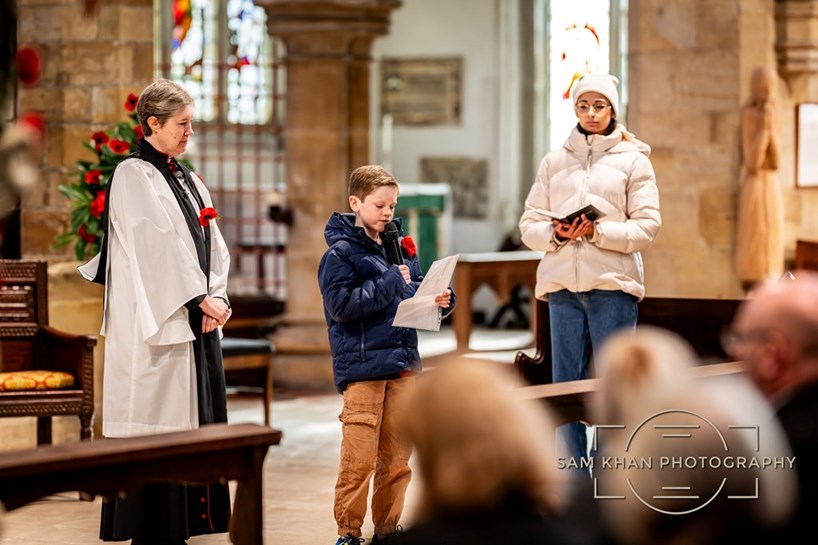 Lisa back to work in her “new normal” phase at Remembrance in Horsham last year
Western society encourages us to compartmentalise our spiritual life, professional life, and personal life, but the Bible sees no such distinction. As the Christian minister and author Tyler Staton preached to his church, Bridgetown, in Portland, Oregon: “The biblical story is one that gets worked out and expressed in the material world and permeates every area of our lives. So, to live as disciples of Christ means to eat meals, budget, go to work, raise children, hang out with friends, make weekend plans, and do it all marching to the beat of a different king in the procession of another kingdom” (Sermon: Vocation, 15 August 2022).
A couple of years ago, we enjoyed hearing from members of our congregation each Sunday morning about their TTT: This Time Tomorrow. Each shared with us what they would be doing on Monday morning, and how their Christian faith was worked out during the six days of the week that they weren’t in church. We heard from an architect and a foster mum, a nurse and someone who was retired.
Each story reminded us of the diverse places where church members were spending their lives, and the unique opportunities and challenges that they each had in order to live distinctive lives as children of God and disciples of Christ.
Brother Lawrence, whose book bears the title The Practice of the Presence of God, spent much of his life washing dishes in a monastery in 17th-century Paris. This was the context in which he learnt to be with and in God in each moment of his life, and not just when at prayer in the chapel. It is written of Brother Lawrence: “Everything was the same to him, every place, every task. The good Brother found God everywhere, as much while he was repairing shoes as while he was praying with the community. He was not eager to go into retreat, for he found in his common tasks the same God to worship as in the depths of the deserts” (Practice of the Presence, 1981, Blaiklock).
THOUGH I wasn’t expecting 2025 to bring me a new vocation, when cancer became part of my story, I none the less recognised that this was God’s vocation to me for this season. Naming the cancer journey as my vocation ensured that I lived with God in each moment rather than seeing the cancer treatment as something to get through as quickly as possible, so that I could get back to my real vocation.
Allowing the treatment to be vocational brought a deep sense of freedom, but also of hopeful expectation of all that God would do in me and through me as I made my way through it. As Tyler Staton, who himself faced cancer during 2024, expressed it in his Praying Like Monks, Living Like Fools podcast: “You can meet God in a deeper way in circumstances you’d never choose.”
As the days, weeks, and months of treatment progressed, I kept returning to the Ignatian questions: “What is God’s call to me in this season of cancer treatment, and how I am being invited to find God in this difficult time?”
I kept holding on to God’s lifelong invitation to an ever-deeper surrender and trust of all that I am and have to God. Though I was scared at what the journey might bring, I was also confident that God would be with me through it; calling me and leading me. . .
As soon as a serious illness becomes part of our life, we are propelled into a place of extreme vulnerability. We find ourselves in the hands of doctors, nurses and medical systems, having to trust people that we barely know with one of our most valuable assets — our health. We trust anaesthetists and surgeons to bring their A game to our care, and not to be having a bad day.
We trust the advice of our medical teams, amid the vulnerability of recognising that some aspects of treatment aren’t an exact science, and we could plausibly get different advice from a different medic on a different day. Suddenly “clerical errors” aren’t just annoying: they take on the weight of life and death, and everything has a greater sense of anxious urgency and pressure.
As the person in the midst of this whirlwind of medical systems and procedures, we take on the status and vocation of a patient. No longer are we invited to define ourselves by our career trajectory, social network, education and family. We are now defined by a hospital number, a diagnosis, and a treatment plan. No longer are we free to make our own choices and manage our own schedules. We now need to put ourselves in the hands of surgeons, anaesthetists, oncologists, nurses, and radiographers, and allow them to direct our journey.
Entering into this place of profound vulnerability can be immensely uncomfortable, and this vulnerability extends right through the treatment and beyond.
There is vulnerability in waiting for the diagnosis and treatment plan, and then in waiting to see if the treatment has been successful. There is vulnerability in showing to numerous medics parts of our bodies that would usually remain hidden, and revealing our nakedness to those who approach it as scientists rather than lovers. There is vulnerability in sitting in corridors wearing hospital gowns or attached to drips, looking and feeling profoundly unwell while in a public place.
In response to this sense of vulnerability, numerous books about cancer focus on reclaiming autonomy, using phrases like, “Take control of your cancer,” “Take back your life from cancer,” “Become the boss of your cancer.” Though these sentiments can be helpful in stirring courage and confidence, there is also much to learn from the experience of, and vocation to, vulnerability, because, just as our vulnerability compels us to place ourselves in the hands of medics, so we can once again place ourselves in the even firmer hands of our loving and ever-present God.
The Stature of Waiting, by W. H. Vanstone, is a concise exploration of the significance of Jesus’s vulnerability and what it means for humanity. Drawing on the Greek word pascho, from where we get the English word “passion”, Vanstone points out that the most direct translation of this word is “to be done unto”, and that, “at a certain point in His life, Jesus passed from action to passion, from the role of subject to that of object and from working in freedom to waiting upon what others decided and receiving what others did.”
Vanstone goes on to argue that we see something of the nature and glory of God when Jesus becomes vulnerable, is “handed over”, and becomes the one who is done unto, rather than the agent of the action. God is therefore not only recognised in power and strength, but also in the ways that Jesus chooses the path of weakness and vulnerability. . .
St Paul writes most directly about his own experience of vulnerability in 2 Corinthians 12, when he refers to a “thorn in the flesh” from which God doesn’t heal him (12.7). Instead, he senses God saying to him, “My grace is sufficient for you, for my power is made perfect in weakness.” (12.9) He goes on to declare: “That is why, for Christ’s sake, I delight in weaknesses, in insults, in hardships, in persecutions, in difficulties. For when I am weak, then I am strong” (2 Corinthians 12.10).
This is one of the paradoxes of the Christian faith: that sometimes it is in our weakness and frailty that we are most able to live out our true vocations as creatures before our creator God, and as children of our heavenly Father.
This is an edited extract from Called Through Cancer: Vocation, vulnerability and the God who holds us by Lisa Barnett. Pre-order now for delivery after 30 September 2026 (Canterbury Press, £13.99; 978-1-78622-746-1).