THIS fascinating and formidably well-researched book has completely changed my view of fairies. Far from being the ethereal little creatures with wings dancing round in rings portrayed in children’s stories and Romantic Victorian paintings, they turn out to have had their origins in animism, with its concept that personhood extends beyond human beings, and to have been variously seen as godlings, fallen angels, and members of a monstrous race.
Francis Young is particularly interested in, and illuminating on, the effect of Christianity on fairy lore. Although he takes fairies to be pre-Christian in origin, he engages in biblical exegesis to show how they were variously seen as representatives of a pre-Adamite race that survived the flood or as carriers of the mark of Cain.
In early Christian Ireland, which, Young suggests, was especially open to embracing pre-Christian supernatural beings, síde, as they were known, were thought to dwell in natural or artificial burial grounds and to have their own churches, which far outnumbered human places of worship.
But it was not just among the Celts, with their misty spirituality and penchant for supernatural encounters, that belief in such creatures flourished in the early Middle Ages. Much was made of St Anthony’s meeting with a faun or satyr who spoke to him in the dry valley where he was seeking the cave of his fellow hermit, Paul of Thebes. In his City of God, St Augustine discussed the monstrous races descended from Adam who lived at the edge of the world. Insisting that they were human, in spite of their peculiarities and deformities, he suggested that their existence testified to the diversity and pleroma of God’s creation.
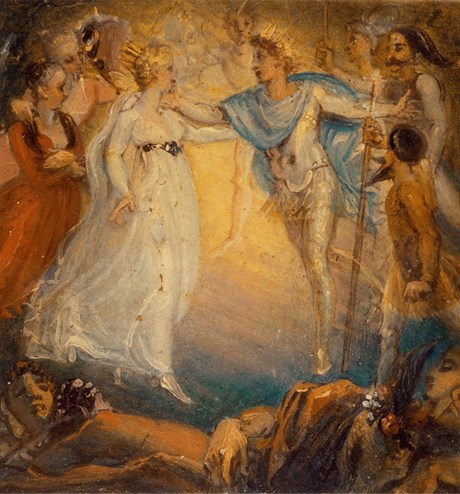 AlamyOberon and Titania from “A Midsummer Night’s Dream,” Act IV, Scene i (1806) by Thomas Stothard (1755-1834). Despite the title of the play, the action takes place on the “morn of May”
This generally benign view of fairies and other human-like intermediate spirit beings gave way in the later Middle Ages to a much more hard-edged and hostile approach that characterised them as demonic and malevolent. The demonisation of fairies gathered pace in the aftermath of the Reformation, when they came to be seen as essentially pagan and were often associated with witchcraft. The idea that they were fallen angels also gained ground, not least in Calvinist Scotland, where they were regarded as beyond salvation, as exemplified by a fairy who, when reciting the Lord’s Prayer, could only ever say “Our Father, who wert in heaven”, referring to the fallen Lucifer.
Young charts the modern revival of interest in fairies, which he attributes in part to the writings of Chesterton, Tolkien, and C. S. Lewis, as well as to the influence of Romanticism, eco-consciousness, the re-enchantment of nature, and what he calls the “rewilding of fairy land”. He concludes his magisterial survey by reflecting that Christianity has always found a way “to squeeze fairies in”; and, for that reason, that they are as much Christian as pagan beings.
The Revd Dr Ian Bradley is Emeritus Professor of Cultural and Spiritual History at the University of St Andrews.
Fairies: A history
Francis Young
Polity Press £25
(978-1-5095-6677-8)
Church Times Bookshop £22.50