THE Bishop of Newcastle, the Dr Helen-Ann Hartley, said that it was a “moral necessity” to give the Terminally Ill Adults (End of Life) Bill adequate scrutiny during the final day of the debate in the House of Lords.
The proposed legislation to legalise assisted dying in England and Wales ran out of time to become law on Friday, nearly 17 months after MPs first voted in favour of the Bill.
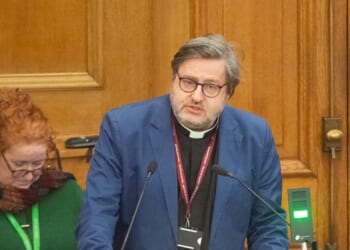
“In our context, where questions of life, death, care, and conscience are so closely intertwined, the quality of our scrutiny is not a procedural detail — it is a moral necessity,” Dr Hartley, who was a member of the Lords Select Committee that examined the Bill, said during the debate.
“Some may dismiss my contribution as one which is grounded in a faith, but this is as legitimate and significant as any other viewpoint — grounded in faith, belief or none,” she continued.
Dr Hartley told peers that her experience on the Select Committee had shown her “that the more closely we have examined this Bill, the more concerns have come into focus, not fewer”.
She said: “For a Bill of this magnitude in terms of societal change, the highest level of scrutiny is imperative.”
MPs supported the Bill in principle by a majority of 55 in November 2024. The Bill then cleared the House of Commons last June with a majority of 23 (News, 20 June).
Friday marked the fourteenth and final day of the Committee stage, when the legislation was scrutinised in detail and amendments were considered. More than 1200 amendments were tabled in the Lords, and the Bill did not clear all its stages.
The Archbishop of Canterbury also spoke in the debate on Friday, and emphasised the need of investment in palliative care.
“I oppose this Bill in principle, both as a priest and as a nurse; but what is clear is that there are some things that unify us,” she said. “Whether we are in support of this Bill, or we oppose it, we are unified by the fact that what we want is as many people to die in a dignified, pain-free, and compassionate way, with the least possible fear that they can have.”
The Labour MP for Spen Valley, Kim Leadbeater, who introduced the Bill in the House of Commons, told the BBC earlier on Friday that she was a feeling a mixture of “extremely disappointed and upset and also quite angry” that the legislation was likely to fall in the House Lords.
It is possible that another attempt to introduce the proposed legislation will be made on 13 May, in the next session of Parliament.
“Until the questions that have been raised are answered more fully, and until this Bill has received the depth of scrutiny it requires, it would be irresponsible to allow it to move forward,” Dr Hartley concluded.