THE artist Gwen John’s images — from tiny watercolour studies of figures swiftly produced on the backs of food packets to monumental portraits of nuns — were tenderly attentive, materially innovative, and steadily meditative. Raised in Wales, she studied art at the Slade, in London, and moved to Paris. She spoke with a Pembrokeshire accent throughout her life, and her Welsh identity, along with her Roman Catholic faith, were a steady foundation for her unique perspective as an insider and outsider in 20th-century France.
The Gwen John exhibition at the National Museum of Wales, in Cardiff, which marks the 150th anniversary of her birth, is open until June, and, in 2027, it will be shown at the Yale Center for British Art in New Haven, Connecticut. The complex terrain of culture, gender, heritage, power, and imagination is as present in Gwen John’s meticulous still life of a prayer book, shawl, inkwell, and vase of flowers in afternoon light as it is in a metres-long scroll made in Lucknow depicting a river journey teeming with life.
The exhibition amplifies the artist’s own words alongside her work. Broadly chronological in scope, the show’s pilgrimage begins in the 1890s with paintings of John’s family, figure studies from art school, and early experiments with colour and light as well as with emotion and gesture.
I ask a staff member in the gallery what I might search for and notice in John’s work, and whether he has a favourite painting in the exhibition. We begin talking about faith. He is not a regular at his parish church, but he explains that he always goes to church when he is in Italy, lights candles, and says prayers for his family and friends, and finds himself “drawn into it again”. I pull a rosary out of my pocket, and he smiles and says that he always has one with him, too.
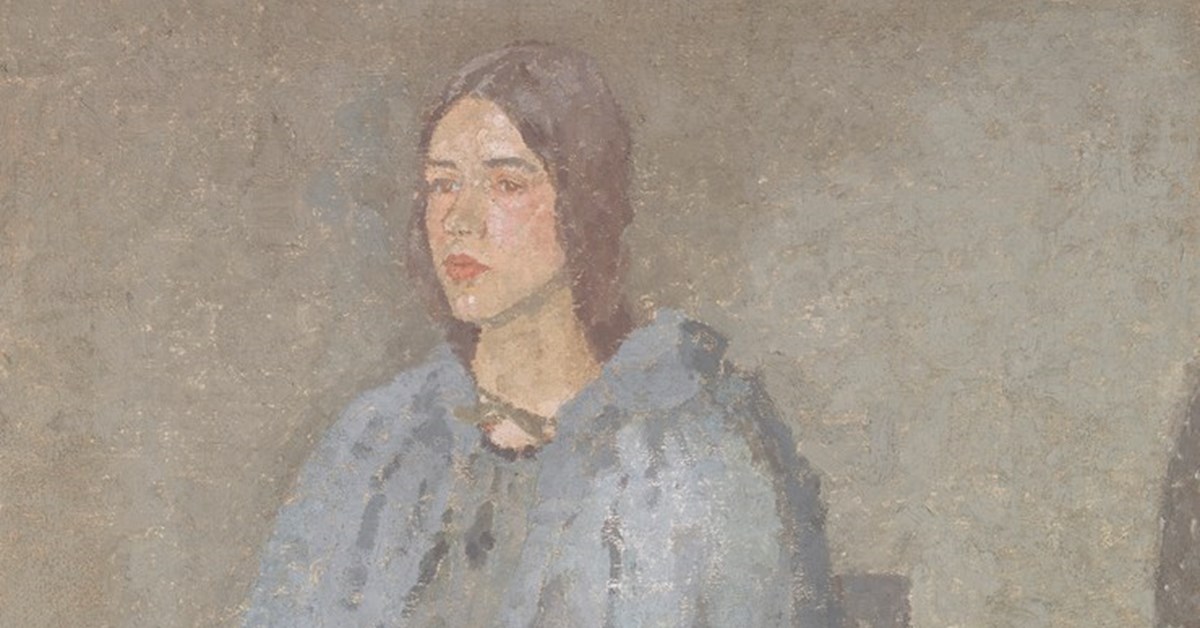
He shows me one of John’s earliest paintings in the exhibition: a study of her sister, Winifred. The girl’s face in profile is highlighted with bright white passages of paint; this young person has the look of someone considering life’s deepest questions, and her steady presence suggests that she knows that she is being seen — painted at the time, and now viewed by us more than a century later — and she doesn’t care what anyone thinks of her.
This sense of inner anchoring in the value of one’s own presence in the world, with one’s own thoughts and quality of inherent dignity, is a feature of John’s images of women, her four-decade career as an artist, and her wider life as a Christian.
HOW and what she painted introduced and insisted on a luminous and mystical approach to sacred art and modern life. Although significant exhibitions of her work have been rare, the painter’s vision has inspired many. In 2024, the artist Celia Paul’s Letters to Gwen John was published (Penguin Books). In it, she wrote to the painter across many years, connecting across generations and interweaving their artwork, memories, and ways of seeing.
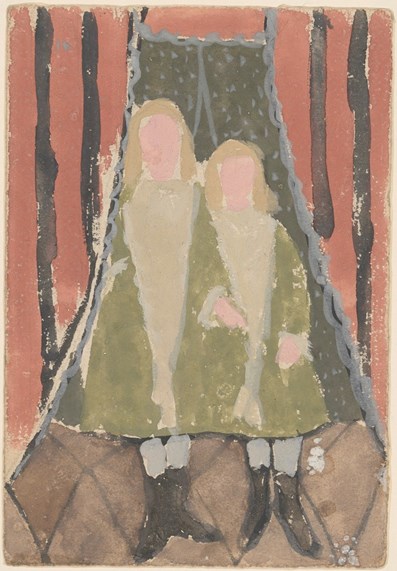 By Permission of Amgueddfa Cymru — Museum WalesSt Thérèse of Lisieux and her Sister by Gwen John.
On 10 October 2019, Paul wrote from Lee Abbey, North Devon, where she grew up. She describes golden leaves, her “darker thoughts”, quoting scripture (“I said to my soul, be still”), and her series of comments in the Abbey’s visitors’ book. Paul writes these as a ritual now that she is older, making these spiritual pilgrimages to re-enter early memories and create new ones on a rural coast.
Each time, Paul writes, “please may this peace stay with me where I live in central London.” The letters are a path through John’s world. They accompany experiences of gazing at John’s paintings and being patient with them and curious about them. Asking John directly, “Were you a joyful child?”, Paul then observed — on a 21st-century autumn morning — “You have an inner life, and that’s what counts.”
The Cardiff gallery has a quiet hush, but is never silent. It is an invitation to contemplation. In John’s paintings and Cardiff’s new approach to displaying them, the soft hum of expectation, a kind of aesthetic ASMR (a euphoric, relaxing, tingling sensation), is perpetually present. The paintings form an unexpected kind of Stations of the Cross, and the art resists a fast-paced visit.
In the exhibition’s four locations across the coming months on both sides of the Atlantic, each institution will work with John’s art in a different way, but that quality of present absence and near-silent sound is an emanation from the pictures themselves. It is up to us to tune in as closely as we can.
JOHN’s imagery is often simple — a chair, a book, a child, a cup of tea — and a call into a deeper interior landscape, if viewers choose to travel across that threshold. Each picture could be a personal pilgrimage through the unseen places of an artist’s heart. Light, playing through a gauzy curtain, could slow our breathing, hold our attention, and even provide an unexpected shimmer of what the second collect at evensong calls “the peace which the world cannot give”.
In 1917, John wrote herself a note: “In my art I need not lose sight of God too long.” She was often concerned that this loss was a genuine risk. John instructed herself, in 1932, that she should “enter into Art as one enters into Religion”. Entering both, simultaneously, was an experience that sought to keep God at the heart of her endeavours.
John’s life is sometimes told as if it were a series of retreats: withdrawal into Meudon in 1911, away from the clatter of Paris; quiet inhabitation of small, gentle interiors; sketching figures in congregations from behind, unseen and unheard; and solitude with God as the ultimate goal.
Her life and work is, however, also a story of persistently attempting to translate faith into form. Catholicism was, for her, not just a change of creed, but a seismic shift in how John responded to the world and to herself as a creator of “strange beauties”, and to her mission as an artist-theologian.
For more than two decades, John wrote of the tensions that she sometimes experienced between art and faith. The more she could create an inner and outer unity between spirituality and her work, the more liberated her sense of vocation became. In 1916, she wrote, “Oh what a world is open to us when our mind is in peace! A world of eternal things. What a world and what sweetness in humble solitary work, what pleasures.”
Sometimes, she felt that art drew her too far into material things and away from God. She sought to anchor herself in the examples of saints who gave themselves wholly to God’s will. St Francis was one of her inspirations: “I must try and lose myself like Saint Francis and then the spirit of God can come and live in me.”
IN 1913, not long after she relocated from Paris to Meudon, John was invited to produce portraits of a local French Dominican nun, Mère Marie Poussepin (1653-1744). John used the engraved portrait on a 1911 prayer card as a starting point for her work. Depictions of Meudon nuns at rest, prayer, and in death became a powerful aspect of her work for several years.
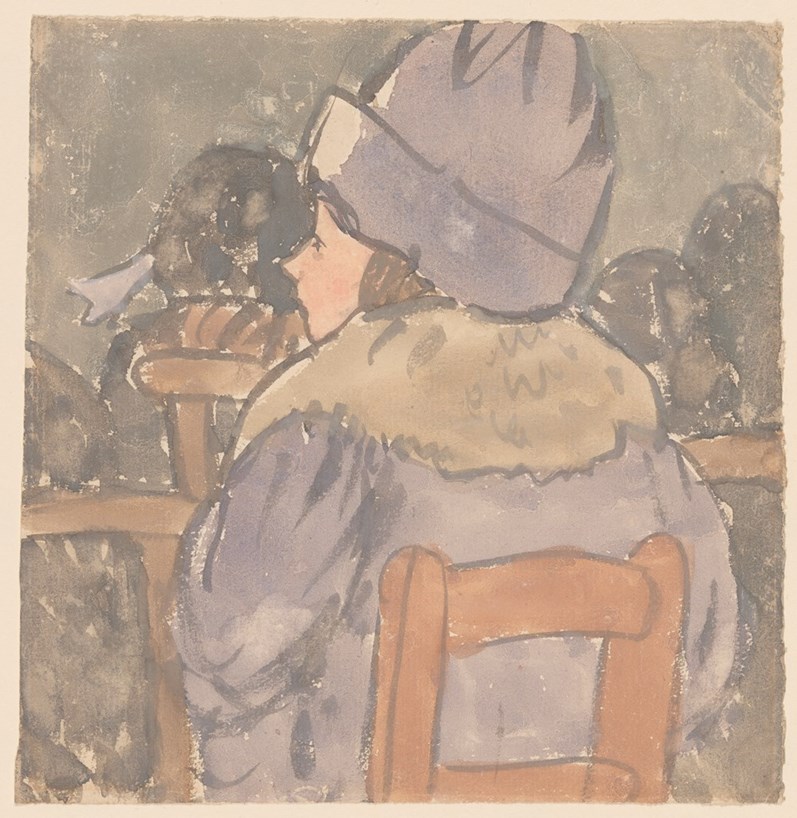 By Permission of Amgueddfa Cymru — Museum WalesGirl in a Church by Gwen John
In addition to the Poussepin series, John was intrigued and inspired by the life of the young 19th-century French nun Thérèse of Lisieux. Known as the “Little Flower”, this saint’s embrace of a mystical simplicity spoke directly to John’s own determination to make work and live life for God alone, in ways that may have appeared to be diminutive or self-effacing, but were bold and courageous precisely because they were so daringly personal.
Thérèse died in 1897, at the age of 24, was canonised in 1925, and her spiritual writings provide countless followers with a “little way”. For the saint, this was a path of humility in daily life, made up of small sacrifices accepted with love rather than dramatic feats of faith, and therefore a way of being Christian that anyone could inhabit. These small quotidian events, whatever they might be, are a sign of self-awareness as a child of God.
One of the most powerful and strange collections in the exhibition is a large number of works inspired by this saint’s childhood. Among them is a roughly drawn grid within which are several drawings that John made of a photograph of Thérèse and her sister. John often worked out her ideas on notepaper from the Salon de Lecture des Grands Magasins du Louvre (the reading room of an upmarket department store in Paris).
John wasn’t sketching and working out ideas in the Louvre Museum among the classic greats of European painting — at least, not for this. She was responding to a small photographic prayer card produced for private devotion. The photo is an opportunity for John to experiment with form, colour, and scale; and it is also an invitation to her own invocations of the saint as among her favourites in the “great cloud of witnesses”.
In this mode of making and imagining, paper from a busy Parisian department store became its own sequence of prayer cards. The photo itself is intriguing, because it is not a typical image of Thérèse of Lisieux alone in her habit, but a portrayal of her as part of a family before she entered the convent, before she offered her “Little Way” as a gift to Christ’s followers, and long before her untimely death.
John’s connection with this holy girl as a subject for new work is perhaps, as the exhibition curators suggest, a quasi-liturgical repetition, similar to the rhythmic repetition of the rosary.
Rosaries are present in John’s art, too, most prominently in her two large paintings of a young woman in grey. The Pilgrim, with her steady gaze, is praying with beads that pass through her fingers one at a time. The hands and beads suggest the slow movement of prayer. Grey, the colour of ashes, protects the figure without overwhelming her. Bright eyes and their steadfast gaze communicate abiding dignity.
The five biblical passages taking the worshipper along the narrative of the rosary’s Sorrowful Mysteries could be invoked here without being depicted. This pilgrim may be on the move, even as she sits on a simple chair in a sparse room, making her way through an inner Via Dolorosa.
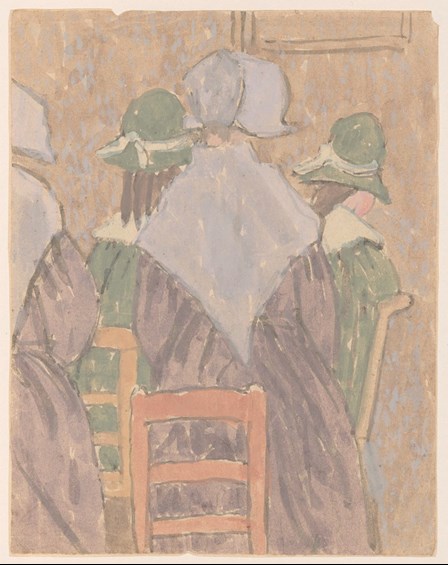 By Permission of Amgueddfa Cymru — Museum WalesNuns and Schoolgirls Standing in Church by Gwen John
In 2014, the former Archbishop of Canterbury Lord Williams published a book of poetry with a Gwen John painting on the cover. That painting, A Corner of the Artist’s Room in Paris, is a visual description of time passing, of reading, drawing, and writing in progress, and of the artist herself as an observer of her own furniture, clothing, and everyday spaces. It is both still life and self-portraiture. The book, its pages sun-brightened, are blankly expectant, waiting for the artist’s return. This is an easel, canvas, and oil-paint job that refers to the daily sketchbook practice that might take the artist out into the city later in the day.
One of Lord Williams’s poems in this collection imagines the interaction between St Thérèse’s father and the future saint, when he would have been shrouded by a black cloth behind the camera, preparing to take the photo that inspired John’s repetitive series of drawings and paintings of the Little Flower.
Did her father know that he would be producing a devotional image for Catholic pilgrims? Lord Williams’s words imagine the scene in a way that makes fresh contact not only with the 19th-century photo of a future nun and her sister, but also the full range of John’s own work, decades later.
Visitors to the exhibition who spend time with these paintings — whether of a family member, a vase of flowers, a quiet Paris afternoon, or the nuns at Meudon — might keep this poem alongside the images. The lens that Lord Williams provides is a quiet question-and-answer between family members, Christians, and artists:
She says, Can you see me
Not seeing you? That’s when
You see me.
Gwen John asks each of us: “Can you see me?”
“Gwen John: Strange Beauties” is at the National Museum, Cathays Park, Cardiff, until 28 June. Phone 0300 111 2 333. museum.wales/cardiff