WHY do the British speak English? Or, put differently, why don’t they speak a modern descendant of Latin or Brittonic, the two languages most commonly used at the end of Roman rule on the island?
The old “Germanist” scholarly tradition had no trouble in answering this question. Its proponents argued that Anglo-Saxon invaders swept away the indigenous British population, and its languages, through sheer force of numbers.
This argument was kicked into touch, however, in the years after the war, as scholars increasingly came to reject emphases on racial difference. Since the 1960s, the Anglo-Saxon newcomers have been typically (but not exclusively) identified as a small, elite group, which, as Nicholas Higham points out in his new book, leaves open the question how they were able to impose their material culture, religion, and language so completely on the local population. After all, the Franks, another Germanic people, adapted to the elite language that they discovered in Gaul: Latin. This would eventually evolve into modern French. English, on the other hand, absorbed no more than ten words from Brittonic.
Higham takes an essayistic, synthetic approach, combining historical sources with archaeological ones to produce an exceptionally readable, even gripping, scholarly text. How England Began — a revisiting of his Rome, Britain and the Anglo-Saxons (Routledge, 1992) — manages to provide a succinct and yet detailed survey of the transition from Roman to Anglo-Saxon England, crossing a vast tranche of time and space with élan and without sacrificing academic nuance.
He begins with a swift and evocative account of Roman Britain, a diverse edgeland that had been quite thoroughly “Romanised” and was home to both Christianity and a mishmash of pre-Roman, Roman, and other European pagan cults, concentrated in temples, natural features, and cemeteries. The collapse of Constantine III’s regime in c.410 — victim to both internal politics and external plundering — probably had little immediate effect on governance in Britain. Rather, its effects were reflected in a slow decline in building work, coinage, local manufacturing, and urbanisation, even as lowland elites maintained their “Roman” lifestyles. Taxpaying, Latin, and Christianity proved tenacious, as the powerful waited expectantly for the return of imperial armies.
Higham is a trenchant defender of the use of textual sources, and he gives more than two chapters to the only more-or-less contemporary account of the arrival of the Anglo-Saxons, an allusive, complex letter of c.540 by the wealthy Christian Gildas. For him, the story of the Britons worked like that of the Israelites: early, faithful converts who were punished with invasion for their sinfulness. As a member of the British elite, with a traditional education in the Latin classics, his concern was to oppose the military successes of Saxon mercenaries, who were taking advantage of fighting between British kingdoms.
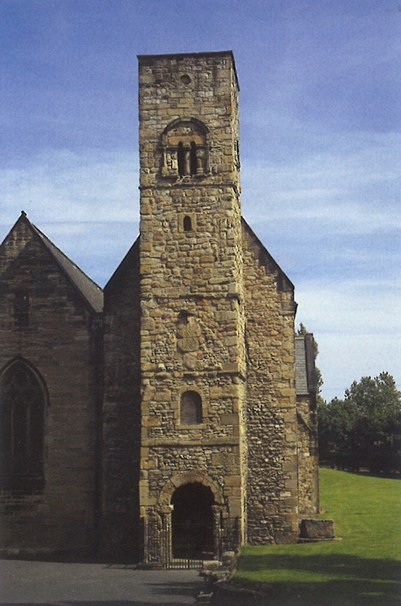 author’s photoSt Peter’s, Wearmouth, in Sunderland, begun in 674, used Roman masonry. Benefiting from an estate granted by King Ecgfrith, the church was built on the Continental basilica-type model, the book under review says
Anglicisation was gradual. Studies of ancient DNA have identified burials of individuals from Northern Europe, occurring in dribs and drabs from c.420 to c.470 and representing probably a small minority of the population, perhaps as little as six per cent. Many were comparatively and increasingly wealthy, with British labourers working the land for them. Their material culture spread unevenly, from growing settlements into new districts defined largely by natural features.
Augustine’s small if tenacious mission in 597 thus encountered a Pagan Anglo-Saxon military elite and a majoritarian British underclass, often speaking Celtic and practising Christianity. Even among the rulers, climate breakdown and plague may have shaken faith in the old gods and encouraged a turn to the dominant religion among Continental Germanic peoples: Christianity. New English converts to Rome faced resistance from British Christians, and relied on a mix of powerful figures, such as Edwin of the Deirans, and gradual persuasion to have their way. The Synod of Whitby (664) marked one of many acts of bridge-building in this slow but ultimately hegemonic process.
Still, the west and north remained under British control well into the seventh century, when “Britishness” finally collapsed as an identity. In the end, the British were neither massacred nor deported, but, rather, gradually acculturated.
Perhaps the most distinctive parts of Higham’s answer to the “why” question is the centrality and the changeability of group identity as vested in ethnos, race, and religion, terms that historians are often squeamish about retrojecting so far into the past. The strength of British identity, he argues, pushed the diverse Germanic arrivals to understand themselves as a single people. It was, however, ultimately their powerful kings who were able to enforce a homogeneous culture on the British. As English religion, language, and material culture became dominant, this finally ended the most distinctive aspect of British identity: Christianity.
Dr Gabriel Byng is a Fellow at the University of Vienna. He is the author of Church Building and Society in the Later Middle Ages (Cambridge University Press, 2017).
How England Began: From Roman Britain to the Anglo-Saxons
Nicholas J. Higham
Yale £25
(978-0-300-25492-1)
Church Times Bookshop £22.50