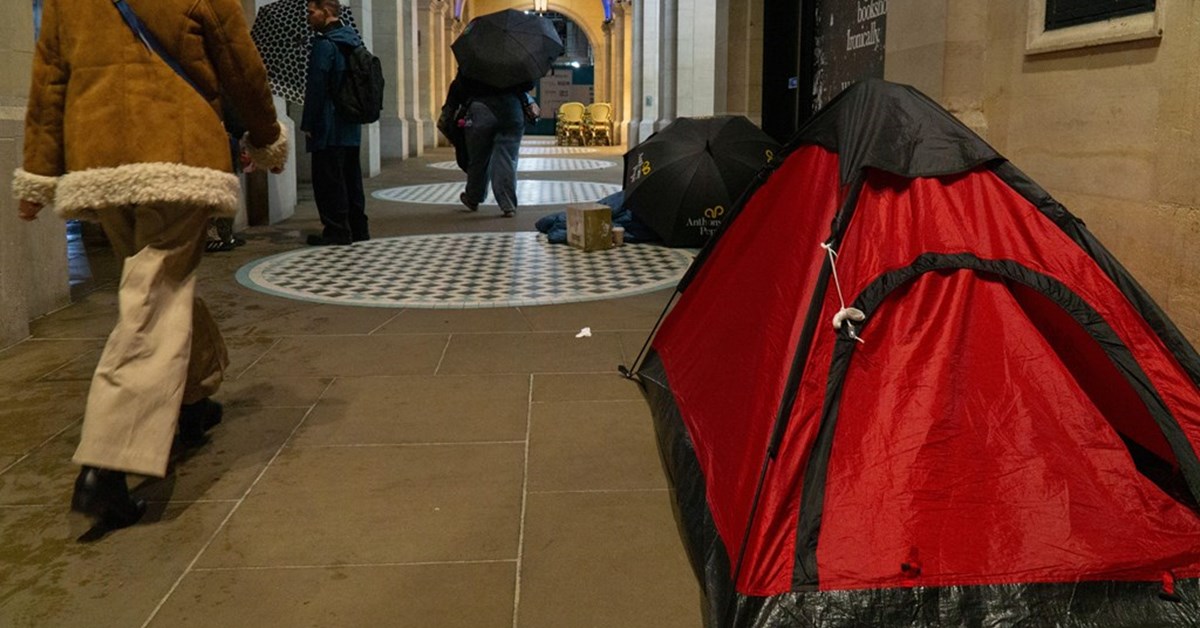
THE number of rough-sleepers in England had risen last autumn by 171 per cent since 2010 — an increase that should be seen as a “wake-up call”, the Christian homelessness charity Housing Justice says.
The report Rough Sleeping Snapshot in England: Autumn 2025 estimates that this is the fourth annual increase in a row: three per cent on 2024. The Ministry of Housing, Communities and Local Government published the figures on Thursday.
Across England, 4793 people slept rough on a single night last autumn, compared with 4667 for the same period the previous year. The figure has reached a “record high”, exceeding the previous peak of 4751 in 2017, the report says.
Housing Justice on Thursday expressed concern about the figures, describing them as “a wake-up call to the Government and wider homelessness sector that much more needs to be done to strengthen prevention efforts alongside supporting those already at crisis point”.
The report says that 43 per cent of all rough-sleepers on a single night last autumn were in London and the south-east. The north-west of England experienced the largest regional increase: 20 per cent, from 367 in 2024 to 441 in 2025.
Decreases were recorded in Yorkshire and the Humber area (15 per cent), London (three per cent), and the East Midlands (two per cent), the report says.
As in previous years, most of the rough-sleepers were male, over 26, and from the UK. The number of female rough-sleepers had risen by eight per cent since 2024.
The Ministry of Housing, Communities and Local Government has announced plans to tackle homelessness with more than £50 million in funding over the next three years to councils and front-line homelessness services.
The funding will be divided between various programmes. The Ending Homelessness in Communities Fund has received £37 million, most of the allocation. This money “will supercharge the work of voluntary, community and faith groups, often the first port of call for people in crisis”, the Government says.
A further £15 million is for the Long-Term Rough Sleeping Innovation Programme, which is to target 28 areas under the worst long-term pressure, including London. The Government’s National Plan to End Homelessness includes three pledges to be achieved by the end of this Parliament: to halve long-term rough sleeping, to end the unlawful use of B&Bs for families, and to prevent more households’ becoming homeless in the first place.
The chief executive of Housing Justice, Bonnie Williams, expressed disappointment at the increase in rough sleeping. “After years of growing numbers, we very much hope that this year will be a turning point,” she said on Thursday. “The underlying pressures that drive homelessness have not disappeared, and, while rough sleeping is the most visible form of homelessness, it is only part of the picture. The record numbers of households in temporary accommodation show just how many families are living in limbo.”
She welcomed the Government’s strategy, “particularly its stronger emphasis on prevention and early intervention. Preventing people from reaching crisis point, improving pathways out of temporary accommodation, and strengthening partnership working across housing, health, and local government will be essential if we are to see sustained change.
“The dedicated Ending Homelessness in Communities Funding is also a positive step. It has the potential to enable the voluntary, community, and faith sector to play an even greater role in the solution, providing compassionate, relational support that helps people move from crisis to stability, sustain tenancies, and rebuild fulfilling lives within their communities. We hope that this renewed focus on prevention and community-based solutions will mean that this time next year we see a significant and sustained reduction in rough sleeping.
“What we now need is continued collaboration between Government, local authorities, and community organisations to ensure that progress is maintained and that homelessness becomes rarer, briefer, and non-recurring.”