ALTHOUGH it is often claimed that religion was the main force preventing the advancement of medical knowledge and the practice of proper medicine in the Middle Ages, the Church actually played an important part in educating the laity — and perhaps especially the illiterate — about their bodies.
In theory, every priest needed at least a basic medical knowledge in order to do his job properly, since a confessor was supposed to consider his penitent’s complexion and state of health when assigning a penance, taking into account both their susceptibility to particular sins and their ability to cope with, for example, a prolonged fast.
Consequently, clergymen often had access to medical books. In Rochester, Bishop Hamo (1319-52) established a reference library for the use of priests, which included a volume of “Avicenna on the counsel of medicine” (that is, his Canon of Medicine), alongside works of canon law and theology.
A few decades later, Don Pedro Gómez Barroso, Archbishop of Seville (d. 1390) bequeathed his books — including both numerous medical texts by ancient authorities such as Galen and Avicenna and up-to-date works by contemporary experts such as Bernard de Gordon and the Spanish papal physician Arnau de Vilanova — to establish a similar library at his cathedral church.
Preachers also made frequent use of medical metaphors in their sermons, suggesting that both they and their audiences knew more about the body’s workings than we might expect. One widely circulated preacher’s handbook, written by a friar in early-14th-century England, provides valuable insights into what an ordinary Christian might have heard from the pulpit. It discusses topics including blood-letting, jaundice (which “arises from the disordered heat of the liver”), the dangers associated with bad smells and “raw and unhealthy food”, and the significance of sweat. Most intriguing of all is a passage in which the habits of a good Christian are compared to those of a healthy life, and spiritual practices such as confession and penance are compared to healthy habits such as exercise and phlebotomy.
More broadly, church teachings suggested that keeping healthy was a moral duty — not so much in the sense that we might now see it (as a way to reduce the tax burden and save the National Health Service, as well as protect the more vulnerable from contagious disease), but, rather, because of the belief that the body was God’s creation.
Although medieval saints often embraced an ascetic lifestyle (engaging in harmful practices such as extreme fasting and sleep deprivation), and churchmen often complained about people prioritising the health of their bodies over the health of their souls, it was widely accepted that Christians had a duty to look after their bodies.
OF COURSE, knowing what you should do doesn’t necessarily mean that you will do it: figures released by the British government in 2022 suggested that many of us ignore widely disseminated health advice, so that only one third of UK adults ate five or more portions of fruit and vegetables a day, and slightly fewer than two-thirds reached the recommended target of 150 minutes of moderate-intensity physical activity a week.
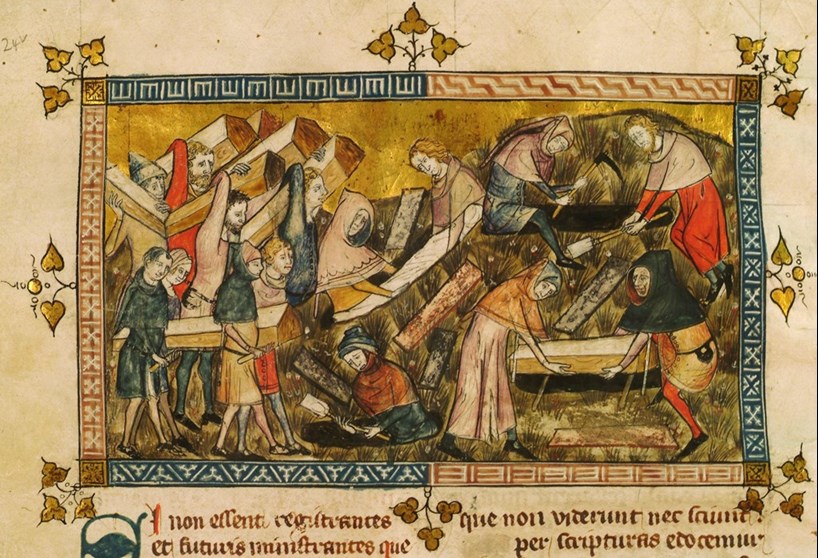 Bibliothèque Royale de Belgique, Brussels (MS 13076–7, fol. 24v), photo Jean-Louis Torsin/KIK-IRPA, CC by 4.0
The people of Tournai burying victims of the Black Death, 1349; from a chronicle by Gilles Li Muisis (c.1272-1352)
In the same year, 64 per cent of adults were overweight or obese, and 13 per cent smoked, while 30 per cent of men and 15 per cent of women admitted exceeding the recommended weekly alcohol limit.
Medieval people — even those who had access to the best-quality medical care — were similarly prone to ignoring their doctors’ advice. Petrarch wrote: “I have known many who obeyed doctors, and even doctors themselves, to have brief, sickly lives while others, defying them, live longer and healthier.”
Nor does it mean that you can afford to follow the advice. Health inequalities remain a serious problem in the modern world, as was vividly illustrated during the Covid-19 pandemic. A recent report by the UK charity The Health Foundation found that adults who lived in one of the most deprived areas of Britain were more than twice as likely to have a major health condition (such as chronic pain, chronic obstructive pulmonary disease, or diabetes) than someone who lived in one of the least deprived areas; they would, on average, develop a major illness ten years earlier than their more affluent counterparts, and were three times more likely to die before reaching 70.
And the gap was even bigger in the Middle Ages: many people lived at subsistence level, and their ability to take care of their health would often have been limited. Nevertheless, it is clear that medieval people placed greater value on their health, and had a better idea of what they could do to preserve it, than we often assume.
Doctors were also very clear on the consequences of too much wine, which dried out the body and turned to bile in the stomach, causing unpleasant symptoms such as insomnia, fevers, spasms and loss of wisdom. Such warnings were reinforced by church teachings, which condemned drunkenness as a gateway sin; in particular, it led to lust, because the “winds” produced by wine led to erections and the production of semen. (Interestingly, moralists often cited medical arguments when building a case against alcohol — pointing out that it caused bad breath, nausea, headaches, general loss of health, and eventually insanity.)
But inevitably, people did have too much to drink — with predictable consequences. Because the modern concept of proof emerged only at the very end of the Middle Ages, medieval people tended to understand a beverage’s strength in terms of the effects it produced, and thought that wine caused drunkenness because of the vapours that were produced when it was digested. These vapours rose to the head, where they affected the brain’s processing of images, leading to strange dreams and double vision.
Hildegard of Bingen described the effects of excess in graphic terms: if a person drank too much, “then all their blood is liquified, runs to and fro in their blood vessels, and spreads out so that their intellect and sensibility become confused, just as rivers, overflowing after a heavy rainstorm, cause a sudden flooding.” Drunk people behaved badly because their rationality was “suffocated and submersed”.
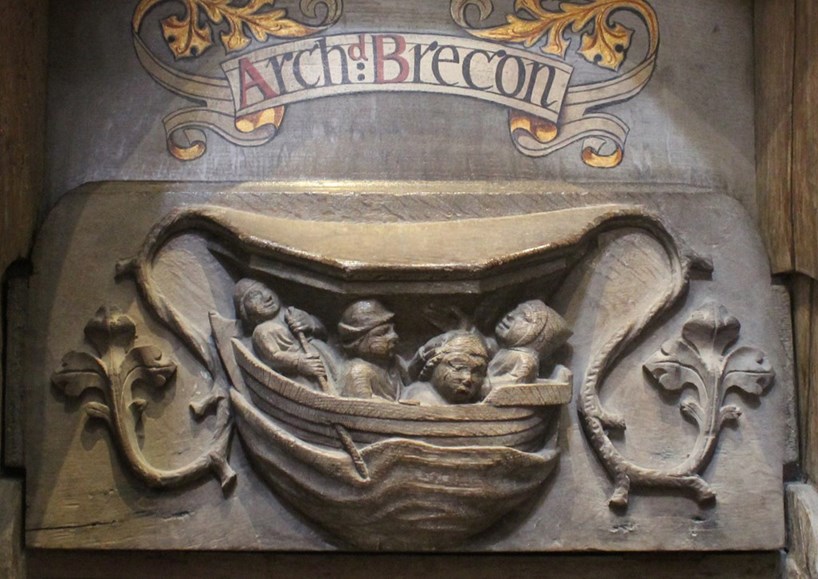 Photo Martinvl/Wikimedia Commons, CC by 4.0
A seasick pilgrim, from a late medieval misericord at St Davids Cathedral
Fortunately, there were lots of helpful tips to avoid drunkenness, preventatives including drinking an eggshell full of betony juice, eating a sour apple, or wearing an amethyst (which would suck alcohol vapours out of the body). One of the women in The Distaff Gospels (which purports to be a record of the conversations of six ordinary women in 15th-century Flanders, and probably does reflect the folk beliefs of that region) claimed that her father had never got drunk, however much wine he had, “because he would always invoke St Nicholas before and after drinking”.
Drinking sweet wine after strong wine might also help to prevent drunkenness, because its light vapours stopped stronger vapours rising to the head. Those who forgot to take precautions might take comfort from Avicenna’s suggestion that monthly inebriation could provide a useful purge — although this was not widely accepted by medieval physicians, who were strongly opposed to binge drinking.
FROM a modern perspective, food and (to a lesser extent) drink are inextricably linked to weight, so that we are frequently warned about the dangers of obesity, and constantly bombarded (whether or not we want to be) by the moralising messages of diet culture.
Medieval people saw things a little differently. Within the humoral system (according to which health was based on the equilibrium of four bodily fluids, each of which had a distinctive set of characteristics: blood was hot, wet and airy, while phlegm was cold, wet and watery; black bile — also known as melancholy — was cold, dry and earthy, and yellow bile — sometimes called choler — was hot, dry and fiery) weight could be viewed as a reflection of one’s complexion. Those with a phlegmatic nature were thought to be naturally plumper than their choleric counterparts, and consequently the ideal body weight was specific to the individual rather than determined by one-size-fits-all scales such as Body Mass Index.
But, while medieval people did not weigh themselves or count calories, they understood that there was a connection between overeating and obesity, and that certain foods were particularly likely to cause health problems. Hildegard of Bingen warned against eating too many fatty or blood-rich foods, including meat, because their “extremely slippery moistness” meant that they could not be properly digested.
Whatever caused it, obesity was an illness, because it stopped the body from working properly. According to Constantine the African, obesity suffocated the body’s natural heat, reducing the amount of blood and blocking the flow of the spirits. Hildegard suggested that the weight of surplus flesh would compress the pores, preventing the excretion of bad humours from the body.
Medieval people were well aware of the health risks associated with extreme fatness, and such medical messages were firmly reinforced by moral ones. The Church viewed gluttony as a deadly sin and railed against those who ate too much — for, as St Bernard of Clairvaux (1090-1153) proclaimed, “The soul is not fatted out of frying pans!”
Ordinary Christians would see and hear warnings against overeating in their church, and might be interrogated about their eating habits in confession. According to a manual for confessors used in the 13th-century diocese of Exeter, gluttony was “an immoderate fondness for eating and drinking”; the sin was committed when an individual “eats or drinks so much that the natural and regular workings of his body and mind are impeded by food and drink”, but also when a person enjoyed food too much, taking too much time over its preparation or spending all day looking forward to dinner.
The true motivations of people who restricted their food intake for reasons of vanity may also have been concealed (whether deliberately or otherwise) behind a patina of piety, since the Church strongly disapproved of gluttony, and encouraged its members to fast. While ordinary Christians fasted at particular times of year and when doing penance, the most devout were expected to go much further. Saints were particularly keen on extreme abstinence, to the extent that it was almost impossible for a medieval person who ate and drank normally to become a saint, however virtuous their life.
ACCORDING to the Church, the best form of joy came from God, in the form of religious devotions — and many medical experts agreed that such activities could improve a person’s mood, conveying the same health benefits as secular pleasures. Thus a 14th-century Occitan regimen included prayer as one of the activities that a person must do “with joy”, and that would lengthen life, while the bestselling Dietary written by John Lydgate (c.1370-c.1451) discussed moral conduct and the importance of regular devotions (a person should, for example, “do reverens” to God on rising), alongside warnings to regulate one’s emotions.
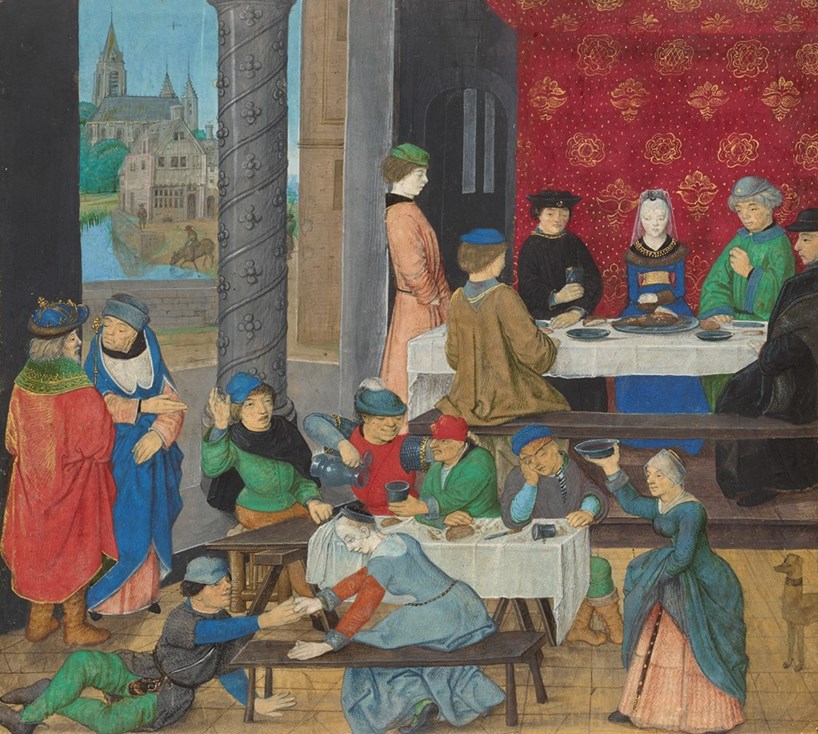 The J Paul Getty Museum, Los Angeles (MS 43)“The Temperate and the Intemperate” from a late-15th-century manuscript of The Memorable Deeds and Sayings of the Romans
Ideally, spiritual practices should be incorporated into daily life, so that the regimen commissioned by Archbishop Pedro of Seville (d. 1390) for that city’s residents advised them that the correct way of having a meal included both prayer and the consumption of healthy foods — and made clear that these things would help a person to live healthily and happily.
The perceived impact of religious devotions on bodily health is further proved by the fact that physicians often prescribed them, along with other forms of joy, to treat the sick. For example, the Paduan physician Bartolomeo Montagnana (1380-1452) told a patient with a cold complexion to pray and sing psalms in a high voice; these activities were almost certainly intended to provoke joy, which would warm his body.
The experiences of the Florentine wool merchant Giovanni di Paolo Morelli, who described the grief and guilt that he experienced after the loss of his eldest son, should be understood in a similar manner. Morelli found the first anniversary of the boy’s death especially hard and was tormented by terrible dreams, so that he “became desperate almost to the point of putting an end to all those adversities”. But his faith saved him.
The close relationship between the body, mind, and soul meant that a person who wanted to look after their soul must also look after their body, and vice versa. According to Maino de Maineri, “Just as bad morals result from a bad complexion, so bad complexion results from bad morals.” Consequently, a person who wanted to remain healthy must avoid sin and engage in regular acts of worship; in this way, one would improve both physical and spiritual health.
Some made even greater claims for the prophylactic benefits of churchgoing. The Florentine merchant Paolo da Certaldo advised going to church early in the morning; before leaving the house, you should say “Christ before all, peace on the way, may the Holy Spirit always be with us,” and if you did this, “nothing but good shall come to you for the whole day, and you shall come to no harm.”
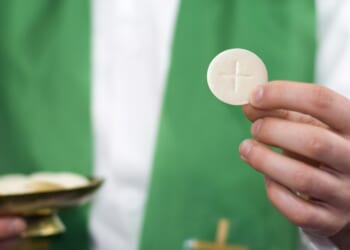
The eucharist was widely held to be good for both spiritual and physical health, and medieval hospitals were often designed so that patients could witness the celebration of mass from their beds. Some even claimed that anyone who saw the Host at the moment of elevation would be safe from death and blindness for the rest of the day.
Confession was another common and health-giving devotional practice, especially after the Fourth Lateran Council (1215) formally required Catholics to confess at least once a year. The same council also required physicians to ensure that their patients had confessed before they began treating them — not only to reduce the likelihood of anyone’s dying unshriven, but also because “as sickness of the body may sometimes be the result of sin . . . after their spiritual health has been seen to they may respond better to medicine for their bodies; for when the cause ceases so does the effect.”
The implication of this statement was that confession could treat not only the spiritual disease of sin, but any bodily diseases caused by sin. Consequently, confession was essential for the dying, but also beneficial to those who might recover (so that hospital patients were usually required to confess upon arrival, and healing miracles often began with a sick person confessing their sins), and to those who hoped to avoid sickness altogether.
RELIGIOUS behaviour had a tangible impact on the body, but late medieval Christianity also placed great value on objects and images. It was widely believed that an image or statue of a saint was not just a representation, but a potent object that contained some of the saint’s power — and medieval sensory theory meant that when a person looked at, touched, or otherwise interacted with such an object, they absorbed some of the properties that it contained.
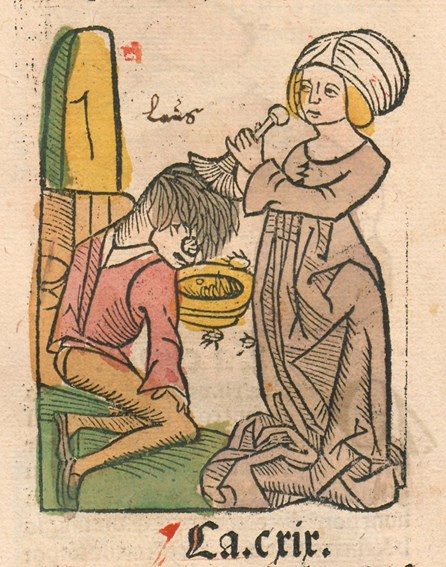 National Library of Medicine, Bethesda, MDA woman delousing a child, in a woodcut from Ortus Sanitatis (1491)
For this reason, medieval people often kissed and stroked images in religious books, to the extent that many are physically damaged, and traces of saliva and facial oils can still be detected on the parchment.
Indeed, the belief in the power of objects meant that a church could be seen as a therapeutic environment: for example, many featured wall paintings of St Christopher carrying the infant Christ across a river, and it was widely believed that a person who saw one would not die suddenly that day.
Popular faith in such talismans also helps to explain why late medieval homes were full of religious objects, many of which were believed to have prophylactic and/or healing powers. Most middle-class and elite homes would have displayed at least one image of the Virgin and Child, and religious imagery also decorated domestic items such as crockery, combs, and storage chests.
In late medieval London most people owned devotional statuettes, with small, clay figures of popular saints such as the Virgin Mary imported in large numbers from Germany, affordable even to servants. Even cakes and sweetmeats were decorated with images of saints. If having holy objects in the home offered protection, objects that could be worn on the body or carried about the person were even more useful.
Many people wore protective jewellery, such as rings inscribed with the names of the Magi (which were supposed to ward off illness) or decorated with tau crosses (to ward off the plague). Clothing fastenings often incorporated devotional inscriptions and images; one remarkable hook and eye from Sweden showed St George vanquishing the dragon. Records kept by late-medieval Italian pawnbrokers suggest that, even among the poor, many people owned cheap, mass-produced devotional objects such as rosary beads and small crosses.
Amulets were another popular form of protection and worked in a similar way, transmitting the power of the words and names written on the parchment to the body on which it was placed. A 14th-century amulet produced for a woman named Lucy invoked a long list of holy names (including Christ, 134 Christian martyrs, the twelve apostles, and All Saints), and promised protection from ailments including headaches, toothache, fever, and gout.
Although some were sceptical about the value of such objects, and some medical men wrote scornfully about those who believed that a piece of paper could offer either protection or cure, demand for amulets remained high right up to the end of the Middle Ages, by which time the invention of the printing press had made mass-production possible.
Such things could be — and no doubt often were — understood in purely spiritual terms, and assumed to work because they pleased God and/or his saints, who therefore granted special protection to the wearer. But, as with many other seemingly irrational aspects of medieval medical practice, they are best understood as part of a sophisticated belief system that combined medical and religious elements to offer maximum protection to vulnerable human bodies — and as part of a much broader landscape of ideas and practices that helped to keep people healthy in a dangerous world.
This is an edited extract from The Medieval Guide to Healthy Living by Katherine Harvey, published by Reaktion Books £20 (Church Times Bookshop £18); 978-1-83639-184-5.