THE eulogy standby “touched the lives of all they met” rings true in the case of John Piper. The art critic John Russell called him “a born collaborator”, referring to works including Coventry Cathedral’s baptistery window and the altar tapestry at Chichester Cathedral.
On a busy Saturday in Wiltshire Museum, in Devizes, I bumped into Hugo Brunner, publisher of Piper’s Places (1983), who recounted shared day trips to parish churches near their homes in Henley-on-Thames. Museum staff say that visitors’ relating stories of meeting the artist, or having a connection to work on display, has been a constant during “John Piper in the South Country”.
Curated by a resident of Devizes, Andrew Lambirth, with a fully illustrated catalogue, the show highlights Piper’s affection for the town. Having first visited as a teenager, the artist described it in 1944 as “an English town that has not been spoiled and has not been preserved artificially”. It is still possible to go to the café where he observed the town from a first-floor window.
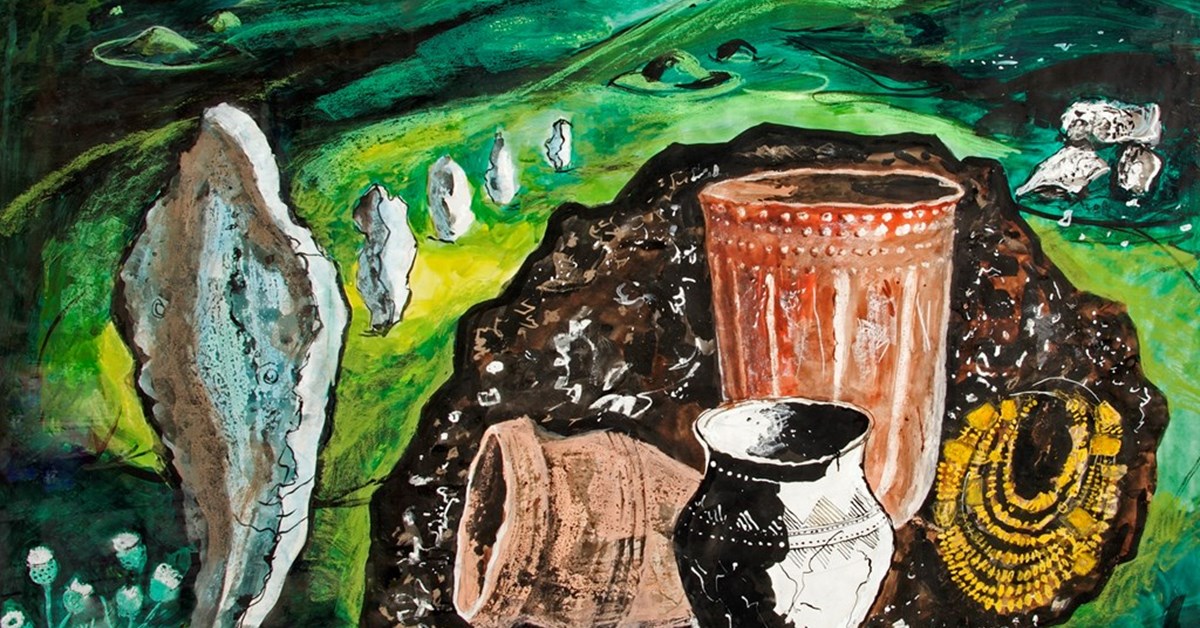
The stained-glass window that Piper created for Wiltshire Museum in 1981 forms a backdrop to the exhibition’s second gallery. Piper’s partner for the museum window was the stained-glass artist Patrick Reyntiens, who was introduced to him by John Betjeman. They went on to work on windows for the chapel at Oundle School, Liverpool Metropolitan Cathedral, and, most famously, Coventry Cathedral. The museum window presents an other-worldly Wiltshire landscape, with a white horse in the background and Bronze Age pots in the foreground, cracked and aged through Reyntiens’s irregularly shaped, heavy black leading. Standing stones draw the eye into the image.
Piper’s ambiguous relationship with figuration is one of the key impressions of the Devizes show. Despite spells at Richmond Art School and the Royal College of Art, Piper was a largely self-taught artist, and a tension between modernist innovation and more conventional neo-Romantic approaches to art runs throughout his career.
In the mid-1930s, when Piper’s art was at its most abstract, he began making collages. In Knowlton, 1936, a white and grey paper church tower gains depth by the raising of the front elevation from the surface of the earth-toned landscape. The mass of the tower is further emphasised by lozenges of pink delineating its upper corner. Piper’s collages were sometimes made with a ready-prepared folio of paper shapes and glue, out in the landscape, and sometimes constructed in the studio. The artist later observed: “The collages were my means of keeping in touch with natural appearances.”
Piper made his first set design in 1938, and the skill of creating the illusion of extensive space through perspective and blocks of colour is evident in Approach to Fonthill, 1940. White detailing around the entrance arch, in contrast to the simplicity of the surrounding shapes, brings the viewer into the picture plane as if navigating a route through a 3D landscape. Autumn at Stourhead, 1939, with its central pale-yellow church tower, fuses different techniques and influences. The oil painting is a translation of a collage that Piper made on the spot at Stourhead. He described the work as “attempting to combine what I saw with what I had learned of ‘non-figurative’ work in the past five or six years”.
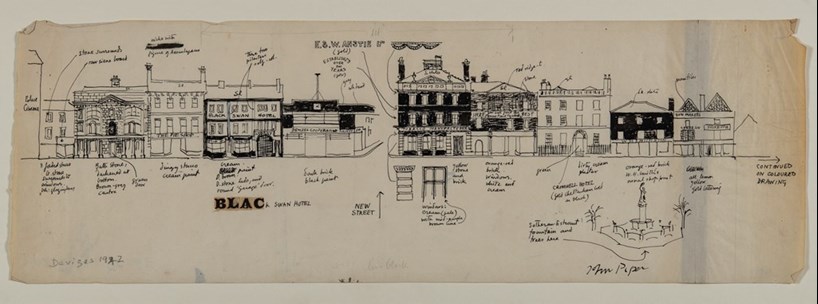 Wiltshire Museum
Purchased with the aid of Art Fund and
Arts Council England / V&A Purchase Grant FundDevizes Market Place, 1942, ink drawing, by John Piper
Figuration was much in evidence in Piper’s work as an official war artist. Wartime art’s use as propaganda to draw the United States into the war left little room for experimentation. Piper embraced a neo-Romantic style, comparable to that of his fellow war artists Edward Ardizzone and Graham Sutherland.
While working in Bristol, drawing bomb-damaged buildings, Piper drew the Gothic Revival Lacock Abbey in the winter of 1940. Returning two years later, when working in Bath, Piper painted Lacock Abbey from the West, 1942. The oil painting is a firework display of red roofs, yellow stonework, long shadows, and multi-hued night sky in charcoal, electric blue. and white. Non-naturalistic colour is a far smaller element of Bishopstone Church, 1946-7, presenting the 13th-century exterior of St John the Baptist’s, near Salisbury, in grey and black watercolour and ink, with a few details washed in yellow and brown. Piper’s affection for English parish churches is well known. This work was in his first solo show in the US in 1948.
Piper’s colour washes became bolder at the end of his career. Stourhead Gardens and Grotto, 1980 offers three vistas of the historic site in shades of crème de menthe and black. For Piper, Stonehenge was “a slowly evolving animal”. Stonehenge, Wiltshire, 1981, based on a photograph taken by the artist’s son Edward, tinges the monument and enveloping sky in bursts of ochre, as if capturing a living form reacting to sunlight.
Piper began writing and illustrating guides as a child, and with his contributions to the Shell Guides and prolific output of English landscapes, it is tempting to think of him as a chronicler of the past lightly alloyed with the present. Yet his window at Coventry Cathedral, created in 1962, shows the boldness and experimentation evident in his earlier works. Perhaps if it were not for the representational demands of the war effort, requiring quickly executed, easy-to-understand, emotionally resonant scenes, Piper might be remembered today as great modern artist, as well as a popular and accessible one.
“John Piper in the South Country” is at Wiltshire Museum, 41 Long Street, Devizes, Wiltshire, until 6 June. wiltshiremuseum.org.uk It will then be at Museum & Art Swindon, Civic Offices, Euclid Street, Swindon, from 4 July until 26 September. museumartswindon.com