SOMETIMES, the liturgy draws you through, and the community of faith carries those for whom Easter does not come — or does not come on time, and never on demand.
This year, thousands have experienced Good Friday in the wars fought out in the Middle East, Ukraine, Sudan, and beyond, where we are all complicit, and the innocent carry the consequences. Whether in death by violence, sudden or long drawn out, in maiming and grieving, or in traumatising for life, the pain is so vast that it blurs the human mind. Sometimes, it is the mystery of the individual which brings us back to the cross.
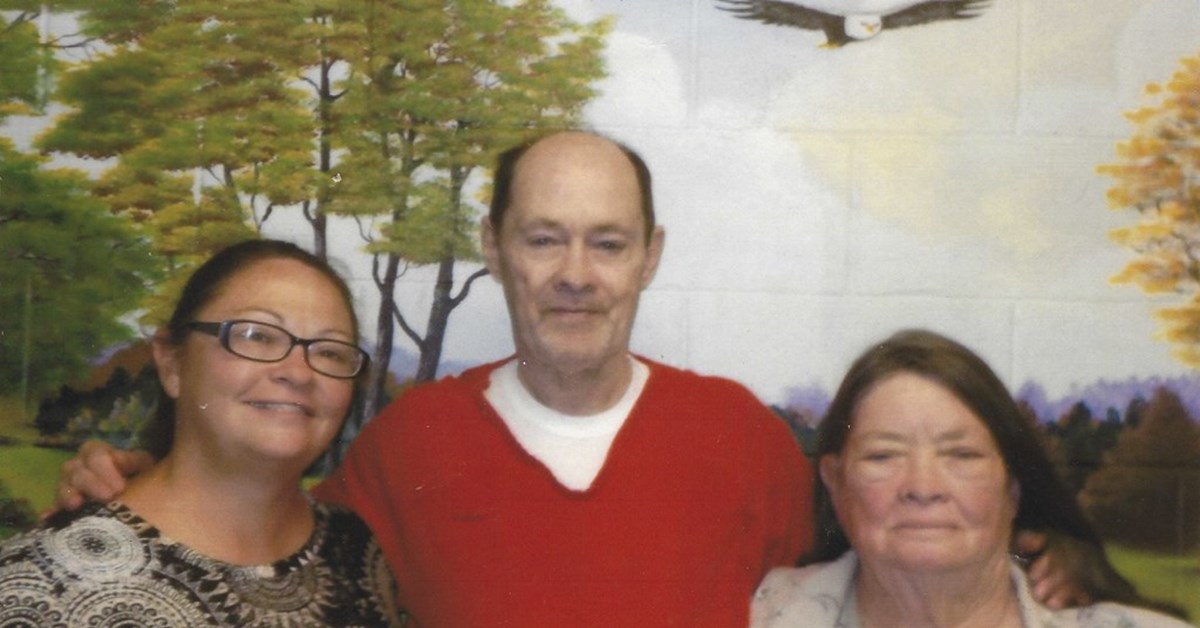
IN HOLY WEEK, James Hitchcock, a prisoner on death row in Florida for 49 years, and my penfriend for nine, heard the van coming. No one knows whom it comes for until their cell is approached and they are swiftly taken. Farewells are forbidden by the system. But the remaining men shouted their care for him through the bars. He was taken to the death cell in the old prison, to be held until his execution date on 30 April.
The news came to me on Holy Saturday: that quiet day when we reflect on our own deceased, but also on a world without God incarnate — in which prayer has no meaning, we have killed the mystery at the heart of the world, and we are on our own.
The imagery is of Good Friday. The three death cells are full, emptying as their occupants are led to their deaths near by or, in rare and troubling cases, to a stay of execution which may only prolong the torture. This is a state that James had known for more than 30 years. Last time he was in the death cells, in 1984, he gained a stay. On the morning of his last presumed day on earth, he was returned to his former cell, not knowing that another 42 years lay before him or that his 70th birthday — on Easter Day — would be marked in the same death cell.
THEY do not crucify people in Florida, although the gurney that the condemned are strapped to is cruciform, the better to get at the veins in order to inject the drugs that are forbidden for use on animals. By all accounts, the killing is agonisingly physically painful — and sometimes lengthy, although the plan is for it to be over in minutes, because physical pain at the end is considered unseemly. The death cells, unlike the death-row cages, even provide air-conditioning for the last four weeks of life.
James would be blessed by onlookers, whereas many have no one. It will not be his sisters who will grieve, Mary and Elizabeth, who stood by him all the years — Betty died at Christmas. Others, younger and also powerless, will mark his death and will beseech the authorities for the body for burial 14 hours’ travel away, beside that sister.
THERE are, of course, the distant ones who sit in judgment, with power of life and death, and the capacity for handwashing. Both the Governor of Florida and the state attorney are Roman Catholics, although they are at variance with Catholics who have condemned the death penalty for decades. The three death cells are usually occupied, but there is even a Barabbas, who has been granted a stay, making James’s execution still more likely. The “good thief” known to James for 30 years was there until he was killed on 21 April.
I understand that the prison governor absents himself at the end. For the uncleanness of killing, there are prison officers. Some are compassionate, and, while they cannot offer cheap wine, they may ensure that final letters and phone calls get out — and in. I received one of each last week, full of concern for his friend. For others, there was a farewell of peace.
JAMES was not Christ, nor were his companions, and, no doubt, like us all, they were not guiltless. But they were not necessarily guilty as charged, and none deserves the obscenity of execution. Each was created uniquely, to enter life in a certain time and place, with certain roles to undertake, ways to experience the fullness of life and to be of service to others. The hour of our death is planned by God. I believe that to shorten it — whether through mass bombings or authorised individual homicides — is to violate God’s will.
On a practical level, it can do no good, but does much evil in further brutalising society, denying the creation of each person out of love, however distorted the shape may be. It is rare that a person is so dangerous that they must be held away from the community. Even then, compassion and respect for what each person could have been is surely the duty of the rest of us.
A CONDEMNATION to death in this society, separated by the Atlantic and yet so similar to our own, means that there is another someone whose life was taken, whose right to life was denied, and whose story may get lost. In this case, she was little older than Jesus was when he was lost in Jerusalem, or Jairus’s daughter, although it seems likely that she lacked the love and protection that they received.
St Matthew’s Gospel requires us to visit prisoners, regardless of why they are there. Some of those on death row are guilty of vile murders; some were bystanders or accomplices; some are innocent. For 50 years, James has maintained his innocence of the crime for which he was, at 19, sentenced to death.
Perhaps it is this declaration that has kept him sane down the years. In a place of no hope, no stimulation, and against the odds, he studied for and passed his school examinations in his twenties. Since then, he has read, thought, written about, and commented on concerns for the world, its wars, the climate crisis, and more. He wrote of his bereaved, impoverished but free-roaming childhood, of troubles that came early. As the other inmates showed in their parting shouts, rather than flee reality, he gave kindness and, perhaps, courage to others. There is camaraderie among those the world has discounted.
THE first time in the death cell, he was, to begin with, afraid. It was slowly, in the torturous month of waiting, that calmness came — and in the end, peace. If this was his portion, he would not be dragged to death, but would face it. He had a faith in God and in a future, less hellish life. There, he would meet friends executed before him.
His last hour would be accompanied by a vigil of strangers, outside the gates and online, following him to the edge. Because he was fortunate, one or two family members would make the long journey to stand behind the glass, watching.
The killings of thousands are too vast for us to carry. God resides in each individual and in the relationships we form. James himself was not lessened as he approached violent, scheduled, death, though others are.
Rosemary Power is a writer and editor. Her latest volume of poetry, Across the Narrow Straits: Place and pilgrimage, is published by Wild Goose Publications: ionabooks.com/product/across-the-narrow-straits.
The charity founded to provide correspondents for prisoners on death row in the United States is LifeLines. lifelines-uk.org.uk