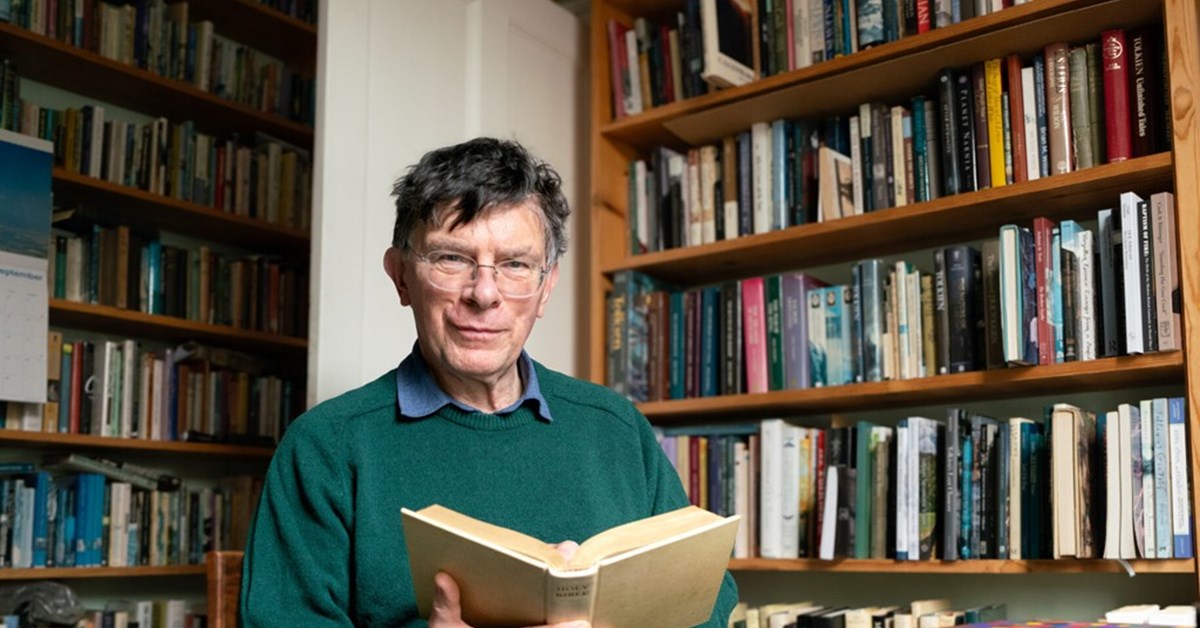
THE winner of 2026 Templeton Prize, worth £1.1 million, is the palaeontologist Professor Simon Conway Morris, it was announced on Tuesday.
He was awarded the prize “for his outstanding contributions to the field of evolutionary biology and his enduring efforts to explore the broader human implications of his scientific discoveries”, the Foundation said.
The Prize, established in 1972 by the investor and philanthropist Sir John Templeton, honours those who yield new insights into religion and science, making what he called “progress in religion”.
Professor Morris is internationally recognised for his research on the Cambrian explosion and his analysis of the Burgess Shale fauna. These studies have, the Foundation said, “significantly reshaped our understanding of the early evolution of animal body plans and the dynamics of evolutionary innovation”.
His books include Life’s Solution (2003), The Runes of Evolution (2015), and From Extraterrestrials to Animal Minds (2022), in which he explores how evolutionary pathways may be “more constrained and directional” than previously assumed.
The president of the John Templeton Foundation, Timothy Dalrymple, said: “What makes Conway Morris abundantly deserving of the Templeton Prize are his groundbreaking advancements on the theoretical foundations of evolutionary theory alongside his commitment to addressing the philosophical implications of that work for humankind.”
Professor Conway Morris said: “As somebody once said — ‘Be careful when you step onto the unending road.’ A PhD on fossil worms might logically lead to field-work in Greenland, but to an absorption with evolutionary convergence and thence the Fermi Paradox? And still the road stretches on, now to the question of human uniqueness and I suspect way beyond.”
Professor Conway Morris was born in 1951 in Surrey and raised in Wimbledon. When he was seven, his mother gave him an album of stamps depicting various prehistoric animals and dinosaurs. This, he says, prompted him to go fossil-hunting and inspired a lifelong fascination with the evolution of life.
He earned a first-class BSc from Bristol University in 1972 and a PhD at St John’s College, Cambridge (where he remains a Fellow) in 1976 under the tutelage of the palaeontologist Harry Blackmore Whittington. In 1990, aged 39, he was elected a fellow of the British Royal Society. He has remained at Cambridge for most of his career. He was Professor of Evolutionary Paleobiology, chairing the department of evolutionary paleobiology, and remains an emeritus professor.
In its announcement, the Foundation said that Professor Conway Morris’s “field-defining work on convergent evolution is the basis of his argument that there is a deeper order to biology that facilitates the development of intelligent life. He is careful to contrast this idea with the Intelligent Design movement, which he has long criticised for purporting that natural processes are insufficient to produce biological complexity, requiring supernatural intervention.
“Instead, Conway Morris seeks to elucidate that the universe itself is biophilic, with fundamental natural laws bringing into being the life forms we see today.”
A professing Christian, Professor Conway Morris is highly critical of materialism and reductionism, and has participated in many public debates on religion and science. His study of the patterns and processes of life on Earth has, in recent years, led to a keen interest in astrobiology — “The study of things that do not exist,” as he says.
Despite the vast number of galaxies and potentially habitable planets in the universe, humans have not detected any life beyond Earth — a concept known as Fermi’s Paradox. Professor Conway Morris has proposed several answers to this enigma. “Life may be a universal principle, but we can still be alone,” he wrote in Life’s Solution.
In a video for the Templeton Prize titled “Patterns of Life”, Professor Conway Morris said: “There’s no reason to think that knowledge somehow will reach some sort of terminus. It may be infinite. . . It’s the sense that one is really just scratching the surface of what one may one day know, and that’s all one can ask for.”
Mother Teresa was the first to win the prize, 50 years ago. Other winners have included Dame Cicely Saunders (1981), Archbishop Desmond Tutu (2013), and the Dalai Lama (2012).