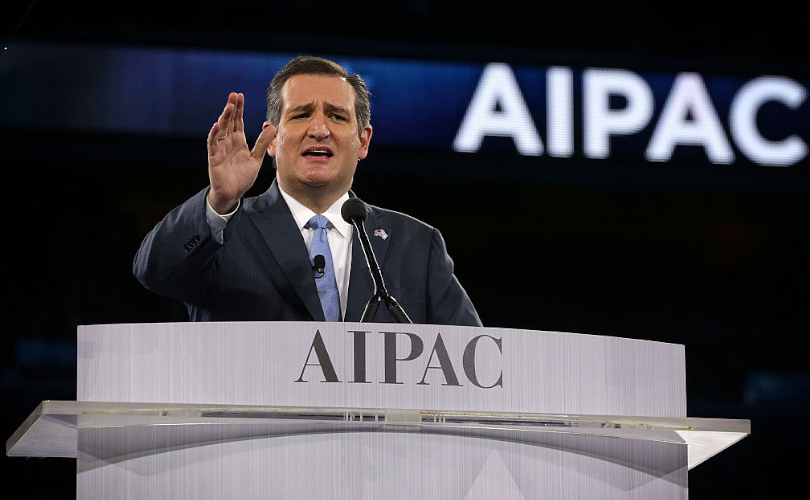
(LifeSiteNews) — Texas Senator Ted Cruz appears to be doubling down on his demonization of traditional Catholics, suggesting that they are being used by “America’s enemies” to undermine support of Israel.
The GOP senator reposted an X message from “The Drunk Republican” which claimed that “America’s enemies are using influencers and centuries-old tropes to divide the right” as a means of “getting the left” into power. He also quote-posted it with a “thinking emoji.”
— Ted Cruz (@tedcruz) March 17, 2026
The message does not name Catholics, but repeats similar themes to the article which he endorsed on March 15, which accused a broad range of Catholics of pushing a “foreign” and “medieval” ideology, which undermined support for Israel among American conservatives.
After intense backlash, Cruz appeared to walk back his endorsement of the article’s anti-Catholicism, but claimed that it showed “how profoundly harmful the concerted efforts are to drive a wedge between [‘faithful Catholics and Evangelical Protestants’].”
I read it as precisely the opposite. We desperately NEED to preserve the strong union of faithful Catholics and Evangelical Protestants—it has been the foundation of the modern conservative movement. The article lays out how profoundly harmful the concerted efforts are to drive a…
— Ted Cruz (@tedcruz) March 16, 2026
Such a comment is itself an attempt to “drive a wedge” between Catholics.
Is there a ‘Catholic conspiracy’?
The content which Cruz has endorsed purports to expose a secret conspiracy of Catholics seeking to subvert the interests of the U.S. This is flawed for two reasons.
First: for centuries, the Church openly taught what has come to be known as “the Social Kingship of Christ.” This doctrine and political philosophy holds that the civil authority is not only obliged to work for the common good of the state; it is also obliged to recognize Our Lord Jesus Christ and His religion, and to govern in accordance with the Gospel.
There is nothing secret about this. It was long a source of conflict in the pluralist United States. Professor Elizabeth Fenton, of the University of Vermont, charts the history of this conflict in her book Religious Liberties, and concludes that American anti-Catholicism only receded in civil life when enough prominent Catholics abandoned this teaching:
Catholicism finally enters liberal democracy’s purview when it out-Protestants the Protestant; remade as individual and autonomous, private and tolerant, the Catholic can at last lay claim to religious liberties. (p. 147)
But the abandonment of this doctrine by a certain number of such men does not change the status of the Church’s teaching, or make Catholic commitment to it secret – even if some non-Catholic American may be surprised when they realize this.
Second: the allegation of such a conspiracy is hypocritical. For centuries, the popes taught and warned the world of the existence of men working to dethrone God from civil society, to replace His law with a revolutionary order based on man himself, and to elevate the state above the Church.
Pope Leo XIII summarized their political ideology as follows:
[T]heir ultimate purpose forces itself into view – namely, the utter overthrow of that whole religious and political order of the world which the Christian teaching has produced, and the substitution of a new state of things in accordance with their ideas, of which the foundations and laws shall be drawn from mere naturalism….
It is held also that the State should be without God; that in the various forms of religion there is no reason why one should have precedence of another; and that they are all to occupy the same place.
By a long and persevering labor, they endeavor to bring about this result – namely, that the teaching office and authority of the Church may become of no account in the civil State; and for this same reason they declare to the people and contend that Church and State ought to be altogether disunited. By this means they reject from the laws and from the commonwealth the wholesome influence of the Catholic religion; and they consequently imagine that States ought to be constituted without any regard for the laws and precepts of the Church. (Humanum Genus, n. 10, 12.)
This is the ideology that triumphed in the American and French revolutions (1765 and 1789 respectively). It is the basis of the American Constitution’s attitude toward religion, and of Cruz’s hostility toward Catholic doctrine on the right ordering of the Church and state.
The popes also warned that the success of such a “conspiracy” would result in the very evils we see today – rampant immorality, a breakdown of social cohesion, and general rejection of God:
[T]hey contend that youth should be instructed, is that which they call “civil,” and “independent,” and “free,” namely, that which does not contain any religious belief. But, how insufficient such teaching is, how wanting in soundness, and how easily moved by every impulse of passion, is sufficiently proved by its sad fruits, which have already begun to appear.
For, wherever, by removing Christian education, this teaching has begun more completely to rule, there goodness and integrity of morals have begun quickly to perish, monstrous and shameful opinions have grown up, and the audacity of evil deeds has risen to a high degree. (Humanum Genus, n. 19)
Thus Cruz is essentially standing as a spokesman for a triumphant party of conspirators and revolutionaries, who have long since become the establishment, and is claiming that there is a conspiracy of those who never accepted those revolutions’ naturalistic and indifferentist ideals.
Support for Israel presented as the linchpin of American conservatism
Although the content Cruz has promoted rejects the Catholic doctrine of “the Social Kingship of Christ” (and who describes the phrase “Christ is King” as “anti-semitic”), the article itself is principally focused on the necessity of support for the foreign state of Israel.
While Cruz and his endorsed sources are united in their opposition to the Social Kingship of Christ, they paradoxically believe that their understanding of the role of Israel should determine the nation’s foreign policy.
According to the material Cruz is promoting, American conservatism is to be open to men of varying denominations and sects – provided that they embrace a very particular view of Israel, which is to be the central, non-negotiable principle of the movement.
This is the principal focus of the material which Cruz has shared, and in keeping with the long-term goal he stated to Tucker Carlson in 2025:
I came into to Congress 13 years ago with the stated intention of being the leading defender of Israel in the United States Senate [and] I’ve worked every day to do that.
The article Cruz shared claims that American Evangelicalism’s “entire political architecture rests on a theological claim”:
[T]hat God made an eternal, unconditional covenant with the Jewish people, that the modern state of Israel is a fulfillment of biblical prophecy, and that Christians who “bless Israel” are obeying a direct divine command.
It also suggests that “evangelical theology” itself is based on this claim, and that it is “the moral engine that has driven evangelical political engagement for half a century.” This is a very striking claim about Evangelicalism.
While it expresses anxiety that Catholic social doctrine will make Protestants “second-class citizens,” the chief fear expressed is that the influence of the “foreign” and “medieval theological framework” will lead to Republican presidential nominees “that no longer need to make the same explicit commitments to evangelical Israel theology that every Republican nominee since Reagan has made.”
Both the article and the post shared by Cruz allege that this commitment is being undermined by “centuries-old tropes” – but in reality, the author of the article admits that this “theological claim” is itself a departure from “the dominant theological position regarding the Jewish people” throughout Christian history. Cruz is endorsing a position which condemns those who have simply declined to take up a novel position, which he and others have elevated into dogma.
The unholy alliance proposed for American conservatism
The article, and by extension Cruz, makes an embrace of this politico-theological framework the condition for a “strong union of faithful Catholics and Evangelical Protestants” in the modern conservative movement.
This makes American support for the state of Israel of higher importance for this “strong union” than God, His rights and His law, and the common good of civil society.
But international alliances should be made in accordance with God’s law and the good of the nation itself; any other basis is a form of idolatry, giving what is due to Christ to a foreign nation – even while it cites God’s will and America’s interests as its rationale.
In rejecting the idea that the state is obliged to recognize and worship God in the way that He has revealed, the worship due to Our Lord Jesus Christ is transferred, effectively, to Israel. Similarly, the good of the nation itself is made subordinate to the good of a foreign nation.
A political movement united around any “values” unmoored from God and the good of society – especially when such “values” are an acknowledged departure from “the dominant theological position” of Christian history – should be divided, because it exists only to detract from the glory of God and the salvation of human souls.