THE first word, “between”, in the first poem in Seamus Heaney’s first collection, Death of a Naturalist, hallmarked the writing that was to become his life, and the life that was his writing. The poem, “Digging”, begins: “Between my finger and my thumb The squat pen rests; snug as a gun.” It contrasts the agricultural history of his forebears in rural Ulster with his scholastic life as a student in Belfast. The poem acknowledges a transfer of power, from spade to pen, and his duty to develop it. The “gun”, in his conflicted country, has to be pacified. Heaney will “dig with it”.
Heaney’s life was a procession of “betweens”. He was the eldest of eight children in a Roman Catholic family in the north-western corner of majority-Protestant Ulster. Life moved between hearing rats scuttling through the thatch of a crowded cottage and academic commuting from a home in Dublin to teach as a professor at Harvard, a peripatetic calling between teaching creative literary achievement and adding memorably to it. Identities ranged from being a homesick scholarship boarder in Derry to receiving the Nobel Prize for Literature.
His poetic career was vertical. Three early poems published in The Listener were spotted by Faber, who became his lifelong publishers. His first collection appeared in 1966, just four years after he had drafted his first poems. Individual collections were published in their thousands: total sales topped one million. Heaney’s “remarkable rendering” of the Anglo-Saxon epic Beowulf sold 193,000 copies in Heaney’s lifetime alone.
The Poems of Seamus Heaney is an appropriately monumental book of some 1250 pages, honouring a poet credited with the introspection of Wordsworth and the grandeur of Yeats. It is prefaced by 29 early, unpublished poems, and bookended by 25 further unpublished poems chosen by his widow, Marie, and the Heaneys’ three children. It includes the 550 poems from 12 collections, interspersed with uncollected poems published around the same time, all the work informed by commentary. It will undoubtedly prove to be the most significant collection of English-language poetry in the 21st century.
Heaney’s supreme achievement is matching deft and recognisable descriptions with determined analysis. He wrote of childhood games and maturing love, of consolatory landscape amid the tensions and terrors of the Irish “Troubles”, always negotiating between the “griefs and wonders” that he detected in the work of his contemporary Michael Longley. In an early poem, “The Peninsula”, written after a drive with his wife and the Longleys, Heaney celebrates “The glazed foreshore and silhouetted log, That rock where breakers shredded into rags”, while acknowledging “that now you will uncode all landscapes By this: . . .”.
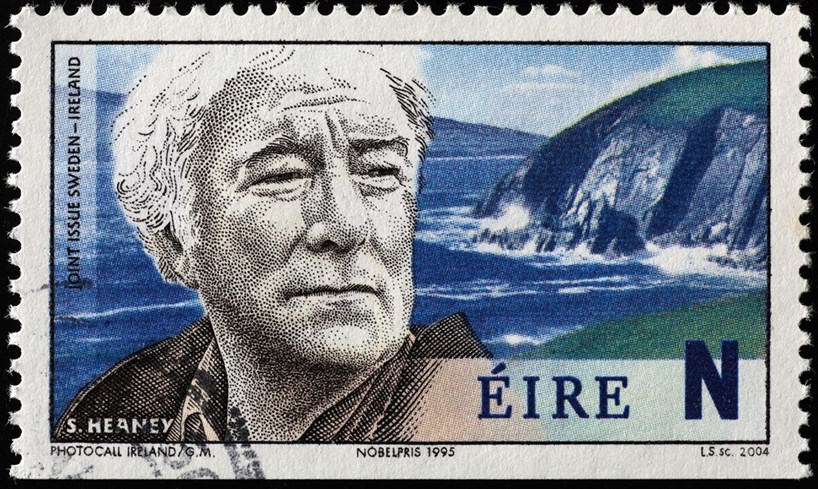 alamyThe Nobel laureate Séamus Heaney commemorated on an Irish postage stamp
A dogged economy powers the poetry, as in his admiration for the imagined preaching style of St Francis addressing a congregation of celebratory birds: “His argument true, his tone light”. Work was developed from “copious drafts”, relying “on blazing graft with the sleeves rolled high”. Demanding travelling produced some of those drafts on hotel or airport notepaper; some “roughs” were dated and timed in the early hours. His collection Electric Light had 41 potential titles. “Trusted readers” would be invited to comment on work in progress, and three or four different versions of a published poem could appear before incorporation into a collection.
Heaney could also hold his ground against those questioning his vision and vocation. An editor of the magazine The Honest Ulsterman who wrote in 1971 that Heaney’s work was “everything that poetry should not be” received a 36-line riposte, which the magazine published, addressed to “you editorial dope”. (The editor, Michael Foley, recanted, writing in 2020 in The Irish Times of his conversion to a “love” of Heaney’s poetry.) In North (1975), which many see as a signpost to deepening political involvement, Heaney also wrote of the cost of writing:
Compose in darkness.
Expect aurora borealis
in the long foray
but no cascade of light.
Similarly, for all his later disavowal of religious belief, Heaney’s poetry remains “between” the faith of Lourdes and penitential pilgrimage, and “no cascade of light”. His work keeps contact with the Christian Gospels, and even up to the final poems of his final collection, Human Chain (2010), the aerial images of airfield, attic, and kite-flying look upwards, into ascension.
Dr Martyn Halsall is a poet and journalist.
The Poems of Seamus Heaney
Seamus Heaney
Bernard O’Donoghue, Rosie Lavan, and Matthew Hollis, editors
Faber & Faber £45
(978-0-571-34038-5)
Church Times Bookshop £40.50