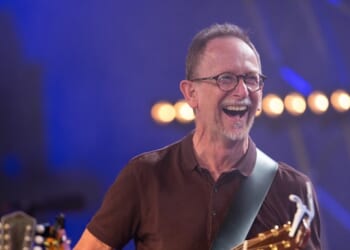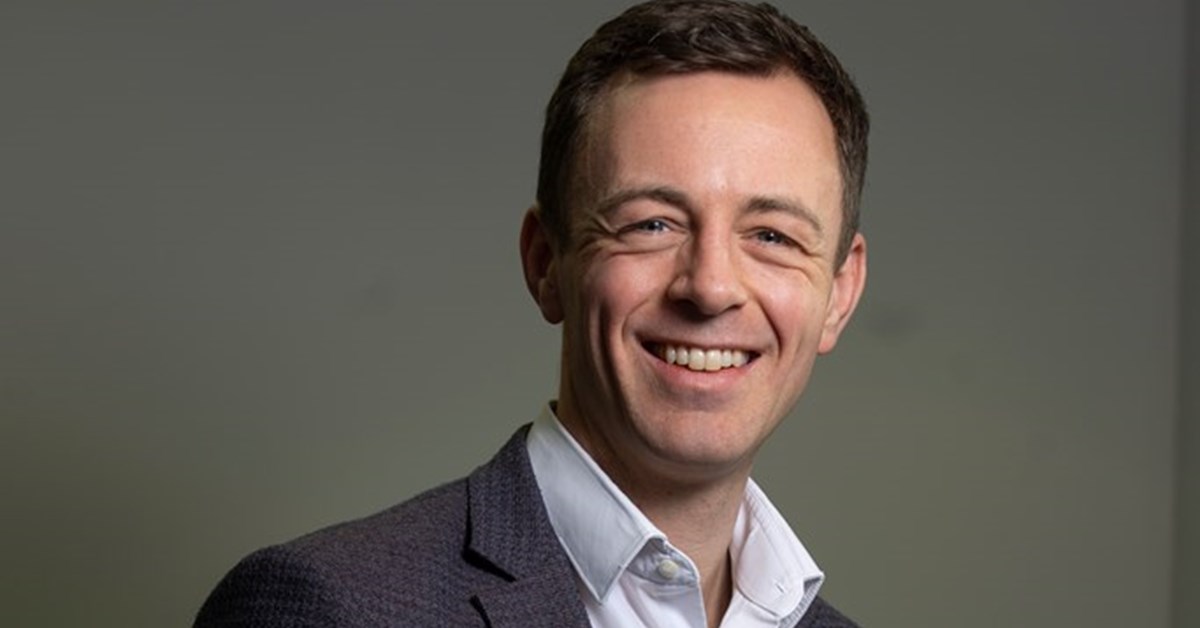
“IT’S the most important thing in my life.” Sam Jackson, Controller of BBC Radio 3, has no doubt about where Christianity ranks among his priorities. He loves to unwind by leading work with under-eights at his parish church, St Mary Magdalen’s, Sheet, just outside Petersfield, in the diocese of Portsmouth.
“I’ve always done a lot of volunteer youth and children’s work,” he says. “Even though I love the day job, it’s a wonderful antidote. On Sunday morning, I’m there with a bunch of four- to seven-year-olds, and we’re doing worship and craft, playing games, memorising Bible verses, and running around being crazy in the way only kids that age can.”
Philippians 4.13 is quoted on Mr Jackson’s X/Twitter profile. He was challenged to be more public about his faith by a good friend in broadcasting, Simon Thomas, the host of Soccer Saturday on Sky Sports. “He and I were chatting about faith and working in the media, and Simon said, ‘I have things like “broadcaster” and “Dad” on my social-media profile. Well, I’m going to put Christian on there, too. I should be open about who I am and what I believe.’ I thought: if Simon can do that, I should follow. I’m always happy to talk about this part of my life.”
As a senior executive in one, and a worshipper in another, he rejects the idea that traditional national institutions are in decline: “The BBC, the Church of England, the National Trust, the armed forces are as important as ever. I don’t subscribe to the view that they are a shadow of what they once were,” he says.
“You could look at the overall number of worshippers in the Church of England falling, but then look at the way cathedral congregations are growing; look at the enduring popularity of choral evensong; look at our work with the poor and marginalised.”
Similarly, while a real-terms BBC funding of about 30 per cent over a decade has genuine implications for how the Corporation works, he rejects that this necessitates compromising on quality. Sacred-music highlights of the Proms programme, released this week, include expensive productions such as Bach’s B-Minor Mass with Arcangelo, and challenging concerts, such as the BBC National Orchestra of Wales’s pairing of Messiaen’s L’Ascension with Szymanowski’s Stabat Mater.
WHILE he needs to be “evangelistic for classical music” in his job, he denies that it has to fight an uphill battle for its slice of BBC funding. He acknowledges that recent changes to the Radio 3 schedule and recording locations have upset some people inside and outside the corporation, but notes that he has just taken the Chief Content Officer, Kate Phillips, on the short walk from Broadcasting House to the Wigmore Hall to hear the Brentano string quartet perform pieces by Bartók, Haydn, and the contemporary American composer Timo Andres, for Classical Live.
“When the outgoing BBC director general Tim Davie was asked the highlight of his time in post, he said ‘Sitting in the Albert Hall with perhaps three other people listening to Semyon Bychkov rehearsing Mahler with the BBC Symphony Orchestra.’ That gives you a flavour of the belief from above in classical music.” Samir Shah, who chairs the BBC, also comes to “well over 20 Proms” a year.”
He also flags up some of Radio 3’s non-musical output, especially The Essay, at 9.45 on weeknights, allowing detailed exploration of topics in a “proudly intellectual” way; and he celebrates the Sunday-lunchtime interview show Private Passions as in a similar register.
Comprehensive-educated, he was able to have music lessons thanks only to the generosity of a childless relative who paid for his tuition with a “wonderfully bohemian” piano teacher who had him jamming everything from Clementi to Oasis. Thus, he is passionate about widening access to musical education.
“Talent is everywhere,” he says; “opportunity isn’t.” Last year, he concluded a decade as a governor of the Trinity Laban Conservatoire, and worries that, by the end of his time there, the proportion of state-school applicants had fallen noticeably.
He gainsays the idea that openness must come at the cost of the highest standards of musicianship or challenge. “When I listen to cricket commentary, they don’t feel the need to explain ‘lbw’ [leg before wicket] every time they use the term. We should be warm and welcoming, but also unflinching in how we present classical music: there is an audience out there for deep thought and intellectual broadcasting.”
The rise of podcasting has revealed a market among young adults for serious, lengthy, spoken-word content. Similarly, he sees young people enjoying Mahler and Shostakovich at the Proms, and feels that they need to be “given more credit for being able to cope” with challenging works rather than brief playlists.
HE DID not grow up in either of the institutions that play such a significant part in his life. Aged 42, he came to the BBC three years ago, after a working life in Classic FM and the classical recording business.
“I had a really happy upbringing — idyllic, even — in a loving family, but not one that had a faith. Growing up, faith didn’t elicit much of a reaction in me. Church was remembering to take a tin of beans to Harvest Festival.”
Originally from Godalming, in Surrey, he was the first in his family go to university, and he came to faith in Christ during his first term reading for a music degree at York.
“Some people came into our communal kitchen as I was cleaning the pots and pans — frankly, disgusting as only teenage boys can leave them.
“Two people came in and put something on the pinboard about the Alpha Course. We got chatting, and that was the start of my own personal journey to faith. I made a commitment as a Christian a few months later. That was 24 years ago.
“I hope it gives me a sense of perspective. When you do a job like this — if it all ended tomorrow, it wouldn’t be the thing that defines me. There’s something deeper and more about the core of who I am than the job I happen to do.
“The Christian life has ups and downs — high peaks of faith, and then moments of doubt. I’m encouraged by the fact that, when you read the Bible, there are stories of similar, very human, experiences. Those are the bits of the Bible that speak to me most profoundly.”
Mr Jackson and his family have worshipped at St Mary Magdalen’s “for about three or four years” since moving from Liphook, where his wife, Helen, worked for their Anglican parish.
When he was 16, revising for his GCSEs, he heard Rachmaninov’s Cello Sonata playing on the radio, “and that’s when classical music really started to grab me in a more overt way. I still love many other forms of music, and my Spotify playlist is very eclectic.”
He believes that music can address the deep spiritual needs held in common by people of all faiths and none. “Music can speak incredibly profoundly, in a way that words sometimes fail to do, about the human condition, the soul, who we are, our hopes and our fears, and many other things besides.
“Whether we have a faith or not, the human condition is to search for meaning beyond the day-to-day,” he says. “We have those moments when we’re forced to address that. I was at a funeral the other week for my amazing head teacher. When you’re looking in the eyes of people who are grieving, you face questions of meaning.
“We had a performance of Mahler’s ‘Resurrection’ Symphony at the Proms last year, with Wong Kah Chun conducting the Hallé Orchestra, and it was completely silent at the end — a deeply spiritual moment. Whatever the views of the diversity of the people in the hall, music took us collectively somewhere very special.
“In a world where we’re so assaulted by noise and distraction, music enables us to step away, reflect, and contemplate. That could be rock, pop, or jazz — but classical music has a particular ability to take people deep.
“We sit down in tears from Bach’s St Matthew’s Passion: it’s one of the most profoundly beautiful pieces of music ever written. But I can listen to Radiohead and get that profound sense of music speaking to me and connecting with that core of who we are, not least our frailty and imperfection. Music takes me to a deep and spiritual place.”