THIS accomplished study by a young Christian scholar, who won plaudits for his previous book, A Short History of Islamic Thought (2021), will appeal to more advanced students of Islam. It should become a core text for MA courses requiring modules on Islam and the challenges of modernity, gender, politics, and Christian-Muslim relations. The chronological focus is the past three centuries, as Muslims sought to renew Islam, drawing on its rich, multi-layered tradition.
The first half is devoted to the renewal of Islam before the impact of Western colonialism. Five chapters focus on a variety of reformers from across the Muslim world, Sunni and Shia — the majority Sufis — who seek to reform an Islamic tradition that, they consider, has departed from normative Islam.
In the 18th and early 19th centuries, a current of reform emerges, in which individual Sufis consider themselves “a Companion of the Prophet through mystical visions of Muhammad”, enabling the mystic to derive their “understanding of Islam directly from the Prophet himself and in this way to bypass and transcend both the schools of law and existing Sufi orders . . . [culminating] in the original and most comprehensive mystical way . . . Muhammadan Path”.
The second half identifies many continuities in reform as individuals and movements seek to renew Islam in the light of the challenges of colonial and post-colonial societies. This is covered in three substantial chapters. Two are devoted to responses to modernity, first in colonial India, and then in the modern Middle East. The final chapter, “Defending God’s sovereignty”, deals, inter alia, with responses to the crisis of the caliphate before and after its abolition by the Turkish President, Mustafa Kemal, in 1924.
This includes fine discussions of formative Islamist thinkers, the Indo-Pakistani Mawdudi (d.1979), the Egyptian Sayyid Qutb (d.1966), and the Iranian Ayatollah Khomeini (d.1989), as well as illuminating rethinking on gender.
Throughout the study, Professor Morrissey reminds us that Islam has always had its own indigenous categories of reform. For example, the distinguished Egyptian scholar Jalal al-Din al-Suyuti (d.1505) devoted a treatise to Muhammad’s promise that, at the beginning of every century, God would send someone to “renew” Islam. Al-Suyuti claimed for himself the title of “renewer” (mujaddid) for his century and declared himself a mujtahid, a scholar capable of using his own “independent reasoning” (ijtihad) to work out divine law directly from its scriptural sources, bypassing the established Sunni schools of law.
A recurring motif is the claim that the Prophet himself appears — as do members of his family and famous long-deceased Sufis — to the individual in vision or dream appointing him as renewer. Such experience presupposes the phenomenon of continuing revelation, rooted in the Prophet understood as a cosmic reality, a flawless reflection of God and his light — ideas already articulated by the Sufi Ibn ‘Arabi (d.1240). Such an idea is clearly open to contestation. At its extreme, the ever more extravagant claims made by the founders of Baha’ism, Baha’Allah (d.1892), and the Ahamdiyya, Mirza Ghulam Ahmad (d.1908), put them outside, respectively, Shia and Sunni traditions.
Morrissey makes clear that it is a “mystical type of renewal” which is most characteristic of early modern Islamic thought. The occasional enforcement of renewal through violence, as practised by Muhammad ibn’ Abd al-Wahhab (d.1792) in the Arabian peninsula and the Fulani scholar and Sufi Muslim Usman dan Fodio (d.1817) in West Africa, which precedes Western colonialism, was not the norm.
Another important aspect of “renewal” movements was an egalitarian impulse to make knowledge of Islamic sciences available to ordinary Muslims outside the scholarly elites. Shah Wali Allah of Delhi (d.1762) and his sons, the modernist Egyptian ‘Abduh (d.1935), and the Indo-Pakistani Islamist Mawdudi (d.1979) all wrote Qur’anic commentaries intended for a wide readership, in accessible vernacular languages. The distinguished traditionalist Deobandi Sufi and scholar Ashraf ‘Ali Thanawi (d. 1942) sought to address the “ruination” of Islam among Muslim women in India ascribed to their ignorance of religious sciences, by penning for them, in simple Urdu, Heavenly Ornaments, a compendium of Islamic law.
Finally, Morrissey provides many examples of the rethinking of Islamic terminology. Mawdudi reconfigures the term jahiliyya — traditionally used to describe pre-Islamic pagan “ignorance” and barbarism — and “turned it into a transnational phenomenon representing the polar opposite of everything truly Islamic. . . The history of Islam . . . was a story of perpetual struggle between Islam and jahiliyya. . .” This was further radicalised by the Egyptian Islamist Sayyid Qutb (d.1966), who, even more than Mawdudi, “elevated this idea into a metaphysical statement about the very nature of reality”.
This insightful study will be particularly valuable to a British audience, since generous coverage is devoted to “renewers” from South Asia, where more than two-thirds of today’s British Muslims have their roots.
Dr Philip Lewis is a consultant on Islam and Christian-Muslim relations, advised bishops of Bradford for some three decades, and taught in the Peace Studies Department at Bradford University.
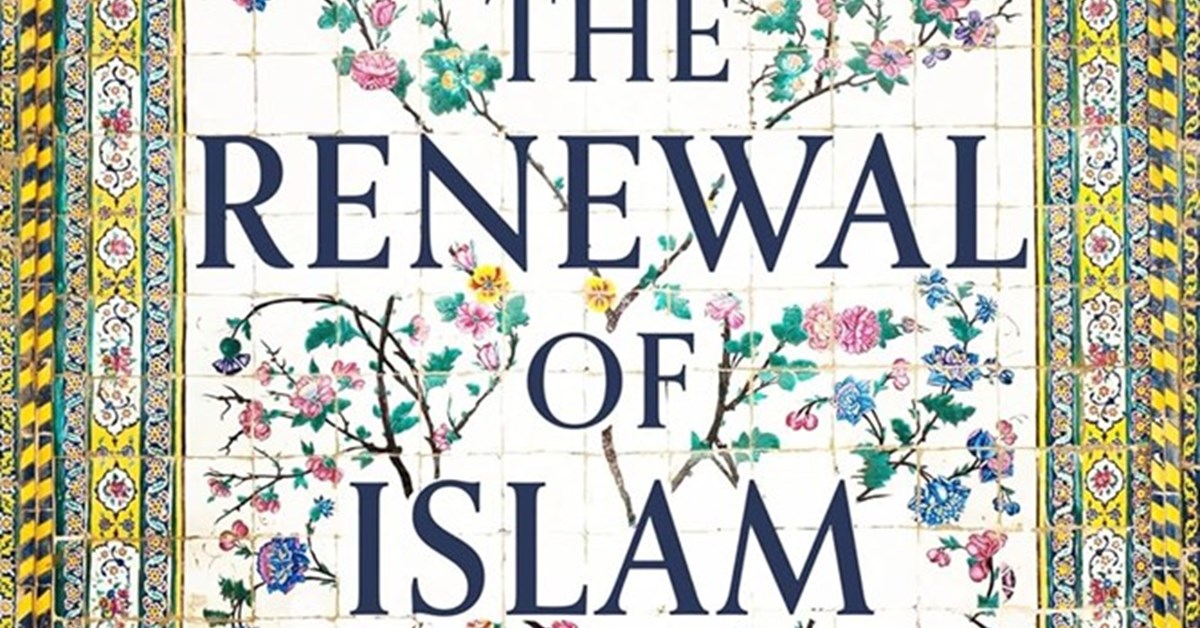
The Renewal of Islam: Thinkers and believers of the modern era
Fitzroy Morrissey
Head of Zeus £25
(978-1-80454-217-0)
Church Times Bookshop £22.50