
Britain’s Royal Navy has a storied history, but the current conflict in the Gulf has exposed its current inadequacy. The Telegraph has a long story on Britain’s naval decline:
The most visible sign of strain on the Royal Navy has been the scramble to deploy HMS Dragon to the eastern Mediterranean, where Britain’s sovereign base in Cyprus has come under attack from Iran-linked proxies.
HMS Dragon eventually left Portsmouth on March 10, a week after Sir Keir Starmer announced she would be sent. But in yet another unfortunate development, she has since had to return to port in Greece due to technical problems.
One ship, and they could barely do that. The problem is fundamental:
The cause of today’s malaise is a “ship gap” caused by decades of short-term thinking by politicians of all stripes, who failed to order enough new vessels and neglected key maintenance facilities, experts say.
Replacement frigates and destroyers are on the way. But they are still years away, while today’s ageing fleet becomes more and more knackered.
This graphic shows how badly the Noyal Navy has shrunk:
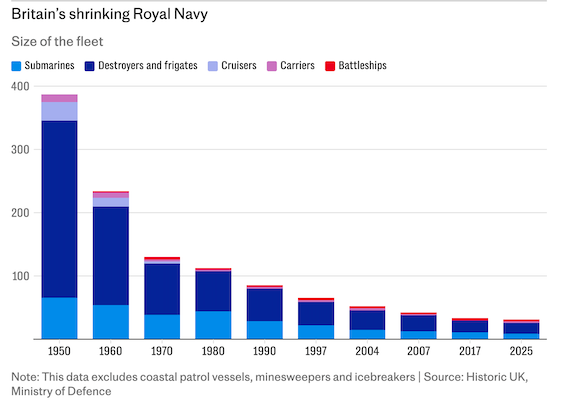
The biggest naval concern for Britain is Russia’s presence in the North Sea:
Service chiefs have warned of a 30pc increase in Russian incursions into waters surrounding Britain in recent years, while the number of ships at their disposal continues to sink ever lower.
***
Labour’s strategic defence review, published in 2025, set out plans for a “Nato-first” military that prioritises the Navy’s duty to keep Russia’s navy contained to the Barents Sea in the event of conflict.That means conducting regular patrols in the High North to keep tabs on Russian submarines, a task that generally requires at least two frigates to be available at all times.
***
Can the Navy realistically spare ships for the Gulf right now? “Probably not,” says [Emma Salisbury, a naval expert at the Foreign Policy Research Institute], who fears that such a deployment would risk emboldening Russia in the Atlantic.
The root of the problem, of course, is that Britain, like many other European countries, has chosen an unaffordable welfare state over its ability to play a significant role in world affairs, or even to defend itself. But, the Telegraph reports, both France and Italy have done a better job of maintaining their navies.