It is a well-documented fact that conservatives are, on average, happier than liberals, and less prone to mental illness. This is true not only in the United States, but in many other countries as well. And conservatives’ superior well-being has been documented for as long as the question has been studied, going back to the early 1970s.
Conservatives are more likely than liberals to be religious, patriotic and married, all of which are conducive to happiness. But even when these factors are accounted for, there is a residual happiness advantage among conservatives.
Further, this longstanding divide has been exacerbated since 2011. This chart measures incidence of depression among young people, beginning in 2005:
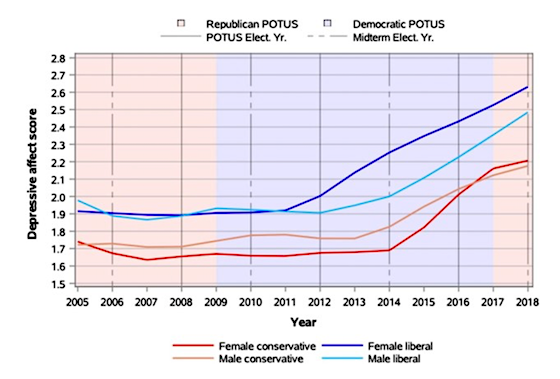
These data are also stark:
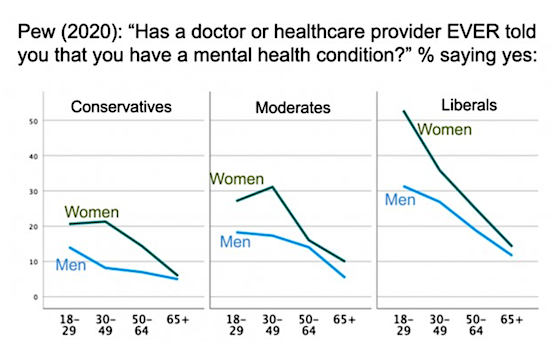
This long article in American Affairs reviews the evidence, with copious links to a large number of studies. It includes, among others, the charts embedded above. The article is well worth your time. Here are the its conclusions:
The well-being gap between liberals and conservatives is one of the most robust patterns in social science research. It is not a product of things that happened over the last decade or so; it goes back as far as the available data reach. The differences manifest across age, gender, race, religion, and other dimensions. They are not merely present in the United States, but in most other studied countries as well. Consequently, satisfying explanations of the gaps in reported well-being between liberals and conservatives would have to generalize beyond the present moment, beyond isolated cultural or geographic contexts, and beyond specific demographic groups. This essay has explored some of the most likely and well-explored drivers of the observed patterns:
1. There are likely some genetic and biological factors that simultaneously predispose people towards both mental illness/ wellness and liberalism/ conservatism, respectively.
2. Net of these predispositions, conservatism probably helps adherents make sense of, and respond constructively to, adverse states of affairs. These effects are independent of, but enhanced by, religiosity and patriotism (which tend to be ideological fellow-travelers with conservatism).
3. Some strains of liberal ideology, on the other hand, likely exacerbate (and even incentivize) anxiety, depression, and other forms of unhealthy thinking. The increased power and prevalence of these ideological frameworks post-2011 may have contributed to the dramatic and asymmetrical rise in mental distress among liberals over the past decade.
4. People who are unwell may be especially attracted to liberal politics over conservatism for a variety of reasons, and this may exacerbate observed ideological gaps net of other factors.
The amount of observed variance that each of these theories explain relative to one another is, at present, empirically unclear and hotly contested. However, the general pattern is clear: conservatives report significantly higher levels of happiness, meaning, and satisfaction in their lives as compared to liberals. Meanwhile, liberals are much more likely to exhibit anxiety, depression, and other forms of psychic distress.