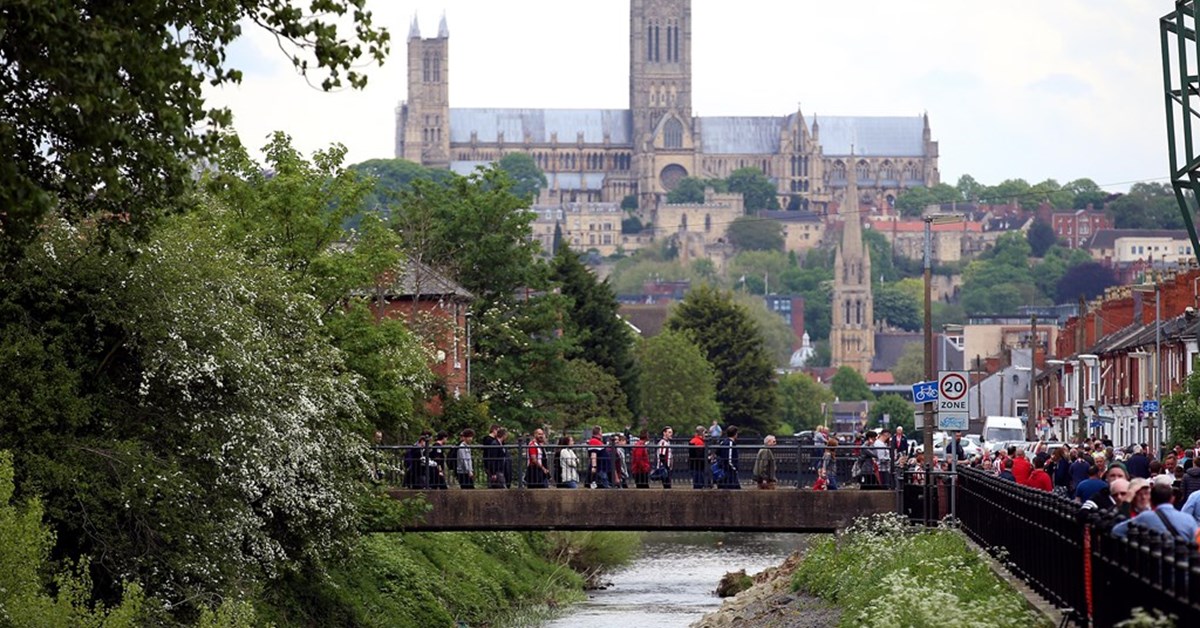
IN THE cathedral city of Lincoln, the Promised Land was finally in sight. Hot on the heels of Good Friday’s three-hour devotion, our beloved football club — fondly known as the Red Imps — kicked off against AFC Wimbledon. A win would put us on the very brink of promotion to the EFL Championship and could even, if other results went our way, “land us safe on Canaan’s side” by suppertime.
The last time that Lincoln City played in the second tier of English football, in the 1960-61 season, Tottenham Hotspur did the double, winning the league and the FA Cup. The Berlin Wall had not quite been built, the American nightmare was Cuba rather than Iran, and Yuri Gagarin was about to become the first human in space — for Lincoln City, 65 years in the wilderness has been far too long.
Not many followers have kept the faith throughout that downtime. A wall of remembrance at Sincil Bank, the club’s home stadium, lists the names of those loved and lost — not least Bill Stacey and Jim West, the two Imps killed in the Bradford City fire of 1985.
Despite brief, bright interludes under the management of Graham Taylor (later the England manager), Colin Murphy, and Keith Alexander, relegation — and, before that, re-election (whereby clubs that finished at the bottom of the league were not relegated automatically, but had to apply to keep their place) — were long the order of the day. The club has been twice banished into the outer darkness of non-league, that hapless place of wailing and gnashing of teeth.
For my part, I jumped aboard the Lincoln loco in the late 1970s. Murphy soon had us on the up and up, and, by March 1982, we topped the third tier. A hidden gem and now Lincoln institution, Crust Restaurant, opened the same month on the very site of the old Monson Arms, the public house in which Lincoln City Football Club had been founded in 1884.
The players soon came to wine and dine, but, alas, there was to be no heavenly banquet. The promotion push that season hit the buffers at Craven Cottage (home to Fulham FC) and petered out again 12 months later. Then came the drop through the divisions — and with the fall came financial peril, fractious infighting, administration, and a marked malaise in everything.
IN THE past decade, however, with good governance and innovative leadership at last taking root, growing numbers of us “Yellow-Bellies” began daring to believe that our entire lives might not, in fact, be spent in football’s basement.
Cue Danny Cowley, who became manager in May 2016 — if not the Messiah, then certainly a Moses pointing us in the right direction. Like John the Baptist, he was a forerunner — engaging the community, prophesying salvation. We were FA Cup quarter-finalists in 2017, title-winners the same year and again in 2019, with EFL Trophy success at Wembley sandwiched in between.
After Cowley dragged us up into League One, in 2019, he disembarked for Huddersfield Town. Michael Appleton, an acolyte of Sir Alex Ferguson, assumed the reins, and took the Imps to a play-off final in 2021, but no further.
We were getting closer, and so, this season, the feeling grew that — given modest foreign investment and with an elite futsal coach, “Professor” Michael Skubala (“Football is an invasion game”), at the helm — the stars might one day align.
In the event they did not, at least not on Good Friday, when Lincoln played AFC Wimbledon. Ironically, Nathan Bishop in the Wimbledon goal — booked for time-wasting, no less — kept City’s forwards at bay; and, although super-sub Ryan Oné broke the deadlock late on (“There’s only one Ryan Oné!”), Lincoln’s closest rivals for promotion also triumphed, and so the Promised Land remained a gnat’s whisker away. A single point at Reading on Easter Monday would, however, suffice.
This seemed fitting. In the cathedral, the Dean had warned us not to hasten the resurrection. In their anxiety, human beings much prefer resolution to uncertainty, he said. But Good Friday cannot be hurried. It is a day for empathy, for recognising the griefs and grievances that so often shape our short stint on this planet. It is a day not for looking ahead but for looking around.
Wise words. At Sincil Bank, I scanned the fraught, friendly faces of 10,000 souls, whose hopes and dreams I have for so long shared. What I, aged 16, had hoped would come to pass has taken me until 60 to behold. But perhaps the long wait makes it sweeter still, as does its realisation at Easter, when, “healed, restored, forgiven”, we can all enjoy the promise of promotion to dizzyingly new heights of humanity.
And so it proved. At Reading, the Red Imps picked up more than a point: gloriously, we took all three, with a last-gasp winner scored right in front of the travelling faithful. Mission accomplished. The Promised Land reached!
THREE weeks on, the “Impvasion” shows no sign of letting up. Unbeaten (as I write) for 27 games, crowned last week as runaway champions of League One, open-top bus parade in the offing: these are heady days indeed. Quite improbably, Lincoln City have become darlings of the national press, and we are proclaimed on social media and podcasts to be England’s model club.
Run on a (relatively) shoestring budget and relying on enlightened recruitment; the patient, humane development of talent; myriad community partnerships; and newly-conceived, closely-guarded metrics for on-field success — there is indeed much to admire. It might not be the body of Christ, but nor is the club’s “It takes a village” philosophy at odds with the gospel that I know and love. To paraphrase Jesus, “If they aren’t against you, then they’re definitely onside.” This Imp, for one, cannot help swelling with pride at every mention of the club in the media.
In stark contrast, another LCFC, Leicester City, have now been “humbled for a season” twice in a row. Julian Barnes — very possibly Leicester City’s most high-profile fan — won the 2011 Booker Prize for The Sense of an Ending; but he cannot possibly have foreseen successive relegations for a team that picked up the Premier League title as recently as 2016. I admire his stoicism: he says that past glories do not make the club’s present predicament more painful, but more bearable.
In much the same vein, I know that, by instinct and personality, I am well-disposed to be a supporter — and not only at the football. It makes service in the church and through chaplaincy a good fit, too. Ultimately, it is a calling.
In a recent address, one of our postgrads at Jesus College, Oxford, Shelby Knighten, helped to frame faith’s interplay with vocation. He put it like this: “In the synagogue, 30-year-old Jesus at the beginning of his ministry puts forward a clear vision of what He is called to do: bringing ‘good news to the poor’, ‘proclaiming release to the captives’, setting the oppressed free. He doesn’t say, ‘The Lord has called me to be a rabbi, teacher, doctor, political revolutionary. . .’
“Jesus doesn’t profess a career. Instead, he speaks of his vocation. And, in the words of the Old Testament scholar, Walter Brueggemann, the wait between the dream and its disclosure is the time to discern it.”
The Revd Philip Harbridge is Chaplain of Jesus College, Oxford.