AN UPDATE on the Church Growth Fund, in an appendix to the report by the Representative Body, went to the heart of the dilemma the Church in Wales has been grappling with for more than 20 years. What will a future Church look like, and where, therefore, should money best be invested?
The Fund, launched in October 2023, set aside £100 million from capital reserves to invest in evangelism over the next decade. It was described as “a once-in-a-generation opportunity to resource confident and consistent evangelism throughout the province.”
The Rowe-Beddoe report of 2005 established the principle that the RB would move away from funding stipendiary ministry to directly funding dioceses. A Private Member’s Motion to the GB in September last year asked the RB to bring to the April 2026 meeting a financial and budgetary analysis of the effect of restoring its contribution towards local ministry costs to the levels before that 2005 report, “whilst maintaining Church Growth funding at present levels”.
Early analysis had shown that the RB had “heard very clearly the request for additional support for ministry areas. . . It is clear that some face an existential threat and need help now,” Professor Medwin Hughes, who chairs the RB, says in his appendix. “If the Fund came to a close tomorrow, there would be significant financial resources immediately available for other purposes.
“Were this done, we would be disadvantaging some dioceses who are yet to make a successful bid. If we chose to let the Church Growth Fund run its course, that would mean that substantial help for ministry areas would need to wait until 2033, which may be too late for some.
“The RB has an obligation to fund the mission of the Church whilst also ensuring the intergenerational equity of its financial resources. The assumption that we work to, is that the structure and cost of the Church in Wales in the next generation will be similar to how it is today.
“However, we know that dioceses are closing churches, that the Church in Wales will be leaner, and so can we assume that the cost of support will decline? Conversely, if giving declines, will the RB be required to offer more to support dioceses with the cost of mission?”
Termination of the Fund remains an option, he says. Some measure of relief is offered in the RB’s taking on the full cost and administration of church insurance from January 2027. It accepts that it “needs to listen more to the wider voice of the Church in Wales, and particularly to the ministry areas if it is going to be able to present a coherent funding proposal back to the Governing Body”.
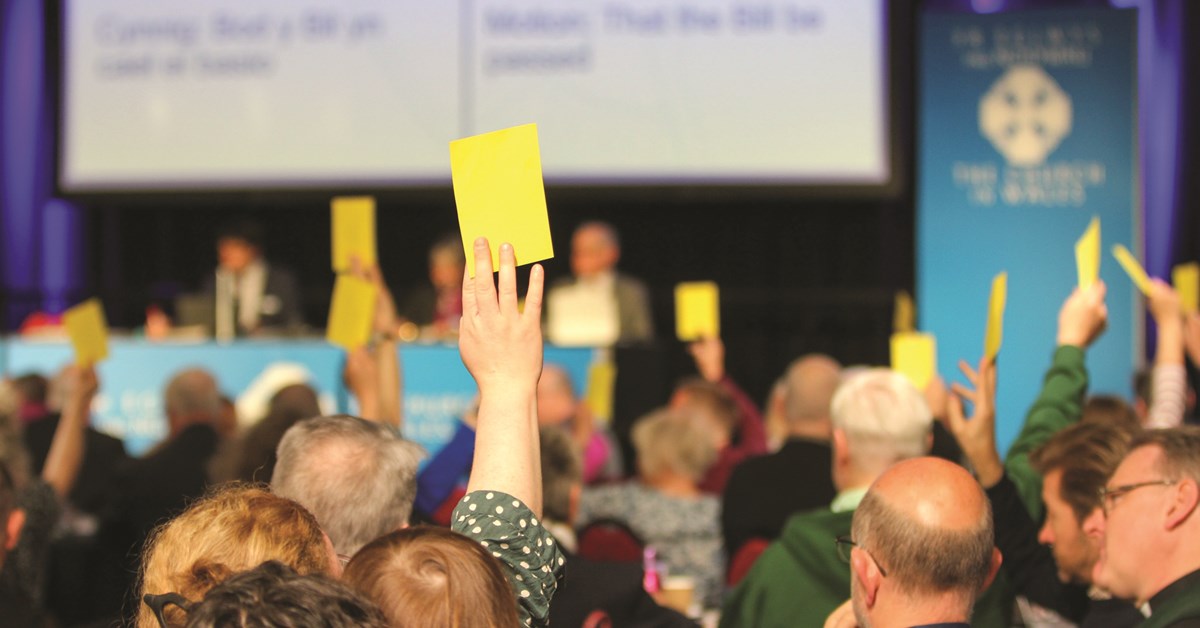
To that end, it proposes a provincial listening process between May and July, in advance of a full debate in September. Debate was limited at this April meeting, where Professor Hughes was represented by his deputy, the Dean of St Asaph, the Very Revd Nigel Williams, but speakers made their views clear.
The Archdeacon of St Davids, the Ven. Mones Farah (St Davids), spoke of the pressure on clergy: “We feel we have become fund-raisers, particularly in smaller communities,” he said. “We feel exhausted, not able to think afresh about where we take the gospel. It’s all very well to have a big project of the diocese, but the sell-by date of the Church in Wales is diminishing every year.”
Nigel Evans (St Davids) was churchwarden in a church with a badly leaking roof. ”Do we add another bit of plaster, another bit of red tape?” he asked. “Or do we decide on our ministry share? It’s a dilemma lots of churches are having to face. Everyone agrees about stewardship. All I ask, as a simple churchwarden, is to encourage our congregations to be generous as stewards, and the RB to be generous in theirs.”
The Revd Richard Ellis (Bangor) concluded, “We don’t have a clear view on what a future church might look like. We’re looking to find answers to supporting structures we aren’t able to maintain . Crumbling buildings are taking away our resources. The enormous reserves of the Church in Wales are intended to supply long-term support.”
The meeting voted to accept the RB report.
ends